
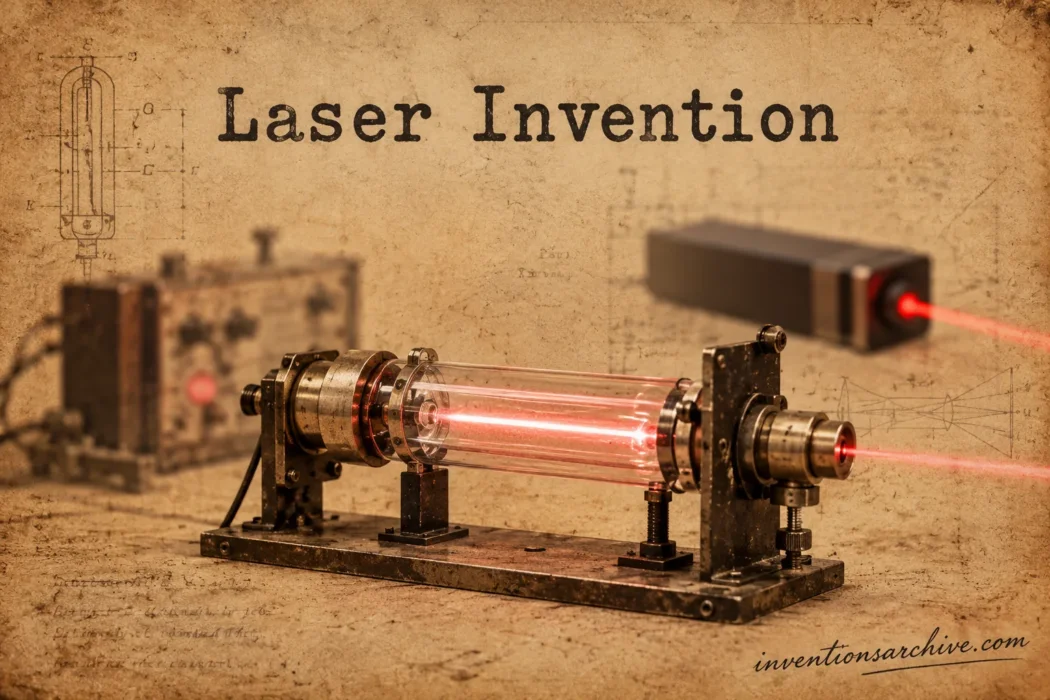
| Invention Name | Laser |
|---|---|
| Short Definition | A device that generates and amplifies coherent light through stimulated emission. |
| Approximate Date or Period | First working laser: 16 May 1960; theoretical and experimental foundations developed from 1917 through the 1950s. |
| Geography | First working laser demonstrated at Hughes Research Laboratories in Malibu, California, United States; major earlier work took place at Columbia University, Bell Telephone Laboratories and the P. N. Lebedev Physical Institute. |
| Inventor or Source Culture | Theodore H. Maiman for the first operating laser; broader attribution includes Albert Einstein, Charles Townes, Nikolay Basov, Aleksandr Prokhorov, Gordon Gould and Arthur Schawlow. |
| Category | Optics, quantum electronics and photonics |
| Importance | Made controllable coherent optical radiation available for research, measurement, communications, manufacturing, medicine and later photonic technologies. |
| Evidence Status | Confirmed for Maiman’s first working laser; Attribution varies when credit is assigned to theory, naming, published design or patent rights. |
| Main Problem Solved | Generating and amplifying coherent optical radiation through stimulated emission rather than relying on ordinary spontaneous light emission. |
| Development Path | Stimulated emission theory → maser → laser concepts and optical-maser design → Maiman’s ruby laser → continuous-wave gas lasers and later laser families. |
| First Working Device | Synthetic ruby gain medium, optical pumping by a xenon flashlamp, reflective cavity surfaces and pulsed deep-red output near 694.3 nm. |
| Technical Basis | Population inversion, stimulated emission, optical gain and resonant optical feedback. |
| Surviving Evidence | Ruby crystals, laser-head hardware and experimental output records from Maiman’s Hughes work survive in the Smithsonian collections, although the exact individual crystal or assembly used for the first pulse is not certain. |
Who Invented the Laser?
If “invented” means built and demonstrated the first working laser, the strongest attribution is Theodore H. Maiman. On 16 May 1960, at Hughes Research Laboratories in Malibu, California, Maiman and assistant Irnee D’Haenens obtained laser action from a synthetic ruby crystal. The device produced short pulses of deep-red coherent light rather than the continuous beam commonly associated with lasers today.
That answer does not cover the whole invention history. Maiman’s experiment depended on a physical process described decades earlier, on the development of the microwave maser, and on several competing attempts to extend stimulated emission into the optical region. Gordon Gould also introduced the word laser and developed early laser concepts, while Arthur Schawlow and Charles Townes published an influential optical-maser design before Maiman’s demonstration.
| Achievement | Person or Team | Date or Period | What It Established |
|---|---|---|---|
| Stimulated emission theory | Albert Einstein | 1917 | Provided the physical process that later made optical amplification possible. |
| First working maser | Charles Townes, James P. Gordon and Herbert J. Zeiger | 1954 | Demonstrated amplification by stimulated emission at microwave frequencies. |
| Parallel quantum-electronics work | Nikolay Basov and Aleksandr Prokhorov | 1950s | Developed independent theoretical approaches to oscillators and amplifiers based on stimulated emission. |
| The term “LASER” and documented laser concepts | Gordon Gould | 1957 | Recorded “Light Amplification by Stimulated Emission of Radiation” and developed concepts later involved in patent disputes. |
| Published optical-maser design | Arthur Schawlow and Charles Townes | 1958 | Showed how maser principles could be extended to infrared and optical wavelengths using an optical resonator. |
| First working laser | Theodore Maiman, with Irnee D’Haenens | 16 May 1960 | Produced stimulated optical radiation from synthetic ruby at Hughes Research Laboratories. |
| First continuous-wave gas laser | Ali Javan, William R. Bennett Jr. and Donald R. Herriott | 1960 | Demonstrated continuous laser operation in a helium-neon gas system at Bell Laboratories. |
Einstein Supplied the Physical Principle, Not a Laser Design
The laser’s earliest theoretical root is Albert Einstein’s work on the interaction between matter and radiation. In 1917, he described three related processes: absorption, spontaneous emission and stimulated emission. The third process became the basis of laser amplification.
An atom or molecule can occupy discrete energy states. When it absorbs the right amount of energy, it can move to a higher state. It may later return to a lower state on its own and emit a photon; that is spontaneous emission. In stimulated emission, incoming radiation interacts with an already excited atom and induces it to emit additional radiation matched to the stimulating optical mode. Repeated across many excited atoms, the process can amplify light.
Einstein did not propose the 1960 ruby apparatus, an optical resonator, or a practical laser system. His contribution was the physics that explained how radiation could trigger further radiation with ordered properties. The engineering problem remained unsolved for decades: researchers still needed a way to prepare enough atoms or molecules in suitable excited states and make the emitted radiation reinforce itself rather than escape randomly.
The Maser Turned Stimulated Emission Into a Working Machine
The direct technological predecessor of the laser was the maser, whose name came from microwave amplification by stimulated emission of radiation. Charles Townes, James P. Gordon and Herbert J. Zeiger built the first working ammonia maser in 1954. It operated at microwave frequencies rather than visible or infrared wavelengths.
The maser showed that stimulated emission could move beyond theory. A prepared population of molecules could provide gain, while a resonant cavity supplied feedback so that the desired electromagnetic radiation was amplified. Nikolay Basov and Aleksandr Prokhorov developed related theoretical work in the Soviet Union during the same period. Their contributions, together with Townes’s, later formed the basis of the 1964 Nobel Prize in Physics.
Moving from microwaves to light was not a simple matter of shrinking a maser. Optical wavelengths are vastly shorter, and conventional microwave cavities could not simply be scaled down into an equivalent optical device. Researchers needed suitable gain media, a practical way to create population inversion, and an optical cavity that could return light through the medium while keeping losses low enough for amplification to exceed them.
Gould, Schawlow and Townes Defined Different Parts of the Laser Before It Worked
Gordon Gould Coined “LASER” in 1957
Gordon Gould, then a graduate student at Columbia University, recorded laser ideas in a laboratory notebook in 1957. His notes used the phrase “Light Amplification by Stimulated Emission of Radiation”, producing the acronym LASER. The term eventually displaced “optical maser,” the expression commonly used by researchers during the late 1950s.
Gould’s role extended beyond naming. His work included ideas for optically pumped and discharge-excited laser systems. He did not file his patent application immediately; the National Inventors Hall of Fame records that he filed in 1959, after other laser researchers had already filed. The result was a long series of patent disputes. Gould eventually received major laser patents beginning in 1977, decades after Maiman’s first successful experiment.
Schawlow and Townes Published the Optical-Maser Design in 1958
Arthur Schawlow and Charles Townes approached the same problem from the maser side. Their paper “Infrared and Optical Masers”, published in Physical Review on 15 December 1958, analyzed how maser techniques could operate at infrared and optical wavelengths.
The paper described an optical resonant cavity in which highly reflecting end surfaces could provide feedback and select radiation traveling along the cavity axis. It also discussed pumping the active medium with incoherent light. The proposal gave laboratories a published route from microwave stimulated-emission devices to optical oscillation, even though Schawlow and Townes had not yet produced a working laser.
By 1959 and 1960, Bell Labs, Hughes, RCA, IBM and other research groups were pursuing optical masers. The question was no longer whether stimulated emission existed. The immediate problem was finding a material and pumping arrangement that could cross the threshold into sustained optical amplification.
Why Maiman Chose Ruby When Other Researchers Doubted It
Theodore Maiman had already worked with ruby in maser research at Hughes. Synthetic ruby is primarily corundum containing chromium ions, and those chromium ions provide the energy transitions used for laser action. In 1959, Maiman heard claims that ruby was unsuitable for an optical maser. Smithsonian records of his experimental apparatus describe how he questioned the numerical assumptions behind that view and returned to Hughes to investigate the material himself.
Ruby had disadvantages. It behaves as a three-level laser medium, so creating a useful population inversion requires moving a large fraction of the active ions away from the ground state. That makes the threshold demanding. Maiman’s solution was to use an intense burst of optical pumping from a xenon flashlamp around the ruby. The energy arrived rapidly enough to create the conditions needed for laser action.
The design was compact. A synthetic ruby element acted as the gain medium, the flashlamp supplied the pumping light, and silver-coated end faces along the ruby’s optical axis formed the resonant cavity. Maiman’s success came from matching the material, the pumping method and the cavity to one another well enough for optical gain to exceed the losses.
What Happened Inside the First Ruby Laser?
The flashlamp first delivered a burst of broad-spectrum light to the ruby. Chromium ions in the crystal absorbed part of that energy and moved into higher-energy states. They then relaxed into a longer-lived excited state where energy could accumulate for a short time.
Once enough active ions occupied the excited state, a photon at the appropriate transition could trigger stimulated emission. The newly emitted radiation matched the stimulated optical mode rather than emerging as unrelated spontaneous fluorescence. Light traveling along the resonator axis passed through the ruby repeatedly, causing further stimulated emission on each pass.
Laser action began only after the gain became large enough to overcome losses in the system. This point is the laser threshold. The first ruby system crossed that threshold briefly, so its output arrived as pulses. Maiman later reported stimulated optical radiation at 6943 Å, equivalent to about 694.3 nm, in the deep-red part of the visible spectrum.
16 May 1960: The Experiment Crossed the Laser Threshold
On 16 May 1960, Maiman and Irnee D’Haenens demonstrated the first operating laser at Hughes Research Laboratories. Surviving experimental records show why the event was more than unusually bright ruby fluorescence. Smithsonian material from the Hughes experiments includes photographs of output measurements taken below and above the oscillation threshold. As the pumping level passed that threshold, the recorded output showed the change associated with laser action.
Maiman’s result was published in Nature on 6 August 1960 under the title “Stimulated Optical Radiation in Ruby.” The short paper identified ruby—chromium in corundum—as the active material and reported stimulated emission at 6943 Å. The publication connected the device directly to the earlier work of Schawlow and Townes while documenting that optical pumping of a solid material had produced stimulated optical emission.
Physical artifacts from the Hughes experiments also survive, but their identity requires care. The Smithsonian holds a ruby crystal donated by Hughes that may have generated the first laser light, yet the museum notes that several crystals were present during the experiments and certainty is impossible. A surviving laser-head assembly has a similar problem: donation records linked it to the first laser, while Maiman later described receiving the original device when he left Hughes. The museum therefore treats the exact identity of the first individual crystal and assembly as unresolved.
The First Continuous Laser Followed Within Months
Maiman had proved that optical stimulated emission could produce a laser, but the ruby device operated in pulses. At Bell Laboratories, Ali Javan, William R. Bennett Jr. and Donald R. Herriott developed a helium-neon gas laser that operated continuously later in 1960. Their work showed that a laser could remain above threshold as a steady oscillator instead of releasing energy only in short bursts.
| Feature | Maiman Ruby Laser | Javan-Bennett-Herriott Helium-Neon Laser |
|---|---|---|
| Demonstration | 16 May 1960 | 1960 |
| Gain Medium | Synthetic ruby containing chromium ions | Helium-neon gas mixture |
| Excitation Method | Optical pumping by a flashlamp | Electrical discharge in the gas |
| Output Regime | Pulsed | Continuous-wave |
| Early Output | Deep red, about 694.3 nm | Near-infrared; the familiar visible 632.8 nm helium-neon line was demonstrated later |
| Historical Role | First working laser of any kind | First gas laser and first continuously operating laser |
The distinction matters because later laser technologies did not simply copy Maiman’s ruby arrangement. Gas lasers, semiconductor lasers, dye lasers, fiber lasers and other systems use different gain media and pumping methods. What persisted was the general physical pattern: an excited medium provides optical gain, stimulated emission amplifies a selected mode, and optical feedback controls the radiation produced.
Patent Priority Was a Different Question From the First Working Laser
Laser history became unusually tangled because experimental priority, published theory, terminology and patent rights followed different timelines. Schawlow and Townes filed work associated with the optical-maser concept before Maiman’s 1960 demonstration and received a patent for their design in 1960. Gould, despite documenting his own ideas in 1957, did not file until 1959.
Gould’s later patent victories therefore did not establish that he had operated the first laser before Maiman. They concerned legal rights to specific laser concepts and applications. The National Inventors Hall of Fame records that Gould’s first basic laser patent was issued in 1977 after years of Patent Office proceedings, with later patent rights following.
This distinction is necessary when assigning credit. A dated notebook can establish that an idea existed. A scientific paper can establish publication priority. A patent can establish enforceable rights to defined claims. A working experiment establishes that a device actually functioned. In the laser story, those milestones belong to different people.
Why the 1964 Nobel Prize Did Not Identify a Single “Laser Inventor”
The 1964 Nobel Prize in Physics was awarded to Charles H. Townes, Nikolay G. Basov and Aleksandr M. Prokhorov for fundamental work in quantum electronics that led to oscillators and amplifiers based on the maser-laser principle. Theodore Maiman was not among the laureates.
The wording of the award concerns fundamental work in quantum electronics and the maser-laser principle; it does not identify the laureates as the builders of the first operating laser. Maiman’s place in the history rests on the first successful operating laser, while the Nobel award recognized the underlying maser-laser physics and its development into oscillator and amplifier concepts.
What Maiman’s 1960 Device Established
The first ruby laser proved that optical radiation could be amplified by stimulated emission in a real device and driven past an oscillation threshold. It also showed that a solid crystal could serve as the gain medium and that intense optical pumping could create the required excited-state population.
Later lasers changed nearly every physical element of Maiman’s design. Gas mixtures replaced crystals in some systems; semiconductor junctions made electrically driven compact lasers possible; other solid-state materials produced different wavelengths and operating regimes; fiber systems placed the gain medium inside optical fiber. The underlying idea of controlled stimulated emission remained.
This is why the invention spread far beyond a single red-light experiment. Coherent laser radiation became useful wherever narrow spectral output, precise direction, controllable pulses, stable frequency or concentrated optical energy could solve a measurement or engineering problem. That led to applications in spectroscopy, interferometry, fiber-optic communications, manufacturing, data storage, surveying, medicine and precision metrology.
Who Deserves Credit for the Laser?
Theodore Maiman deserves the clearest credit for the first working laser. His Hughes experiment on 16 May 1960 crossed the line between proposed optical amplification and an operating device. Irnee D’Haenens assisted with the experiments that demonstrated it.
The broader history cannot be reduced to one inventor without losing how the technology emerged. Einstein supplied the stimulated-emission principle. Townes, Gordon and Zeiger demonstrated the maser, while Basov and Prokhorov developed parallel quantum-electronics work. Gould coined the word “laser,” documented early concepts and later secured major patent rights. Schawlow and Townes published the optical-maser design that helped set off the race to build one. Javan, Bennett and Herriott then demonstrated continuous-wave laser operation in a gas system.
For the question “Who invented the laser?”, the most precise short answer is therefore: Theodore H. Maiman built the first working laser in 1960, after decades of theoretical and experimental work by several other physicists made that achievement possible.
Sources and Verification
- Ruby Crystal from Maiman Laser — Smithsonian collection record documenting the May 1960 ruby experiments, the 16 May demonstration, pulsed operation and uncertainty over which surviving crystal produced the first laser light.
- Head Piece from Maiman Laser — Smithsonian record describing Maiman’s ruby experiments, xenon flashlamp arrangement and the unresolved identity of the exact first laser assembly.
- “Laser output” photo montage from Maiman laser experiment — Smithsonian record preserving experimental output images and explaining the oscillation threshold seen in the Hughes measurements.
- Einstein predicts stimulated emission — American Physical Society history article explaining Einstein’s 1917 stimulated-emission concept and its relation to laser physics.
- Infrared and Optical Masers — The 1958 Schawlow-Townes paper in Physical Review, directly documenting their optical-maser proposal and resonant-cavity approach.
- Stimulated Optical Radiation in Ruby — Maiman’s 1960 Nature report documenting optical pumping of ruby and stimulated emission at 6943 Å.
- Gordon Gould — National Inventors Hall of Fame record documenting Gould’s LASER acronym, 1957 notebook work, delayed patent filing and later laser patents.
- Landmarks: The First Laser to Stay On — American Physical Society account of the Javan-Bennett-Herriott helium-neon laser and the transition from pulsed ruby output to continuous-wave operation.
- The Nobel Prize in Physics 1964 — Official Nobel Prize record stating the award to Townes, Basov and Prokhorov for work in quantum electronics based on the maser-laser principle.