
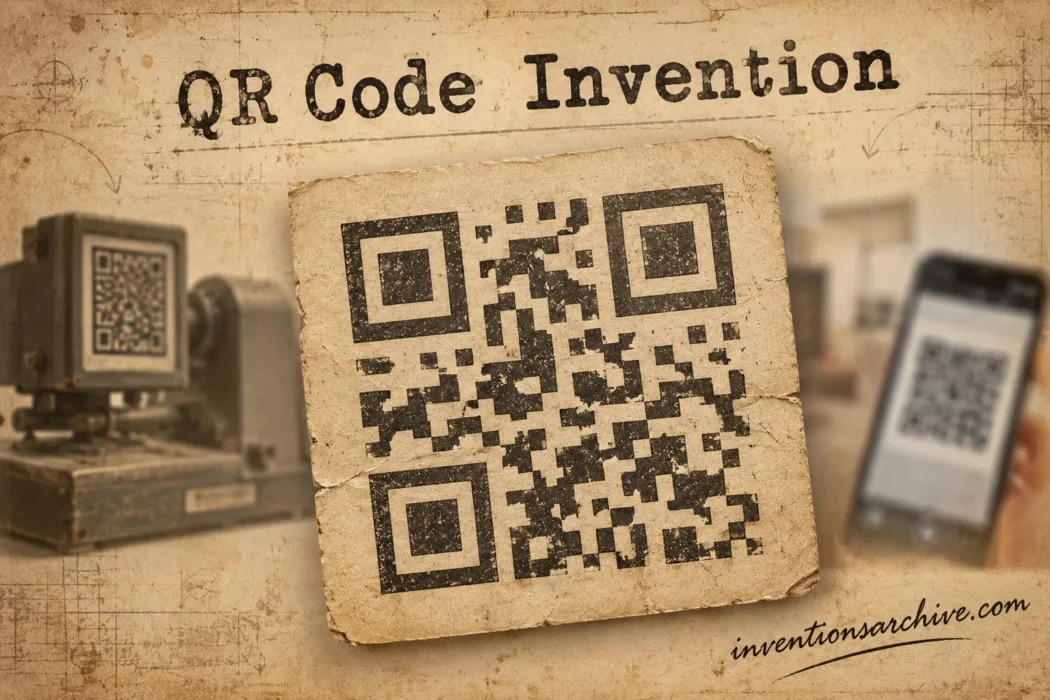
| Invention Name | QR Code |
|---|---|
| Short Definition | A matrix-type two-dimensional code designed to store substantial data in a compact symbol and be located and read rapidly from different orientations. |
| Approximate Date or Period | Development began in 1992; QR Code was released in 1994. |
| Geography | Kariya, Aichi Prefecture, Japan |
| Inventor or Source Culture | Japanese engineering team at DENSO, led by Masahiro Hara |
| Category | Automatic identification, data capture, manufacturing, logistics, information technology |
| Importance | Combined high data capacity, compact size, rapid position detection, multi-angle reading and error correction in a practical 2D symbol. |
| Evidence Status | Confirmed Development history, inventor attribution, patents and standardization are documented by DENSO, DENSO WAVE, the European Patent Office and ISO. |
| Main Problem Solved | Conventional barcodes stored too little information for changing automotive production workflows and could require repeated scans. |
| Development Path | Factory request in 1992 → new 2D code development → release in 1994 → industrial adoption → international standardization → mobile and consumer use |
| Encoding Principle | Information is arranged across both horizontal and vertical dimensions in a grid of black and white modules. |
| Early Use Context | Automotive production, electronic Kanban, parts management, shipping and logistics |
| Current Published Base Standard | ISO/IEC 18004:2024, Edition 4 |
QR Code was developed in Japan in 1994 by an engineering team at DENSO led by Masahiro Hara. Its original purpose had little to do with smartphones, restaurant menus or web addresses. The immediate problem came from automotive factories, where ordinary one-dimensional barcodes could no longer carry enough information without multiplying the number of labels and scans.
The invention succeeded because the team treated reading speed as seriously as storage capacity. A useful factory code had to hold more data, occupy little space, survive imperfect working conditions and tell the scanner where it was even when the symbol approached from an unexpected angle. Those requirements produced several features that remain recognizable in every standard QR Code, especially the three large square finder patterns.
The Problem Began on the Automotive Factory Floor
By the early 1990s, Japanese automotive manufacturing was moving toward high-mix, low-volume production. Factories needed to identify and manage a wider range of parts while attaching more production and logistics information to them. Conventional barcodes had become an awkward way to carry that growing data load.
Masahiro Hara recalled that a barcode of the type being used could hold only about 20 characters, forcing workers in some operations to read roughly ten barcodes in sequence for a product. DENSO’s account of the earlier development period also describes workers carrying out around 1,000 barcode scans in a day. Oil contamination created another problem: a dirty barcode could become unreadable.[a]
At first, Hara worked on the request as a scanner problem. Could the existing barcode simply be read faster? The limits of that approach became apparent. More information meant more barcodes, and more barcodes meant more scanning. Products were also becoming smaller, leaving less room for labels.
The engineering target changed. DENSO needed a code that could carry far more information in less physical space, support Japanese characters and still be identified rapidly on a working production line.
| Production Problem | Limitation of Existing Barcodes | QR Code Response |
|---|---|---|
| More data per item | Low character capacity encouraged multiple labels. | Data distributed in two dimensions greatly increased capacity. |
| Repeated scanning | Several barcodes could have to be read in sequence. | A single symbol could carry much more information. |
| Limited label space | Additional information required longer or additional barcodes. | The square matrix stored data densely in both directions. |
| Changing scan angles | Fast reading depended heavily on locating and orienting the symbol. | Three finder patterns made rapid position and orientation detection possible. |
| Oil, dirt and physical damage | Contamination could prevent successful reading. | Error-correction data allowed recovery when part of the symbol was damaged. |
| Japanese-language information | Existing workflows were poorly suited to dense Japanese text. | QR Code provided efficient Kanji and Kana encoding. |
Who Invented the QR Code?
Masahiro Hara is the lead inventor most closely associated with the QR Code. He had worked on barcode scanners, optical character recognition and related recognition technology at Nippondenso, the company later renamed DENSO. When development of the new code began in 1992, the initial code-development effort described by DENSO WAVE involved Hara and one other engineer.
The finished technology should not be reduced to a lone-inventor story. The European Patent Office’s record for the QR Code recognizes Masahiro Hara, Motoaki Watabe, Tadao Nojiri, Takayuki Nagaya and Yuji Uchiyama. The EPO also associates the team with European patent EP0672994.[b]
Hara therefore fits the description of lead inventor, while the broader technical record preserves contributions from a development team. DENSO has also documented that Toyota Central R&D Laboratories participated in error-correction work during development.
The Hard Part Was Finding the Code Fast Enough
Two-dimensional codes already existed before QR Code. Moving data into both vertical and horizontal dimensions could solve the capacity problem, but it introduced another one: a scanner had to locate a more complex symbol quickly enough for factory work.
This became the defining engineering challenge. A code with excellent capacity would still be inconvenient if a scanner spent too long separating it from nearby text, graphics, packaging patterns or other visual noise.
Why a QR Code Has Three Large Squares
Hara’s team added distinctive patterns to three corners of the symbol. These are commonly called finder patterns or position-detection patterns. They give a reader recognizable reference points from which it can determine the location and orientation of the code.
The three-corner arrangement is why a QR Code can be approached from many angles without requiring a user to rotate the label into a single fixed position. DENSO WAVE describes the symbol as capable of 360-degree reading because the reader can use these patterns to identify the code independently of its orientation.
The remaining grid contains additional structural and encoded information. Depending on the version, this includes timing patterns that help establish the module grid, alignment patterns that help compensate for distortion, format and version information, encoded data and error-correction codewords.
The 1:1:3:1:1 Pattern Was Chosen Through Printed-Material Analysis
The finder squares could not simply look distinctive to a human observer. A scanner needed a pattern that would be unlikely to appear accidentally in nearby printing.
DENSO’s development account says the team converted images and characters from materials such as magazines, flyers and cardboard packaging into black-and-white patterns and measured their proportions. The search eventually produced a black-and-white width relationship that was rarely encountered in ordinary printed material:
1 : 1 : 3 : 1 : 1
When a scan line crosses a finder pattern through its center, the alternating dark and light runs produce this characteristic ratio. The ratio can be detected from different directions, helping the reader determine that it has encountered a QR Code rather than an unrelated square graphic. Hara’s 2024 recollection places the discovery about six months into the development work.[d]
How Much Information Could the New Code Hold?
A conventional barcode represents most of its encoded information along one principal direction. QR Code distributes modules across a two-dimensional matrix, allowing far greater information density.
Standard QR Code has versions from Version 1, with a 21 × 21 module grid, through Version 40, with 177 × 177 modules. Each increase in version adds four modules to each side. The amount that fits in a particular symbol depends on its version, data type and chosen error-correction level.
The maximum specified capacities include:
- 7,089 numeric characters
- 4,296 alphanumeric characters
- 2,953 bytes of binary data
- 1,817 Kanji characters
These are upper limits rather than the capacity of every QR Code. A small version holds much less, and reserving more space for error correction reduces the amount available for the payload.
Japanese text was part of the original design requirement. QR Code supports compact encoding of JIS Level 1 and Level 2 Kanji, which made it particularly useful in the production environment for which it was developed.
Why Dirt and Damage Influenced the Design
Factory labels do not remain perfectly clean. Oil, scratches, smudges and damaged print were ordinary conditions in the environment that produced the QR Code. The new system therefore incorporated error correction rather than assuming that every printed module would remain readable.
QR Code uses Reed-Solomon error correction. Redundant codewords are added so that missing or corrupted information can be reconstructed within defined limits. Four error-correction levels are available.[e]
| Level | Approximate Recoverability | Trade-Off |
|---|---|---|
| L | About 7% | Leaves more symbol capacity available for data. |
| M | About 15% | A commonly used middle setting. |
| Q | About 25% | Provides greater recovery capability while requiring more redundancy. |
| H | About 30% | Provides the highest standard level of recovery with less room left for user data. |
The familiar claim that “30% of a QR Code can be destroyed and it will still work” is too absolute. The percentages refer to approximate recovery of codewords at the corresponding error-correction level. Real readability depends on the amount and location of the damage, the symbol configuration and whether structural areas needed to identify and decode the code remain usable. DENSO WAVE explicitly warns that recovery may fail depending on the degree of staining or damage.
Why It Was Named QR Code
The letters QR refer to quick response. The name described the intended reading behavior of the new symbol: the scanner should locate and process it rapidly.
Related articles: QWERTY Keyboard Invention: Who Invented QWERTY and Why? [Industrial Age Inventions Series]
The “response” was therefore unrelated to opening a website quickly or to any later smartphone function. High-speed recognition was already one of the development targets before consumer QR applications existed.
DENSO WAVE announced the code in 1994 after roughly a year and a half of development. Its initial market was industrial. The automotive sector adopted it for electronic Kanban and related production, shipping and transaction-document workflows.
The QR Code Was Patented, but Standardized Use Was Opened
One of the most persistent errors in QR Code history is the statement that the technology was never patented. DENSO WAVE lists multiple patents connected with QR Code technology, including Japanese patent JP2938338 and corresponding patents in other jurisdictions. The European Patent Office also identifies EP0672994 in its record of the QR Code inventors.[f]
The reason QR Code could spread without ordinary per-use licensing was different. DENSO made the specification publicly available and chose not to exercise the relevant patent rights against use that follows the standardized QR Code specifications. DENSO WAVE states that anyone may use standardized QR Codes freely when following JIS or ISO requirements.
This distinction matters. The technology had patent protection, but the company adopted an open-use approach for standardized implementations. Manufacturers of scanners, printers, software and industrial systems could therefore support the same symbol without creating isolated proprietary versions.
The name has a separate legal status. QR Code is a registered trademark of DENSO WAVE INCORPORATED. DENSO WAVE distinguishes the registered word mark from the visual QR Code pattern itself.
Standardization Moved QR Code Beyond One Manufacturer
Public specifications made wider adoption possible, while formal standards gave other companies a common technical definition to implement. QR Code moved through industry, Japanese and international standardization during the years after its release.[g]
| Date | Standardization Stage | What Changed |
|---|---|---|
| 1994 | QR Code released | DENSO introduced the new 2D code for practical industrial use. |
| October 1997 | AIM International | QR Code was approved as an international automatic-identification industry standard. |
| March 1998 | JEIDA | It became a standard of the Japanese Electronic Industry Development Association. |
| January 1999 | JIS | QR Code entered the Japanese Industrial Standards system as JIS X 0510. |
| June 2000 | ISO/IEC | QR Code became an international standard under ISO/IEC 18004. |
Standardization changed the scale on which the invention could be adopted. A company no longer had to treat QR Code as a format tied only to one vendor’s equipment. Compatible encoders, printers and readers could be designed around published rules.
QR Code Was Not Invented for Smartphones
The chronology makes the original purpose clear. QR Code appeared in 1994 as an industrial identification technology. Its consumer life developed later.
DENSO WAVE records 2002 as an important change in that history, when mobile phones capable of reading QR Codes entered the market. Once ordinary users could scan a printed code with a device they already carried, QR symbols became useful for website access, coupons and other consumer services.
The later spread of camera-equipped smartphones made that interaction far more familiar, but smartphones were beneficiaries of an existing industrial invention. They were not the reason it was created.
The development path can therefore be read as:
factory identification → production and logistics management → standardized industrial symbol → mobile-phone reading → widespread consumer and digital-service use
QR Code Did Not Invent Two-Dimensional Coding
QR Code was not the first attempt to encode information in two dimensions. Other 2D code research and systems existed when Hara’s team began its work. DENSO’s own history acknowledges those predecessors.
The 1994 invention is better understood as a particular engineering combination. It brought together:
- high information capacity in a compact matrix;
- rapid symbol location through three finder patterns;
- reading from different orientations;
- efficient Kanji and Kana support;
- error correction for damaged or dirty symbols;
- a design suited to real manufacturing workflows.
The finder patterns were especially important because they addressed a weakness that storage capacity alone could not solve. A factory code had to be found and decoded rapidly while surrounded by labels, text, package graphics and moving equipment. The design therefore joined data storage with machine vision.
From the Original Square Code to Later Forms
The original QR Code remained the main form, while later versions were created for narrower applications. Micro QR Code reduced the symbol area for situations where only small quantities of data were needed. SQRC introduced reading restrictions for selected information, and FrameQR created a defined area in which visual material could be placed without treating arbitrary damage to an ordinary QR Code as a design feature.
A later development, rMQR Code, changed the geometry itself. This rectangular form was designed for long, narrow spaces where a conventional square QR Code may fit poorly. It became the subject of ISO/IEC 23941:2022, a separate international standard for Rectangular Micro QR Code.[h]
These descendants show how the original production problem continued to shape later engineering: data capacity, available printing area and reliable detection still have to be balanced against one another.
The Published QR Code Standard Was Replaced in 2024
Older technical pages may still identify ISO/IEC 18004:2015 as the current QR Code standard. ISO now lists that edition as withdrawn.
The current published edition is ISO/IEC 18004:2024, Edition 4, published in August 2024. It specifies QR Code symbology characteristics, data encoding methods, symbol formats, dimensions, error-correction rules, decoding requirements, production quality and application parameters.[i]
The standard is already moving toward another revision. In 2026, ISO opened work on Edition 5 as ISO/IEC WD 18004. ISO lists it as a working draft under development and states that it is intended to replace the 2024 edition once the revision process is completed.[j]
Edition 5 should therefore not be described as the current published QR Code standard. Until a replacement reaches publication, ISO/IEC 18004:2024 remains the published edition.
What Was Actually Invented in 1994?
The shortest accurate attribution is that Masahiro Hara led the DENSO team that developed the QR Code in 1994. Other engineers contributed to the technology, and the European Patent Office preserves a five-person inventor attribution rather than presenting the system as the work of one isolated individual.
The reason for creating it was equally specific. Automotive manufacturing needed more information than ordinary barcodes could conveniently carry, while workers needed to capture that information with fewer scans, in less label space and under imperfect factory conditions.
The resulting design solved several connected problems at once. Two-dimensional encoding increased capacity. Three position-detection patterns made the symbol easier to locate from different angles. The unusual 1:1:3:1:1 finder ratio helped distinguish those patterns from surrounding print. Error correction improved tolerance of dirt and damage. Japanese character encoding addressed the information actually being handled in its first manufacturing environment.
Later phones, payment systems, tickets and web services changed where people encountered QR Codes, but the recognizable square symbol still carries design decisions made for an automotive production floor in the early 1990s.
Sources and Verification
- [a] Believing in a Faint Light: Obstacles QR Code developer overcame and the source of his idea. — DENSO’s 30th-anniversary interview with Masahiro Hara documents the 1992 factory problem, barcode-capacity limits, repeated scanning, contamination issues and the search for the finder-pattern ratio.
- [b] Masahiro Hara, Motoaki Watabe, Tadao Nojiri, Takayuki Nagaya, Yuji Uchiyama — European Patent Office record identifying the QR Code inventor team and associated European patent EP0672994.
- [c] History of QR Code | QRcode.com | DENSO WAVE — DENSO WAVE’s historical account explains the 1994 release, the DENSO organizational context, industrial adoption and the decision to make the specifications publicly available.
- [d] QR Code development story|Technologies|DENSO WAVE — DENSO WAVE’s engineering history describes the two-person early development effort, finder-pattern research, 1:1:3:1:1 ratio, multi-angle detection and factory requirements.
- [e] Error correction feature | QRcode.com | DENSO WAVE — Technical documentation from DENSO WAVE explaining Reed-Solomon error correction and the L, M, Q and H recovery levels.
- [f] About the patent | QRcode.com | DENSO WAVE — DENSO WAVE’s patent record lists patents relating to QR Code and explains the conditions under which standardized QR Codes may be used freely.
- [g] QR Code Standardization | QRcode.com | DENSO WAVE — Official QR Code documentation records the AIM, JEIDA, JIS and ISO standardization sequence and provides the standard symbol-capacity figures.
- [h] ISO/IEC 23941:2022 — Rectangular Micro QR Code (rMQR) bar code symbology specification — ISO’s official record verifies the publication and scope of the international rMQR standard.
- [i] ISO/IEC 18004:2024 — QR code bar code symbology specification — ISO’s official standard record identifies Edition 4, published in August 2024, as the published QR Code specification and lists the 2015 edition as withdrawn.
- [j] ISO/IEC WD 18004 — QR code bar code symbology specification — ISO’s official project record identifies Edition 5 as a working draft under development in 2026 and states that it is intended to replace ISO/IEC 18004:2024.