
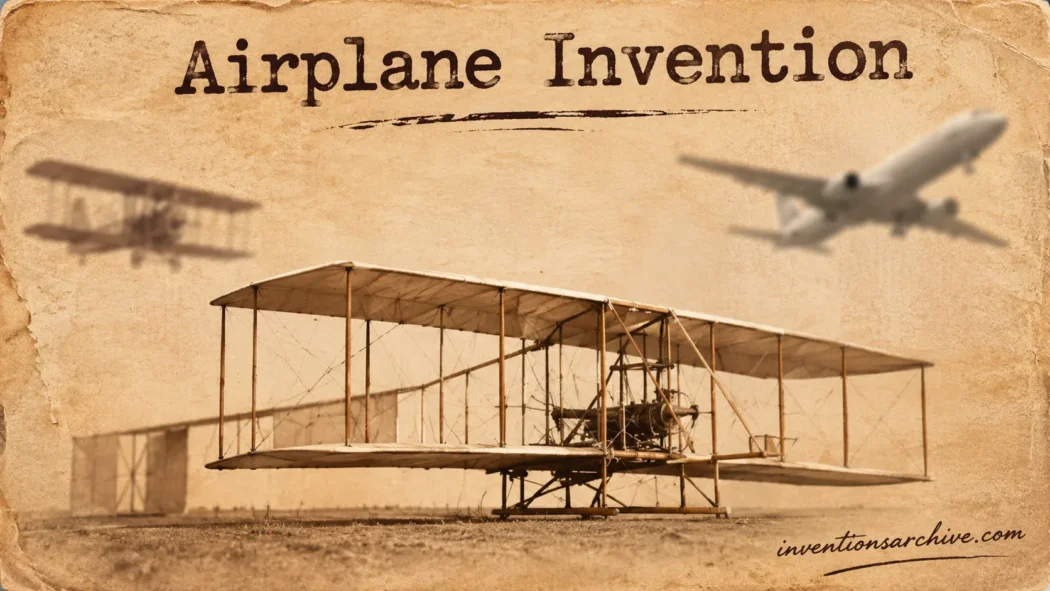
| Invention Name | Airplane (Powered Fixed-Wing Aircraft) |
|---|---|
| Short Definition | A heavier-than-air flying machine that uses fixed wings to generate lift, an engine to provide propulsion, and aerodynamic controls to direct flight. |
| First Successful Flight | December 17, 1903 |
| Inventors | Wilbur Wright and Orville Wright |
| Geography | Kill Devil Hills, near Kitty Hawk, North Carolina, United States |
| Category | Aviation, Transportation, Aeronautical Engineering |
| First Aircraft | 1903 Wright Flyer (Flyer I) |
| First Flight Performance | 12 seconds; 120 feet (36.6 meters); Orville Wright piloting |
| Engine | Approximately 12-horsepower, four-cylinder gasoline engine |
| Technical Principle | Aerodynamic lift, powered propulsion, and three-axis flight control |
| Main Problem Solved | Sustained, controlled, powered flight with a pilot aboard a heavier-than-air aircraft |
| Earlier Contributors | George Cayley, Otto Lilienthal, Octave Chanute, Samuel Langley, and other aviation experimenters |
| Development Path | Early aerodynamics and gliders → Wright glider experiments → 1903 powered flight → 1905 practical airplane → modern fixed-wing aircraft |
| Practical Airplane Milestone | 1905 Wright Flyer III; sustained, maneuverable flights at Huffman Prairie, Ohio |
| Evidence Status | Confirmed The 1903 flights are documented by photographs, contemporary records, and surviving aircraft components. Some competing earlier-flight claims remain debated. |
| Surviving Evidence | Original 1903 Wright Flyer, flight records, photographs, engineering drawings, and U.S. Patent No. 821,393 |
| Importance | Established the technical basis for controlled, powered airplane flight and subsequent aviation development. |
The airplane is commonly credited to Wilbur and Orville Wright, who made the first documented sustained, controlled, powered flights in a heavier-than-air aircraft on December 17, 1903. Their Wright Flyer lifted off from a launching rail at Kill Devil Hills, North Carolina. Orville piloted the first flight, remaining airborne for 12 seconds and traveling 120 feet (36.6 meters). Three additional flights followed that morning.
The Wright brothers’ achievement followed more than a century of experiments with wings, gliders, propulsion, and aerodynamic control. Earlier inventors had demonstrated individual elements of airplane technology, but combining them into a machine that could take off, sustain flight, and respond to a pilot required further investigation. The Wrights concentrated on controlling the aircraft, tested their assumptions in a wind tunnel, and developed a propulsion system suited to a lightweight flying machine.
The 1903 Flyer established powered flight, although it remained difficult to control and could not yet perform the sustained maneuvering expected of a practical airplane. That development came in 1905, when the improved Wright Flyer III completed extended, controlled flights near Dayton, Ohio. The Smithsonian National Air and Space Museum preserves the original 1903 aircraft as physical evidence of the earlier achievement. [a]
The Flying Machines That Came Before the Wright Brothers
The fixed-wing airplane developed from experiments that gradually established how heavier-than-air objects could fly. By the nineteenth century, investigators understood that a suitably shaped wing could produce lift when moving through air. Their remaining problems included building a sufficiently light structure, generating enough forward motion, and controlling the aircraft after it left the ground.
George Cayley and the Foundations of Fixed-Wing Flight
British engineer Sir George Cayley (1773–1857) helped establish the scientific approach to heavier-than-air flight. His work separated the functions of lift, propulsion, and stability, which earlier flying-machine concepts often treated as parts of a single mechanical problem.
In 1804, Cayley built and tested a small glider with a fixed wing and separate stabilizing surfaces. His later experiments included larger gliders capable of carrying people. A widely cited 1853 experiment involved a human-carrying glider crossing a valley near Brompton in Yorkshire, although some details survive primarily through later accounts.
Cayley’s aircraft did not establish practical powered flight. His lasting contribution was the recognition that a flying machine could use wings for lift while obtaining propulsion from a separate mechanism. This distinction became part of subsequent airplane design.
Otto Lilienthal and Controlled Gliding
German engineer Otto Lilienthal (1848–1896) made repeated human glider flights during the 1890s. He studied curved wings, measured their aerodynamic performance, and published data that influenced later aviation experimenters.
Lilienthal generally controlled his gliders by shifting his body weight. This approach allowed limited adjustments but did not provide the coordinated aerodynamic controls later developed for powered aircraft.
He died in 1896 following injuries sustained in a gliding accident. His experiments nevertheless demonstrated that human flight using fixed lifting surfaces was possible and provided the Wright brothers with valuable technical information.
Octave Chanute and Stronger Glider Structures
American engineer Octave Chanute (1832–1910) gathered and circulated aviation research through his 1894 book Progress in Flying Machines. He also supported glider experiments, including work conducted near Lake Michigan in 1896.
The braced biplane structures associated with Chanute and fellow experimenters Augustus Moore Herring and William Avery showed how two wings could be joined into a relatively light, rigid arrangement. The Wrights adopted a braced biplane configuration in their experimental gliders and maintained technical correspondence with Chanute.
Samuel Langley’s Powered Aerodromes
American scientist Samuel Pierpont Langley (1834–1906) demonstrated successful unmanned powered flight in 1896. His steam-powered model Aerodromes flew without pilots, providing evidence that mechanical propulsion could sustain heavier-than-air flight.
Langley’s attempt to scale his work into a human-carrying aircraft proved unsuccessful. Two launching attempts with his larger Aerodrome in 1903 ended in failure, including one on December 8, nine days before the Wright brothers’ successful flights.
Langley’s experiments demonstrated that powered models could fly. They did not establish that a full-sized aircraft could reliably carry a pilot while remaining under control. The distinction between propulsion and control became central to the Wright brothers’ approach. [b]
Why the Wright Brothers Treated Flight Control as the Main Problem
Wilbur and Orville Wright operated a bicycle business in Dayton, Ohio, when they began systematically studying aviation in the late 1890s. Their experience with mechanical systems, balance, and practical testing influenced their experimental methods.
They concluded that designing a powerful engine would have limited value unless a pilot could maintain balance and direct the machine while airborne. A glider provided a way to develop these controls before introducing the additional weight and complexity of a motor.
Pitch, Roll, and Yaw
An airplane moves around three principal rotational axes. Controlling all three makes it possible to maintain its attitude, change direction, and correct disturbances caused by wind or aerodynamic forces.
- Pitch: Rotation that raises or lowers the aircraft’s nose. The Wrights used a movable horizontal surface ahead of the wings, called a forward elevator or canard, to control pitch.
- Roll: Rotation that tilts one wing upward and the other downward. The Wrights controlled roll by changing the shape of the wings through a mechanism called wing warping.
- Yaw: Rotation that turns the aircraft’s nose left or right around a vertical axis. A movable vertical rudder allowed the Wrights to control this motion.
These movements are connected. Banking an airplane changes the direction of its lift, helping it turn, while unwanted yaw can interfere with the intended maneuver. The Wright brothers had to develop a coordinated system rather than independent mechanisms that worked only under ideal conditions.
How Wing Warping Controlled the Aircraft
Wing warping was one of the Wright brothers’ best-known technical developments. Cables and a flexible wing structure allowed the pilot to twist the outer sections of the wings in opposite directions.
When one wing developed greater lift than the other, the aircraft rolled toward the side producing less lift. By adjusting the amount and direction of wing twisting, the pilot could influence the aircraft’s lateral balance.
Early experiments revealed an additional problem. Changes in the wings’ aerodynamic forces could also create unwanted yaw, sometimes causing the glider to turn contrary to the pilot’s intention. The brothers addressed this problem by introducing a movable vertical rudder and coordinating its operation with wing warping.
Modern aircraft commonly achieve roll control with hinged surfaces called ailerons rather than twisting the entire wing. The mechanical arrangement differs, but both approaches create an aerodynamic difference between the two wings to control roll. [c]
From the 1900 Glider to the Wind Tunnel Experiments
The Wright brothers developed three major gliders between 1900 and 1902. Each exposed different weaknesses in the emerging aircraft design.
The 1900 Glider: Less Lift Than Expected
The brothers traveled to Kitty Hawk in 1900 to test a biplane glider equipped with wing-warping controls and a forward elevator. They initially tested it as a kite and later performed limited piloted glides.
The aircraft generated less lift than their calculations predicted. Although it provided experience with control surfaces, the difference between expected and observed performance raised questions about the aerodynamic information available to them.
The 1901 Glider: A Larger Wing Did Not Solve the Problem
For the 1901 glider, the Wrights increased wing area and curvature in an effort to produce more lift. The results remained disappointing.
The glider produced substantially less lift than anticipated and experienced handling difficulties. Its elevator could be overly sensitive, while the interaction between wing warping and yaw made directional control uncertain.
The brothers adjusted the curvature of the wings, improving some control characteristics. The lift discrepancy persisted, leading them to examine the calculations and assumptions behind their designs.
The 1901 Wind Tunnel and New Aerodynamic Measurements
Back in Dayton, the Wright brothers constructed a small wind tunnel that allowed them to measure aerodynamic forces on model wings under controlled conditions.
They investigated as many as 200 model wing shapes in preliminary experiments and recorded formal measurements for nearly 50. Their tests examined the effects of wing curvature, shape, and proportions on lift and drag.
One problem involved the Smeaton coefficient, a historical factor used in calculations of aerodynamic pressure. The commonly used value of 0.005 did not agree with the Wrights’ observations. Their experiments supported a value close to 0.0033, reducing one source of error in their earlier calculations.
They also learned that a longer, narrower wing could offer advantages over some of the heavily curved designs they had tested. Their results helped distinguish problems caused by inaccurate assumptions from those caused by the aircraft’s actual geometry.
The 1902 Glider: The Basis of the First Powered Airplane
The Wrights incorporated their wind-tunnel findings into a new glider in 1902. Its longer, narrower wings provided improved aerodynamic performance, while refinements to the rudder and wing-warping controls improved handling.
The brothers completed hundreds of glides during the 1902 testing season. They learned to control the aircraft through increasingly sustained flights and gained practical piloting experience.
By the end of that season, they had demonstrated a functioning system for generating lift and controlling an unpowered aircraft. Their next challenge was to supply propulsion without making the machine too heavy to fly. [d]
How the First Wright Flyer Was Built and Powered
The 1903 Wright Flyer was developed from the general arrangement of the successful 1902 glider. It retained a braced biplane structure, forward elevator, wing-warping controls, and movable vertical rudders.
The principal new challenge was propulsion. The brothers needed an engine and propellers that could generate enough thrust for flight while remaining light enough for the wings to support.
The Lightweight Gasoline Engine
Commercial engines available to the Wright brothers did not adequately meet their requirements for weight and power. With the assistance of Charles Edward Taylor, a mechanic employed in their bicycle shop, they developed their own gasoline engine.
The resulting four-cylinder engine produced approximately 12 horsepower. Its aluminum crankcase reduced weight compared with a heavier cast-iron construction, while the engine’s compact arrangement helped it fit within the aircraft’s limited structure.
Taylor’s machining and mechanical work were essential to producing the engine. The achievement belonged to a small engineering team rather than to an engine independently built by the two brothers alone.
Why the Wright Brothers Designed Their Own Propellers
The propellers presented a separate aerodynamic problem. A conventional understanding of propellers as devices that simply pushed against air offered insufficient guidance for predicting their performance.
The Wrights treated each propeller blade as a rotating wing. Different parts of a blade move through the air at different speeds, requiring changes in blade angle and shape along its length to produce useful thrust.
Using their aerodynamic research, they developed two wooden propellers driven by the engine through chains and sprockets. The propellers rotated in opposite directions and were positioned behind the wings in a pusher arrangement.
The Smithsonian reports an efficiency of approximately 66% for the original propeller design. This allowed the modest engine to generate sufficient thrust for the aircraft’s first successful flights. [e]
The Aircraft’s Materials and Structure
The Flyer used a wooden airframe covered with muslin fabric. Bracing wires and struts helped the structure retain its form while keeping overall weight relatively low.
The engine and pilot were positioned beside one another rather than directly along the aircraft’s centerline. The right wing was slightly longer to compensate for the heavier engine mounted to the pilot’s right.
The pilot lay face down on the lower wing. A hip-operated cradle controlled wing warping and coordinated rudder movement, while a separate hand-operated control moved the forward elevator.
The aircraft had no conventional wheeled landing gear. Its wooden skids supported it during landing, while a launching rail and wheeled carriage assisted its initial movement along the ground.
| Specification | 1903 Wright Flyer |
|---|---|
| Wingspan | 40 ft 4 in (12.3 m) |
| Length | 21 ft 1 in (6.4 m) |
| Height | 9 ft 4 in (2.8 m) |
| Empty Weight | 605 lb (274 kg) |
| Gross Weight | 750 lb (341 kg) |
| Engine | Four-cylinder, gasoline-powered |
| Engine Power | Approximately 12 hp |
| Propulsion | Two chain-driven pusher propellers |
| Wing Arrangement | Braced biplane |
| Primary Materials | Wood, muslin fabric, metal fittings |
| Flight Controls | Wing warping, forward elevator, rear rudder |
Why the Wright Brothers Tested Their Airplane at Kitty Hawk
The Wright brothers selected the Outer Banks of North Carolina because the region offered conditions favorable for experimental gliding and flight. They had consulted information from the United States Weather Bureau while searching for a location with steady winds and suitable open ground.
The coastal environment provided broad areas relatively free from obstacles. Strong headwinds helped their gliders generate lift at lower speeds over the ground, while the sandy terrain offered space for testing and landing.
The brothers initially worked near Kitty Hawk, then used the dunes around Kill Devil Hills for much of their glider testing. The powered flights of December 1903 occurred on relatively level ground near the Kill Devil Hills, within the area now preserved as Wright Brothers National Memorial.
The Failed Attempt on December 14, 1903
On December 14, Wilbur Wright attempted to fly the powered aircraft from a launching track laid on a gentle slope. The machine left the launching apparatus but rose too sharply, stalled, and struck the ground.
The unsuccessful attempt damaged the aircraft and required repairs. It demonstrated that an available engine and a wing capable of producing lift did not automatically guarantee a controlled takeoff.
The Launching Rail Was Not a Catapult
The successful December 17 flights used a wooden launching rail approximately 60 feet long. The Flyer rested on a wheeled carriage that traveled along the rail as the aircraft accelerated.
The aircraft was propelled by its own engine. Wind over the wings helped it reach flying conditions, and the carriage remained behind when the Flyer became airborne.
The Wright brothers did not use a catapult for their 1903 flights. They developed a weight-powered launching device for later experiments at Huffman Prairie, where strong, steady coastal winds were unavailable. Confusing the later system with the 1903 arrangement creates an inaccurate account of the first flight.
December 17, 1903: The First Four Powered Airplane Flights
On the morning of December 17, 1903, the Wright brothers prepared the Flyer for another attempt. The weather was cold, with strong winds blowing across the coastal testing area.
Several local men, including members of the nearby United States Life-Saving Service station, helped with preparations and witnessed the flights.
At approximately 10:35 a.m., Orville Wright released the aircraft and accelerated along the launching rail. Wilbur ran alongside as the Flyer became airborne.
The airplane remained in the air for 12 seconds, traveling 120 feet before landing in the sand. Its flight path was uneven, but Orville maintained enough control to complete a sustained powered flight.
John T. Daniels, a member of the Life-Saving Service, operated the camera that recorded the historic takeoff. The photograph shows Orville aboard the aircraft and Wilbur running beside it. [f]
The Four Flights and Their Recorded Distances
| Flight | Pilot | Duration | Distance |
|---|---|---|---|
| First | Orville Wright | 12 seconds | 120 ft (36.6 m) |
| Second | Wilbur Wright | 12 seconds | 175 ft (53.3 m) |
| Third | Orville Wright | 15 seconds | 200 ft (61.0 m) |
| Fourth | Wilbur Wright | 59 seconds | 852 ft (259.7 m) |
The fourth flight, piloted by Wilbur, traveled substantially farther than the previous three. For part of the journey, the aircraft maintained a steadier course, demonstrating that the Wrights could sustain powered flight beyond a brief takeoff.
The recorded distances represent travel over the ground. Because the aircraft flew into a strong headwind, its speed through the surrounding air was considerably greater than its ground speed.
After the fourth flight, a gust of wind overturned the aircraft while it was on the ground. The resulting damage ended further testing with the original Flyer. It never flew again. [g]
What the 1903 Flight Proved About Powered Aviation
The Wright brothers demonstrated that an engine-powered aircraft could carry a pilot, lift itself into the air, sustain flight, and respond to aerodynamic control inputs.
The result depended on several engineering achievements operating together:
- Lift: The wings generated enough aerodynamic force to support the aircraft and its pilot.
- Thrust: The engine-driven propellers provided the forward motion needed to sustain lift.
- Control: The pilot could influence pitch, roll, and yaw rather than relying solely on passive stability.
- Structure: The lightweight airframe could withstand the forces encountered during the short flights.
These capabilities established a new category of functioning flying machine. The Flyer was still unstable in pitch, difficult to maneuver, and dependent on favorable conditions. Its four flights followed short, generally straight paths, without the repeated turns and reliable operation needed for transportation.
It also carried only one person. There was no practical passenger compartment, operational navigation system, or arrangement for normal journeys between destinations.
The first successful flight therefore marked the beginning of a development process that continued through further aircraft designs and extended testing.
The Wright Flyer III and the First Practical Airplane in 1905
After returning to Dayton, the Wright brothers continued flight experiments at Huffman Prairie, a field northeast of the city. The location allowed repeated testing near their workshop, although its weaker and less predictable winds introduced new launching difficulties.
The 1904 Wright Flyer II
The second powered Flyer incorporated design changes intended to improve the earlier aircraft’s handling. The brothers adjusted the airplane’s balance and control arrangement while learning to operate without the strong coastal winds of Kitty Hawk.
In 1904, they completed numerous experimental flights, including increasingly successful turns and circuits of the flying field. A weight-powered launching system eventually helped the aircraft reach takeoff speed under less favorable wind conditions.
Their experience showed that maneuvering required more than achieving adequate lift. An aircraft had to maintain stability while banking, changing direction, and returning to its starting area.
Why the 1905 Flyer III Was Different
The Wright Flyer III, introduced in 1905, initially retained some handling problems from earlier aircraft. A serious crash in July led the brothers to revise the arrangement and effectiveness of its control surfaces.
They enlarged and repositioned the forward elevator, improved rudder control, and adjusted how the aircraft responded to pilot inputs. The resulting machine became easier to maneuver and less prone to abrupt pitching movements.
Its improved handling allowed the brothers to fly extended circuits, make repeated turns, and remain airborne for much longer periods.
October 5, 1905: A Flight of More Than 24 Miles
On October 5, 1905, Wilbur Wright flew the Flyer III for approximately 39 minutes, covering more than 24 miles (about 39 kilometers) over Huffman Prairie.
The aircraft could remain airborne, turn repeatedly, and complete an extended flight under the pilot’s direction. These capabilities distinguish the Flyer III from the experimental machine that had made the first short flights in 1903.
The 1905 Flyer III is consequently recognized as the first practical airplane in the historical development of powered aviation. Its performance was far closer to the maneuverability and endurance required for an operational flying machine. [h]
Did Anyone Invent or Fly an Airplane Before the Wright Brothers?
Claims concerning earlier powered flights depend heavily on what qualifies as successful airplane flight. Briefly leaving the ground, flying an unmanned model, and completing a sustained piloted flight under aerodynamic control are different achievements.
Several aviation pioneers produced machines that reportedly left the ground before December 1903. However, the evidence supporting their results differs in reliability, and their aircraft did not necessarily demonstrate the same combination of powered flight and control.
Clément Ader and the Éole
French inventor Clément Ader developed a steam-powered aircraft called the Éole. Reports of an October 1890 experiment indicate that the machine may have briefly risen above the ground and traveled a short distance.
Ader’s later aircraft, the Avion III, was tested in 1897 but did not establish successful controlled flight.
The 1890 experiment remains relevant to the history of early powered takeoff attempts. It is not generally accepted as proof of sustained, controlled airplane flight comparable to the Wright brothers’ later achievement.
Gustave Whitehead’s Claimed 1901 Flight
German-born American aviation experimenter Gustave Whitehead claimed to have flown a powered aircraft near Bridgeport, Connecticut, on August 14, 1901.
Supporters of Whitehead’s priority cite contemporary newspaper reporting and later eyewitness statements. Historians have questioned the reliability and consistency of this evidence, particularly whether it establishes that Whitehead completed a sustained, controlled flight.
The Smithsonian National Air and Space Museum has examined Whitehead’s claims and maintains that the available evidence does not displace the Wright brothers’ documented achievement. The debate persists, but Whitehead’s reported flight has not gained equivalent historical acceptance. [i]
Richard Pearse’s Early Experiments in New Zealand
New Zealand inventor Richard Pearse developed a powered monoplane using an unconventional combination of lightweight materials and mechanical controls.
Accounts of his early flight attempts describe brief powered movements into the air, possibly as early as March 1903. The precise date is disputed, and surviving evidence does not establish that he performed sustained, controlled flight before the Wright brothers.
Pearse himself later acknowledged the Wright brothers’ achievement and did not claim to have completed proper controlled flight ahead of them.
His experiments remain important for their independent engineering approach, including the use of a monoplane configuration and control features that differed from the Wright design. [j]
Alberto Santos-Dumont and the First Official European Flight Records
Brazilian aviation pioneer Alberto Santos-Dumont (1873–1932) developed a series of lighter-than-air craft before turning to powered airplanes in France.
His aircraft, the 14-bis, used a biplane arrangement and wheeled landing gear. Unlike the 1903 Wright Flyer, it could accelerate along the ground on its own wheels without requiring a launching rail.
On October 23, 1906, Santos-Dumont made a publicly observed flight of approximately 60 meters at Bagatelle in Paris, winning the Archdeacon Cup.
On November 12, 1906, the 14-bis completed a flight of 220 meters (722 feet) in approximately 21.5 seconds. The Fédération Aéronautique Internationale recognizes this as the first officially observed European airplane flight exceeding 25 meters.
The distinction between the Wright brothers and Santos-Dumont rests partly on the criteria used to recognize an aviation achievement.
| Criterion | Wright Brothers | Santos-Dumont |
|---|---|---|
| Aircraft | 1903 Wright Flyer | 14-bis |
| Documented Milestone | December 17, 1903 | November 12, 1906 |
| Location | North Carolina, United States | Paris, France |
| Takeoff Arrangement | Engine-powered aircraft launched along a rail | Engine-powered takeoff on wheels |
| Main Achievement | First documented sustained, controlled, powered airplane flights | Officially observed and recorded European powered-airplane flight |
| Historical Recognition | First successful piloted powered airplane | Early officially ratified aviation distance record |
These achievements should not be treated as identical records. The Wright flights preceded Santos-Dumont’s demonstrations, while the 14-bis established an important official public record under different circumstances.
The 1903 Wright Flyer also did not depend on a catapult, a distinction sometimes lost in comparisons with the later Wright aircraft that used launching assistance. Santos-Dumont’s independent wheeled takeoff remains an important development in its own right. [k]
The Wright Brothers’ 1906 Airplane Patent
Wilbur and Orville Wright filed a United States patent application for a flying machine on March 23, 1903, before their successful powered flights.
The resulting U.S. Patent No. 821,393, titled Flying-Machine, was granted on May 22, 1906.
The patent described methods for maintaining and controlling the lateral balance of a flying machine, including the adjustment of wing surfaces and associated directional controls.
Its importance lay particularly in the control arrangements developed during the brothers’ glider experiments. The patent was not a general claim to every possible form of flight or to all future airplane technologies.
The distinction between the filing date and grant date also matters. The application originated in the brothers’ pre-1903 powered-flight research, while the legal patent was issued after they had already demonstrated successful flights and developed more capable aircraft.
Disputes over the scope and enforcement of Wright patents later involved other aircraft manufacturers and affected the commercial development of aviation in the United States. [l]
How Public Demonstrations Established Confidence in the Airplane
Although the Wright brothers had completed successful flights in 1903 and developed a practical machine by 1905, many observers remained skeptical of their claims.
The earliest flights had taken place in isolated locations before relatively small groups of witnesses. The brothers also restricted public demonstrations while attempting to protect their invention and negotiate commercial agreements.
That situation changed in 1908.
Wilbur Wright’s Flights in France
On August 8, 1908, Wilbur Wright began publicly demonstrating an improved Wright aircraft at Le Mans, France. His flights showed European observers that the aircraft could maneuver under control and remain airborne for extended periods.
The demonstrations provided direct public evidence of capabilities previously described largely through reports and correspondence. They also helped establish the Wright brothers’ international reputation.
Orville Wright’s Demonstrations in the United States
Orville demonstrated a Wright aircraft at Fort Myer, Virginia, in 1908 as part of efforts to secure a contract with the U.S. Army.
Those trials included a fatal crash on September 17, 1908, which killed Army passenger Lieutenant Thomas E. Selfridge and seriously injured Orville. The accident exposed the risks associated with early aircraft structures, propulsion systems, and flight operations.
Testing resumed after further development. In 1909, the Wright brothers successfully demonstrated a military aircraft that met the Army’s requirements, leading to its acceptance by the U.S. Army Signal Corps.
These developments showed that the airplane had progressed beyond an experimental machine capable of occasional short flights. It was becoming equipment that institutions could evaluate, purchase, and operate for defined purposes. [m]
Which Wright Flyer Technologies Survived in Modern Airplanes?
Modern fixed-wing airplanes differ extensively from the 1903 Flyer in structure, propulsion, control systems, and performance. The underlying aerodynamic requirements remain recognizable.
Both early and modern aircraft must generate sufficient lift, overcome drag through propulsion, maintain stability, and permit controlled movement around the pitch, roll, and yaw axes.
From Wing Warping to Ailerons
The Wright brothers adjusted roll by twisting the wing structure. Most later airplanes adopted hinged ailerons near the outer trailing edges of the wings.
Ailerons produce a difference in aerodynamic forces between the wings without requiring the main wing structure to twist in the same manner. The principle of controlling lateral balance through differential wing forces remained central to airplane design.
Changes in Pitch and Yaw Control
The Wright Flyer used a forward elevator to control pitch. Most conventional modern airplanes place their horizontal stabilizing surfaces and elevators behind the main wings, although some aircraft retain canard arrangements.
Vertical rudders remain common for controlling yaw and coordinating maneuvers. The exact relationship between control surfaces differs according to aircraft configuration, but the three rotational axes identified in early aviation experiments still describe the basic movements of an airplane.
From Fabric-Covered Frames to Metal and Composite Aircraft
Early aircraft depended on lightweight wooden structures, fabric coverings, external bracing, and comparatively low-powered engines.
Later designers introduced stronger structural arrangements, metal airframes, enclosed fuselages, and more powerful propulsion systems. Aluminum alloys became widely used in aircraft construction, followed by advanced composite materials in many modern designs.
Piston engines continued to serve light aircraft, while turbine engines enabled the higher speeds, power output, and operational capabilities associated with modern commercial aviation.
The transition to these technologies did not invalidate the Wright brothers’ aerodynamic solution. It allowed the same basic flight principles to support heavier aircraft, greater speeds, longer distances, and new operational requirements.
The Original 1903 Wright Flyer and Its Surviving Evidence
The aircraft that made the first successful flights on December 17, 1903, survives in the Smithsonian National Air and Space Museum in Washington, D.C.
Its preservation history explains why the aircraft displayed today does not contain every material component exactly as it existed during the original flights.
Damage, Restoration, and the Original Airframe
The 1903 Flyer was seriously damaged after its final flight when wind overturned it on the ground. The Wrights retained the aircraft, and it was later assembled for public exhibitions.
Orville Wright supervised repairs and restoration work over subsequent decades. Some damaged structural components were replaced, and the fabric covering was renewed.
In 1928, the aircraft was sent to the Science Museum in London, where it remained for approximately two decades. It returned to the United States in 1948 and was formally presented to the Smithsonian on December 17 of that year.
During conservation work in 1984–1985, Smithsonian specialists examined the surviving structure and replaced the fabric covering with material closely matching the original specifications.
The displayed aircraft is the original Wright Flyer, not a modern reproduction. Its surviving historic structure and components are accompanied by documented restoration and conservation work.
The First-Flight Photograph and Contemporary Records
The photograph taken by John T. Daniels on December 17, 1903, preserves the moment of the first successful takeoff. It provides visual evidence of the aircraft’s configuration, the pilot’s position, and the launching arrangement.
The Wright brothers’ records provide additional details about the experimental process, including aerodynamic measurements, aircraft design changes, flight conditions, and observed performance.
The surviving patent documentation establishes the technical features for which the brothers sought legal protection. Together, the physical aircraft, photographs, written records, and engineering drawings make the invention unusually well documented for an early technological achievement.
They also allow historians to separate the documented success of December 1903 from later interpretations of what the machine could accomplish. The original Flyer demonstrated controlled powered flight; the 1905 Flyer III demonstrated the extended maneuverability that made an airplane practical. Both achievements belong to the same development process, but represent distinct stages in the invention of powered aviation. [n]
Sources and Verification
- [a] 1903 Wright Flyer — Smithsonian National Air and Space Museum collection record documenting the original aircraft, physical specifications, materials, propulsion system, and historical attribution.
- [b] Flight Before the Airplane — Smithsonian historical research describing earlier glider and powered-flight experiments and the contributions that preceded the Wright brothers.
- [c] Power and Control in the Air — Smithsonian technical explanation of pitch, roll, yaw, wing warping, rudders, and the development of airplane control systems.
- [d] Researching the Wright Way — Smithsonian documentation of the Wright glider experiments, wind-tunnel measurements, aerodynamic calculations, and improvements leading to powered flight.
- [e] Wright Brothers Propeller, Fixed-Pitch, 1903 Wright Flyer — Smithsonian object record identifying the original propeller’s construction, application, and documented aerodynamic efficiency.
- [f] 1903—The First Flight — U.S. National Park Service historical account of the December 1903 preparations, launching arrangement, witnesses, controls, and first successful takeoff.
- [g] Four Powered Flights — U.S. National Park Service record verifying the durations and distances of the four flights at Wright Brothers National Memorial.
- [h] Huffman Prairie Flying Field — U.S. National Park Service history documenting the 1904–1905 testing program and the development of the practical Wright Flyer III.
- [i] Debunking Gustave Whitehead’s Claim of Flying First (Before the Wrights) — Smithsonian aviation historian Tom Crouch’s assessment of the evidence supporting and disputing Whitehead’s early-flight claims.
- [j] Pearse, Richard William — Dictionary of New Zealand Biography, published through Te Ara, documenting Pearse’s aircraft experiments and the uncertainty surrounding his early flight dates.
- [k] 12 November 1906: The First Flight by Santos-Dumont — Fédération Aéronautique Internationale account documenting Santos-Dumont’s officially observed 1906 flight and recorded performance.
- [l] US821393A — Flying-Machine — Digitized United States patent document recording the Wright brothers’ March 23, 1903 application, May 22, 1906 patent grant, and claimed flight-control mechanisms.
- [m] You Just Invented the Airplane, Now What? — Smithsonian National Air and Space Museum historical account examining early skepticism, commercialization, and the public demonstrations that established acceptance of Wright aircraft.
- [n] What Happened to the Original Wright Flyer? — Smithsonian conservation history documenting the original aircraft’s survival, restorations, museum transfers, and preservation of its historic structure.