
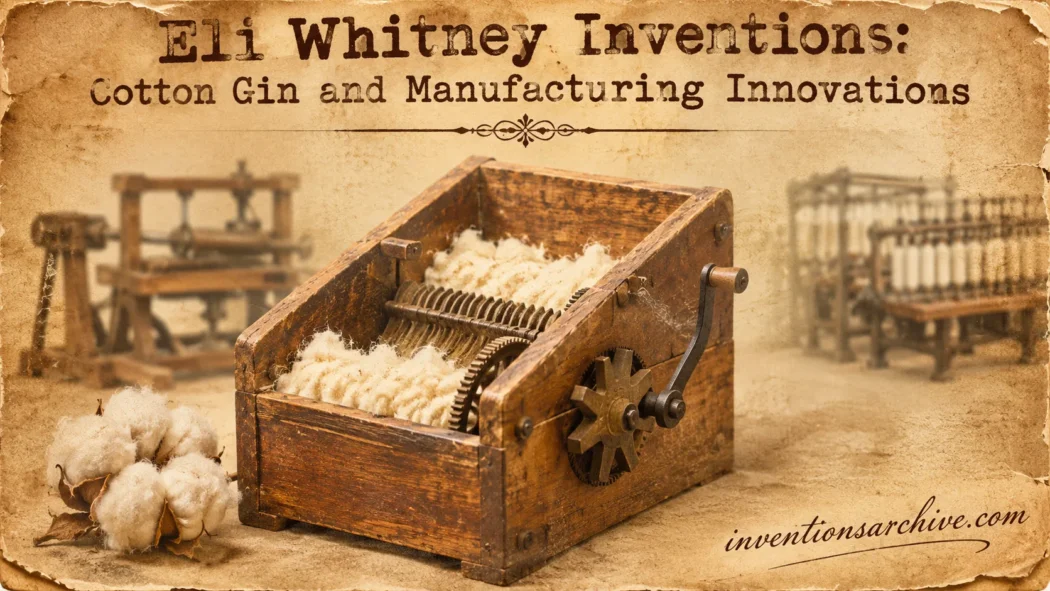
| Full Name | Eli Whitney (commonly distinguished as Eli Whitney Sr.) |
|---|---|
| Born | December 8, 1765 — Westborough, Massachusetts, British America |
| Died | January 8, 1825 — New Haven, Connecticut, United States |
| Nationality | American |
| Occupation | Inventor, mechanical engineer, manufacturer, and industrial entrepreneur |
| Education | Yale College, graduated in 1792 |
| Best-Known Invention | Cotton gin for processing short-staple upland cotton, developed in 1793 |
| Documented Patent | U.S. Patent 72X — Cotton Gin, March 14, 1794 |
| Other Engineering Contributions | Mechanized firearms manufacturing, specialized factory operations, and efforts toward standardized components |
| Major Industrial Enterprise | Whitney Armory, established in Connecticut in 1798 |
| Associated Technologies | Cotton-processing machinery, interchangeable parts, precision manufacturing, and early machine tools |
| Historical Attribution | Cotton gin patent confirmed Manufacturing contributions documented Some inventor claims disputed |
| Main Historical Sources | Patent records, correspondence, federal contracts, factory accounts, surviving firearms, and museum collections |
Eli Whitney (1765–1825) was an American inventor and manufacturer best known for developing the cotton gin in 1793. His second major contribution was establishing a firearms factory that pursued mechanized production and standardized components. These two undertakings placed him at different stages of early American industrial development: the expansion of cotton processing and the organization of factory manufacturing.
Whitney’s cotton gin is supported by a surviving patent record dated March 14, 1794. His work on manufacturing methods is documented through federal contracts, correspondence, factory accounts, and surviving firearms. He is also widely associated with interchangeable parts, milling machines, and mass production, although historians distinguish his actual contributions from inventions that predated him or were completed by other engineers.
What Did Eli Whitney Invent?
Whitney’s clearly documented patented invention was his cotton gin design. His other major work involved improving manufacturing processes rather than creating an entirely new product.
The distinction matters because a patented mechanical device, a production method, and a technological concept do not necessarily have the same inventor.
| Invention or Innovation | Date or Period | Whitney’s Role | Attribution |
|---|---|---|---|
| Cotton Gin | 1793–1794 | Developed and patented a mechanism for separating seeds from short-staple cotton. | Confirmed invention |
| Mechanized Musket Manufacturing | 1798–1825 | Established a factory combining powered machinery, specialized operations, and organized production. | Documented contribution |
| Interchangeable Parts | 1798–1825 | Pursued uniform components in firearms production and promoted their practical application. | Not original inventor |
| Milling Machine | Early 1800s | Associated with early machine-assisted metalworking and specialized milling processes. | Inventor claim unsupported |
| Mass Production | Early 1800s | Contributed to production methods that later developed into standardized factory manufacturing. | Shared technological development |
Whitney did not invent firearms themselves, and no reliable historical record establishes that he originated the general concept of interchangeable parts. His achievement in firearms manufacturing was the sustained attempt to develop a working industrial system based on consistent components and specialized labor.
Eli Whitney’s Early Life and Mechanical Education
Eli Whitney was born on December 8, 1765, in Westborough, Massachusetts. His father, also named Eli Whitney, was a prosperous farmer, and his mother was Elizabeth Fay Whitney.
Growing up on a farm gave Whitney regular contact with agricultural tools, woodworking, and mechanical equipment. He became interested in repairing devices and making useful objects while still young.
The Nail-Making Business
At approximately fourteen years old, Whitney established a small workshop to manufacture nails. Local demand was strong during the American Revolutionary War, when access to imported manufactured goods was disrupted.
His work involved supplying an existing product rather than inventing the nail. The experience nevertheless introduced him to production costs, metalworking, repetitive manufacturing, and the practical relationship between labor and output.
Whitney later made other small manufactured goods and repaired mechanical objects. These activities helped him develop the manual skills he would apply to more complex machinery.
Yale College and His Move to Georgia
Whitney wanted a college education but needed to finance much of it himself. He worked as a teacher and saved money before enrolling at Yale College in 1789, when he was twenty-three years old.
He graduated in 1792 at the age of twenty-six. His original plans included studying law, but financial circumstances led him to accept a position as a tutor in the southern United States.
During his journey, Whitney became acquainted with Catharine Littlefield Greene, the widow of Revolutionary War general Nathanael Greene. She invited him to visit Mulberry Grove, her plantation near Savannah, Georgia.
At Mulberry Grove, Whitney encountered the cotton-processing problem that led to his best-known invention. [a]
Whitney’s First Major Invention: The Cotton Gin
In Georgia, Whitney learned that plantation owners struggled to process short-staple upland cotton efficiently.
Cotton fibers grow around seeds that must be removed before the fiber can be prepared for textile production. The difficulty of this operation varied by cotton variety.
Long-staple cotton could be grown in suitable coastal environments and was comparatively easier to clean with existing equipment. Short-staple cotton could grow across a much larger inland region, but its seeds clung tightly to the fibers.
Removing these seeds by hand was slow and physically demanding. Enslaved workers performed much of this labor, often spending several hours preparing a single pound of cleaned fiber.
How Whitney Developed His Cotton Gin
Whitney began experimenting with a mechanical solution during 1793. His design departed from older roller gins, which separated cotton fibers from seeds by drawing the fibers between closely spaced rollers.
Earlier cotton gins had existed for centuries, so Whitney was not the first person to conceive of mechanized cotton cleaning. His improvement was directed toward the difficult seeds of upland cotton.
The mechanism combined rotating wire teeth, narrow openings, and a clearing brush.
The teeth caught the cotton fibers and pulled them through a grate. The flexible fibers could pass through the narrow openings, while the larger seeds were prevented from following. A rotating brush then removed the separated fiber from the teeth.
These operations allowed the machine to process cotton repeatedly without requiring a worker to separate each seed individually.
The Machine’s Processing Capacity
The National Archives reports that a small Whitney-type cotton gin could produce approximately 50 pounds (23 kilograms) of cleaned cotton in one day.
The figure describes an approximate historical capacity, not a guaranteed output for every version of the machine. Productivity depended on the size of the gin, its operating conditions, the cotton variety, and its source of power.
Smaller gins could be hand-operated, while larger machines could use animal or water power.
The resulting increase in processing capacity made upland cotton much more attractive commercially. It also encouraged further development of cotton-ginning equipment, including the later saw-gin improvements associated with Hodgen Holmes.
The 1794 Cotton Gin Patent
Whitney applied for patent protection while developing his machine. His correspondence with Thomas Jefferson, then serving as secretary of state, documents the application process in 1793.
On March 14, 1794, Whitney received a federal patent for his cotton gin.
The patent identified the mechanical arrangement he claimed as his invention. Its surviving drawing provides direct historical evidence of the machine’s design and the date of legal protection.
The National Archives preserves the restored patent drawing within the records of the United States Patent and Trademark Office. [b]
Why Whitney’s Patent Is Called 72X
The cotton-gin patent is identified as U.S. Patent 72X, also written 72-X.
American patents issued before July 1836 were not originally numbered according to the system introduced that year. After a fire destroyed thousands of early Patent Office records in December 1836, officials attempted to reconstruct the lost collection.
The earlier patents received retrospective identifiers containing the letter X.
Whitney’s patent is therefore classified as 72X, distinguishing it from Patent No. 72 issued under the later numbering system.
The restored drawing records Whitney’s patented design. It does not mean that his original working prototype survives as a physical artifact. [c]
Who Helped Eli Whitney Develop the Cotton Gin?
Whitney was the named inventor on the 1794 patent, but the machine was developed within a plantation economy where other people supplied financial support, practical experience, and knowledge of cotton processing.
Catharine Greene’s Involvement
Catharine Greene provided Whitney with access to a workshop and encouraged his experiments at Mulberry Grove.
Some later accounts suggest that Greene contributed ideas to the cotton gin’s design. These claims sometimes involve the arrangement of the machine’s cleaning components.
The documentary evidence supports Greene’s involvement in enabling the invention, but it does not establish precisely which mechanical elements, if any, originated with her.
She is therefore an important participant in the development history without being a conclusively documented co-inventor.
The Knowledge of Enslaved Cotton Workers
Enslaved workers possessed direct experience with cotton varieties, seed removal, and the limitations of manual processing.
The National Archives acknowledges historical claims that the machine drew on ideas from enslaved laborers familiar with cotton cleaning.
However, the surviving records do not identify every contributor or establish which specific design elements may have originated with individual workers.
Whitney’s patent documents legal authorship under the patent system of the period. It does not fully describe the exchange of practical knowledge surrounding the invention.
Phineas Miller’s Business Partnership
Phineas Miller became Whitney’s partner in the cotton-gin enterprise. He helped finance the project, organize its commercial operation, and pursue patent enforcement.
His contribution was particularly important after the machine began spreading and the partners struggled to receive payment from users.
Whitney’s invention became widely adopted, but the commercial venture proved much less rewarding than its owners expected.
Why the Cotton Gin Did Not Make Whitney Rich
Whitney and Miller initially planned to establish cotton-ginning operations rather than simply sell machines to plantation owners.
They proposed charging a fee equal to two-fifths of the cotton processed. Many growers regarded this arrangement as excessive.
Once the machine’s operating principle became known, competitors began making unauthorized versions. Some modified the mechanism and argued that their machines were separate inventions.
Patent litigation became expensive and difficult to manage. Weaknesses in the early federal patent system complicated Whitney’s attempts to protect the commercial value of his design.
Patent Disputes and State Agreements
Whitney and his associates eventually pursued licensing arrangements and agreements with individual states.
South Carolina agreed in 1802 to purchase rights associated with Whitney’s patent for $50,000, although payment was delayed. Arrangements were also negotiated involving North Carolina and Tennessee.
Whitney sought an extension of his patent protection in 1808 and again in 1812.
His petition dated April 16, 1812, survives among National Archives records. It documents his continuing difficulties with unauthorized use and the approaching expiration of his patent.
The invention had become economically valuable to cotton growers, while the financial return to Whitney remained limited by copying, disputes, and enforcement costs. [d]
The Cotton Gin’s Effects on Cotton Production and Slavery
Whitney’s cotton gin reduced the labor required to remove seeds from upland cotton. The resulting expansion of commercially viable cultivation reshaped agricultural production in the southern United States.
Previously, the difficulty of cleaning short-staple cotton had restricted the crop’s profitability across much of the inland South.
Mechanized processing helped remove this limitation, allowing plantation owners to expand cultivation into additional areas.
The growth of textile manufacturing in Britain and the northern United States provided a large market for the resulting cotton fiber.
Why Labor Demand Increased Despite Mechanization
The cotton gin mechanized seed removal, but it did not mechanize planting, cultivating, or picking cotton.
As plantation acreage expanded, owners demanded more enslaved agricultural workers. The machine thus contributed to the expansion of plantation slavery, even though it reduced the labor needed for one stage of processing.
The growth of cotton agriculture also increased pressure on Native American lands. Plantation expansion was connected with the forced displacement of Indigenous communities as agricultural settlement moved into additional territories.
Whitney’s machine was one factor in these changes, alongside rising textile demand, territorial expansion, government policy, and the plantation labor system.
The Eli Whitney Museum and Workshop documents these consequences as part of the history of the cotton gin and its adoption. [e]
Whitney’s Second Major Contribution: Firearms Manufacturing
Whitney turned increasingly toward manufacturing after his cotton-gin business encountered financial difficulties.
On June 14, 1798, he secured a contract from the United States government to produce 10,000 muskets.
The contract came during growing tensions between the United States and France, when federal officials sought to increase domestic firearms production.
Whitney agreed to manufacture the weapons within approximately two years at a contracted price of $13.40 per musket.
The order was large relative to the capabilities of American arms manufacturers at the time. Springfield Armory, an established federal facility, was producing fewer than 5,000 muskets annually.
Whitney had no comparable firearms factory when he entered the agreement. He needed to develop the facilities, labor organization, and equipment required to complete the order.
Founding the Whitney Armory in Connecticut
On September 17, 1798, Whitney purchased property along the Mill River near New Haven, Connecticut.
The site offered water power suitable for operating industrial machinery. Whitney established workshops for metalworking, woodworking, component production, and final assembly.
The factory became known as the Whitney Armory.
Worker housing developed near the facility, creating the industrial settlement later called Whitneyville.
By 1803, the workforce exceeded sixty people. The factory combined experienced mechanics with workers trained to perform narrower manufacturing tasks.
Why the Musket Contract Took Until 1809
Whitney’s original production target proved unrealistic.
Constructing the factory, acquiring machinery, developing production methods, and organizing workers required far more time than the contract allowed.
Manufacturing large numbers of components with consistent dimensions presented an additional difficulty. Hand fitting remained necessary, and the anticipated production capacity was slow to develop.
Whitney received financial advances and extensions while working to complete the contract.
The final muskets were delivered in January 1809, more than a decade after the original agreement.
Despite the delays, the federal government continued its relationship with Whitney, and the factory received further firearms contracts. The Library of Congress documents the 1798 contract, its original delivery expectations, and the eventual completion of the order. [f]
What Manufacturing Methods Did Whitney Develop?
Whitney’s work at the armory focused on improving how complex manufactured components were produced.
Traditional gunsmithing required considerable handwork. Skilled artisans shaped and adjusted components until they fit a particular weapon.
Because components were individually finished, a part made for one musket could require modification before fitting another.
Whitney attempted to organize production around machinery, repeated operations, and greater uniformity.
Dividing Manufacturing Into Specialized Tasks
One feature of the Whitney Armory was the division of manufacturing labor by type of operation.
Rather than assigning every worker the task of producing an entire component, the factory divided work into processes such as turning, drilling, filing, shaping, and finishing.
A component might pass through several workers before reaching final assembly.
This arrangement allowed employees to specialize in repeated tasks and reduced the need for every worker to possess the complete skills of a traditional gunsmith.
It also required more careful coordination of materials, equipment, and production sequences.
Water-Powered Machine Tools
Whitney’s factory used the Mill River as a source of mechanical power.
Historical records identify equipment for turning, drilling, grinding, polishing, and other metalworking operations.
The armory’s workshops were arranged around the manufacturing requirements of the period, with metal-shaping operations and machine-based finishing carried out in different areas.
Although machinery reduced some repetitive labor, the factory still relied heavily on skilled manual finishing.
Surviving account books from 1809–1810 document payments for hand filing musket components. This provides evidence that the production system was not entirely mechanized.
Jigs, Fixtures, and Consistent Dimensions
Whitney’s production methods are associated with the use of positioning devices now described as jigs and fixtures.
These devices help hold a component in a consistent position during repeated manufacturing operations.
They can reduce variation between pieces made at different times or by different workers. Their usefulness depends on the accuracy of the equipment and the consistency of the underlying manufacturing process.
Historical researchers believe Whitney employed such methods, although the exact designs of all the devices used in his lifetime have not survived.
The surviving factory records and firearms show a combination of machine-based operations and hand finishing, rather than a fully automated or consistently interchangeable production system. [g]
Did Eli Whitney Invent Interchangeable Parts?
Whitney did not originate the concept of interchangeable parts. His role was to promote standardized firearms manufacturing and attempt to make uniform components practical in his factory.
Interchangeable parts are components manufactured to sufficiently consistent specifications that one can replace another corresponding component without individual adjustment.
For this to work reliably, a manufacturer must control dimensional variation across large numbers of parts.
Producing components that look similar is not enough. Their dimensions and mating surfaces must remain within acceptable limits.
Interchangeable Parts Before Whitney
French gunsmith Honoré Blanc had experimented with uniform firearms components before Whitney received his American government contract.
Blanc’s work demonstrated that the concept of interchangeability was already being explored in eighteenth-century Europe.
Thomas Jefferson became familiar with French experiments in standardized firearms manufacturing while serving as the American minister to France.
Whitney’s manufacturing ambitions developed within an existing discussion about uniform production, rather than introducing the idea for the first time.
The 1801 Demonstration in Washington
Whitney’s reputation became closely associated with interchangeability after a demonstration in Washington in 1801.
He presented musket components before officials, including President John Adams and President-elect Thomas Jefferson.
Accounts describe a demonstration involving ten musket locks whose components were presented as interchangeable.
The display impressed officials and helped Whitney secure continued government support despite delays in delivering his contracted muskets.
However, the demonstration does not establish that the entire factory was producing interchangeable components routinely.
A small collection of prepared parts could demonstrate the intended principle without proving that thousands of separately manufactured components met the same standard.
Later historical research has questioned the degree of interchangeability achieved at Whitney’s factory during his lifetime.
What the Surviving Evidence Shows
Whitney pursued uniform components, but surviving factory records and firearms indicate that substantial hand fitting continued.
The Eli Whitney Museum and Workshop explicitly distinguishes his contributions from the later development of reliably interchangeable firearms.
Whitney’s work remains part of the history of standardized manufacturing, but the practical achievement of complete interchangeability required further improvements by other manufacturers and engineers. [h]
Other Inventors Who Developed Interchangeable Manufacturing
The development of interchangeable components involved multiple inventors and manufacturers whose work overlapped with Whitney’s.
Honoré Blanc
Honoré Blanc’s eighteenth-century work in France established an earlier documented effort to manufacture uniform firearm components.
His experiments challenged the assumption that every component of a firearm needed to be individually fitted by a skilled craftsman.
Simeon North
Simeon North operated an arms-manufacturing business in Middletown, Connecticut.
His work contributed to improvements in precision machining and the production of standardized firearm components.
Workers moved between North’s factory, the Whitney Armory, and other manufacturing establishments, helping spread practical knowledge and techniques.
John H. Hall
John H. Hall advanced interchangeable firearms manufacturing at Harpers Ferry during the early nineteenth century.
His work involved specialized machine tools and increasingly precise methods for producing uniform components.
Hall’s developments helped demonstrate how manufacturing equipment, accurate dimensions, and inspection methods could be combined to produce components requiring much less individual fitting.
Later work at Harpers Ferry and Springfield Armory brought interchangeability closer to dependable industrial practice.
The process developed gradually through improvements in machinery, skilled labor, measurement, and factory organization.
Did Eli Whitney Invent the Milling Machine?
Whitney is sometimes credited with inventing the milling machine, a metalworking tool that removes material using a rotating cutter.
Historical research does not support identifying him as the original inventor.
Much of the traditional attribution developed from a milling machine found at the former Whitney Armory site in 1912.
The Milling Machine Discovered in Whitneyville
The surviving machine was discovered in the hayloft of a barn associated with the armory.
Local tradition attributed it to Eli Whitney, and it became associated with early American milling-machine invention.
Later investigators examined the machine against factory documents, probate inventories, and marks preserved on surviving firearms.
The machine does not appear in Whitney’s 1825 probate inventory. Its construction is also inconsistent with the specialized milling operations identified on firearms produced during his lifetime.
Research summarized by the Eli Whitney Museum and Workshop suggests that the machine probably dates from approximately 1827, after Whitney’s death.
It may have been developed during improvements undertaken by his nephews, Philos Blake and Eli Whitney Blake.
Whitney’s Actual Connection With Milling
Surviving firearms suggest that specialized rotary cutting operations were used at the Whitney Armory during the early nineteenth century.
Such equipment could perform particular metalworking tasks, but it should not be confused with the development of general-purpose milling machinery.
Simeon North, John H. Hall, and other arms manufacturers contributed to early milling-machine development.
The presence of a historical milling machine at Whitney’s factory therefore does not prove that he invented the technology.
The Eli Whitney Museum and Workshop’s examination of armory production records and surviving machinery distinguishes the factory’s early equipment from improvements introduced after 1825.
Did Eli Whitney Invent Mass Production?
Whitney helped develop methods associated with later mass production, but he did not invent mass production as a complete industrial system.
Large-scale production, divided labor, and specialized machinery existed in different forms before his armory was established.
Whitney’s contribution involved combining these approaches within an American firearms factory that attempted to produce complex, standardized components.
His workers performed repeated operations, while machinery assisted with tasks that would otherwise require extensive manual effort.
The factory demonstrated the possibilities and difficulties of organizing manufacturing around specialized processes rather than complete individual craftsmanship.
Reliable interchangeability and highly developed mass-production methods emerged later, through changes in machine tools, factory management, measurement, and industrial organization.
The moving assembly lines associated with twentieth-century automobile manufacturing were also later developments. They should not be described as inventions created by Whitney.
What Happened to Whitney’s Factory After 1825?
Eli Whitney died in New Haven on January 8, 1825, at the age of fifty-nine.
The Whitney Armory continued operating after his death. His nephews, Philos Blake and Eli Whitney Blake, managed the business during the following decade.
The Blake brothers introduced additional manufacturing improvements and developed inventions of their own, including the Escutcheon Latch in 1833.
These later inventions belonged to the nephews rather than to Eli Whitney Sr.
Eli Whitney Jr. and Later Precision Manufacturing
Whitney’s son, Eli Whitney Jr., subsequently assumed control of the armory and modernized its operations.
During the 1840s, the factory introduced improved equipment and manufacturing methods.
Thomas Warner, an experienced armorer associated with Springfield Armory, contributed to changes in machinery and gauging.
These improvements helped the Whitney Armory achieve more consistent component production than had been possible during its founder’s lifetime.
The later factory manufactured firearms for government and civilian markets as weapon designs and industrial technology changed.
Winchester Repeating Arms acquired the Whitney Armory in 1888 and subsequently phased out firearms production at the site.
The Eli Whitney Museum and Workshop now occupies the historic factory location in Hamden, Connecticut. Its collections and research document the armory’s development across several generations of workers and manufacturers. [i]
Evidence That Identifies Whitney’s Actual Inventions
Several types of surviving evidence allow historians to separate Whitney’s personal inventions from technologies associated with his name.
The Cotton Gin Patent Drawing
The restored patent drawing dated March 14, 1794, documents the mechanical configuration Whitney claimed as his invention.
Its date and identification within the early United States patent system provide stronger evidence of personal inventorship than later biographical accounts alone.
Correspondence and Government Contracts
Letters associated with the cotton gin establish parts of its development and commercialization history.
Whitney’s government contracts and manufacturing correspondence document his ambitions, production obligations, financial difficulties, and efforts to improve industrial methods.
These materials reveal what Whitney proposed and pursued, although they do not necessarily prove that every proposed improvement was successfully implemented.
Surviving Whitney Muskets
Historical firearms produced at the Whitney Armory provide physical evidence of its manufacturing methods.
Researchers can examine tool marks and evidence of manual finishing to evaluate what types of operations were used.
The manufacturing dates of surviving firearms matter because the armory operated for decades after Whitney’s death. Later products may reflect machinery and processes introduced by his successors.
The 1825 Probate Inventory
The inventory prepared after Whitney’s death provides an additional record of factory equipment.
It identifies numerous tools and machines and helps researchers distinguish equipment present during Whitney’s lifetime from equipment introduced later.
When considered alongside the absence of the surviving Whitneyville milling machine from that inventory, the record provides important evidence against attributing that particular machine to Whitney personally.
Eli Whitney’s Place in American Invention History
Whitney’s most secure claim to inventorship concerns the cotton gin design patented in 1794. The machine addressed the difficult processing requirements of short-staple cotton and helped expand its commercial cultivation.
His work at the Whitney Armory established a separate record of industrial experimentation involving powered machinery, specialized operations, and the pursuit of uniform components.
The factory’s limitations are as informative as its ambitions. Consistent manufacturing required techniques that were still developing, and Whitney did not achieve fully interchangeable firearms production during his lifetime.
Later generations of engineers and manufacturers made additional advances in precision equipment, standardized components, and industrial production. The history of those developments includes Whitney’s work while recognizing contributions from Honoré Blanc, Simeon North, John H. Hall, the Whitney Armory’s workers, and Whitney’s successors.
Sources and Verification
- [a] The Whitney Family — Eli Whitney Museum and Workshop’s biographical record documenting Whitney’s birth, family, education, marriage, death, and the subsequent management of his armory.
- [b] Patent for Cotton Gin (1794) — National Archives collection containing the restored patent drawing and confirming the March 14, 1794 patent date and the machine’s purpose.
- [c] The Search for Lost X-Patents — United States Patent and Trademark Office account explaining the 1836 patent-record fire, retrospective X-patent numbering, and Whitney’s patent identification.
- [d] Eli Whitney’s Patent for the Cotton Gin — National Archives historical account documenting Whitney’s Georgia experiments, Catharine Greene, Phineas Miller, patent litigation, copying, and patent-renewal petitions.
- [e] The Cotton Gin and Its Legacies — Eli Whitney Museum and Workshop research examining cotton processing, plantation expansion, slavery, Indigenous displacement, and textile manufacturing.
- [f] Eli Whitney and the Birth of the American Manufacturing System — Library of Congress research guide documenting the 1798 musket contract, Whitneyville, the Washington demonstration, and the delayed completion of the government order.
- [g] Arms Production at the Whitney Armory — Detailed historical research based on factory records, machine inventories, surviving firearms, tool marks, and scholarship concerning the disputed Whitneyville milling machine.
- [h] Precision Manufacturing — Eli Whitney Museum and Workshop assessment distinguishing Whitney’s manufacturing objectives from the earlier concept and later practical achievement of interchangeable parts.
- [i] History — Eli Whitney Museum and Workshop institutional chronology identifying Whitney’s death, the Blake brothers’ management, later factory innovations, Eli Whitney Jr.’s modernization, and the 1888 Winchester acquisition.