
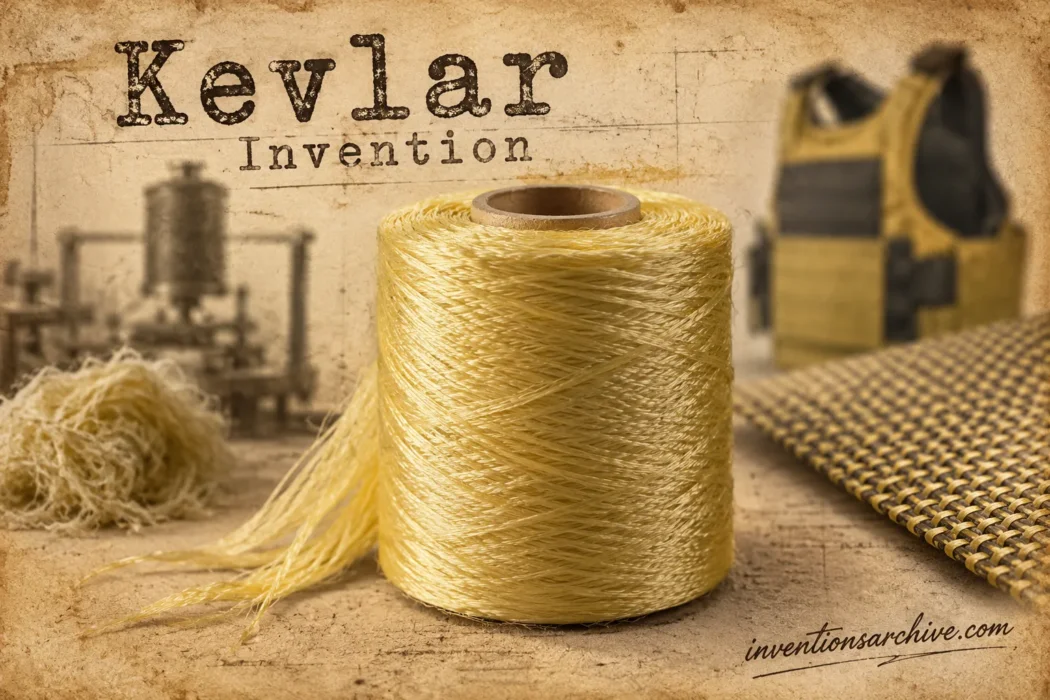
| Invention Name | Kevlar® |
|---|---|
| Short Definition | A lightweight, high-strength para-aramid synthetic fiber. |
| Approximate Date or Period | 1965 for the defining laboratory discovery; commercial production followed about six years later. |
| Geography | Wilmington, Delaware, United States |
| Inventor or Source Culture | Stephanie L. Kwolek at DuPont, followed by a larger research and engineering team. |
| Category | Polymer chemistry; synthetic fiber; materials engineering |
| Importance | Combined low weight with unusually high tensile strength and stiffness, enabling new forms of reinforcement and protective materials. |
| Evidence Status | Confirmed Supported by Kwolek’s oral history, institutional archives, patents and later technical records. |
| Main Problem Solved | Creating a fiber that could provide strong, stiff reinforcement without the weight of materials such as steel. |
| Development Path | High-performance fiber research → unusual aromatic polyamide solution → highly oriented strong fibers → process development → commercial Kevlar. |
| Material Basis | Para-aramid; commercial Kevlar is based on poly(p-phenylene terephthalamide), commonly abbreviated PPTA. |
| Original Research Context | Lightweight, heat-resistant, high-strength reinforcement, including possible replacement of heavy steel tire cord. |
| Commercial Introduction | 1971 |
Stephanie Louise Kwolek is the inventor most directly credited with the discovery that led to Kevlar. Her breakthrough came at DuPont in 1965 while she was studying rigid aromatic polyamides in a program seeking fibers that were unusually strong, stiff and lightweight. The research was not originally aimed at bullet-resistant vests. One practical goal was a lighter reinforcing fiber that could reduce dependence on heavy steel reinforcement, especially in tires.
The familiar one-line version of the story—“Kwolek invented Kevlar in 1965”—is broadly correct, but it compresses several different achievements into one date. Kwolek made the foundational discovery. Paul W. Morgan, Thomas I. Bair, Herbert Blades, Joseph L. Rivers Jr. and other DuPont researchers contributed to patent work, development of the commercial polymer, spinning technology and applications. Laboratory discovery, industrial production and later uses were separate stages.
Why DuPont Was Searching for a New Kind of Fiber
By the early 1960s, synthetic fibers such as nylon and polyester were already well established. DuPont researchers were looking beyond these materials toward fibers with much higher stiffness and strength while retaining the low weight associated with organic polymers.
Kwolek recalled that in 1964 her supervisor asked her group to investigate high-performance fibers. Transportation was one reason for the work. Steel wire could provide strong reinforcement in tires, but steel added weight. Replacing some heavy reinforcement with a textile-like material offered the possibility of reducing vehicle weight and fuel use. Kwolek also recalled concern at the time about a possible future gasoline shortage.
Heat resistance was another research target. Conventional textile fibers performed well in many uses, but researchers wanted polymers capable of retaining useful properties in conditions where ordinary fibers were limited.
The desired material therefore had an unusual combination of requirements: low density, high tensile strength, high stiffness and useful thermal resistance. Finding all of these traits together was far harder than simply producing another textile fiber.
The Cloudy Solution That Changed the Research Program
Kwolek was synthesizing rigid-chain aromatic polyamides and studying whether they could be dissolved and spun into fibers. Polymer solutions familiar to the laboratory were normally relatively thick and clear. One of Kwolek’s experimental solutions behaved very differently.
It was thin, hazy and unusually fluid. Kwolek later described its appearance as resembling a dispersion rather than the viscous polymer solutions the laboratory normally handled. The difference was great enough that the technician responsible for spinning initially resisted putting it through the equipment.
Kwolek persisted because the unusual appearance suggested that the material deserved testing rather than disposal. When the solution was finally spun and the resulting fiber measured, the results showed an unexpected combination of high stiffness, high strength and low weight. She had the measurements repeated several times before accepting them.
The discovery was unexpected, but calling Kevlar a purely accidental invention is misleading. Kwolek was deliberately investigating aromatic polyamides in search of better fibers. What she had not predicted was the unusual ordered behavior of the polymer solution and the exceptional properties of fibers spun from it.
What Kwolek Actually Discovered
Kwolek later identified her main achievement as the discovery of liquid-crystalline solutions of synthetic aromatic polyamides and high-strength, high-modulus fibers produced from those solutions.
The distinction matters because commercial Kevlar was not simply a substance found by chance in a test tube. The broader discovery concerned a new way rigid polymer molecules could organize themselves in solution and then retain a high degree of orientation when converted into fibers.
Kwolek worked during the early research with both poly(1,4-benzamide) and poly(p-phenylene terephthalamide). The commercial Kevlar fiber that followed was based on the latter family, usually described today as PPTA.
The term para-aramid describes an aromatic polyamide whose molecular architecture favors long, relatively straight chains. Kevlar belongs to this class. Its molecular geometry is one of the reasons it behaves so differently from more flexible textile polymers.
Why Molecular Alignment Makes Kevlar So Strong
A useful way to understand Kevlar is to compare flexible polymer chains with rigid ones. Flexible polymers tend to adopt tangled or coiled configurations when dissolved. Manufacturing can stretch and orient them, but obtaining very high alignment requires additional processing.
The aromatic chains involved in Kevlar research behave more like rigid rods. Under the right conditions, many of these molecules organize into ordered regions in a liquid-crystalline solution. Their directions are not completely random even before the final fiber exists.
During fiber formation, flow through the spinning system further aligns these ordered polymer structures along the direction of the emerging filament. The result is a fiber in which a large proportion of the long molecules point along the fiber axis.
This orientation is central to Kevlar’s mechanical behavior. Loads applied along the fiber direction can be carried efficiently through strongly aligned polymer chains and intermolecular interactions. Kevlar therefore achieves a high tensile strength-to-weight ratio without requiring the density of a metal reinforcement.
This does not mean Kevlar is equally strong in every direction or under every form of loading. Like other engineered fibers, its performance depends on how the material is arranged in yarns, fabrics, composites or other structures.
Why Para-Aramid Is Different From Ordinary Synthetic Fiber
The “para” in para-aramid refers to the arrangement of groups around the aromatic rings in the polymer backbone. That geometry encourages a straighter molecular chain than is found in many flexible polymers.
Kevlar is often discussed alongside Nomex because both belong to the aramid family and emerged from related DuPont research. Their molecular arrangements differ, however. Nomex is a meta-aramid whose structure gives it a different balance of properties, particularly in heat- and flame-resistant applications. Kevlar’s para-oriented structure is especially suited to high tensile strength and stiffness.
This difference helps explain why “aramid” and “Kevlar” are not interchangeable terms. Aramid is a broader class of synthetic polymers. Kevlar is a particular para-aramid fiber and a registered brand.
A Discovery by Kwolek, a Commercial Material Built by a Team
Kwolek’s own oral-history account gives an unusually clear record of how the work was divided after the first discovery. She credited herself with the initial discovery of the liquid-crystalline aromatic polyamide solutions and the high-tenacity, high-modulus fibers produced from them. Once DuPont recognized the commercial possibilities, more researchers were assigned to different parts of the problem.
| Person | Documented Role | Historical Credit |
|---|---|---|
| Stephanie L. Kwolek | Made the initial discoveries involving liquid-crystalline aromatic polyamide solutions and high-strength, high-modulus fibers. | Primary inventor associated with the Kevlar breakthrough. |
| Paul W. Morgan | Worked in aromatic-polyamide research, handled much of the early patent work and later worked on the PPTA development program. | Polymer research and patent-development contributor. |
| Thomas I. Bair | Worked with Morgan on preparation and spinning of poly(p-phenylene terephthalamide). | Commercial-polymer development contributor. |
| Herbert Blades | Developed air-gap dry-jet wet spinning methods that produced higher-tenacity para-aramid fibers directly during spinning. | Process and scale-up inventor. |
| Joseph L. Rivers Jr. | Worked on end-use applications and early composite development. | Applications-development contributor. |
Kwolek herself described Kevlar development as a complex effort involving polymer chemistry, processing and end-use research. This is why two statements can both be accurate: Kwolek invented the technology that led to Kevlar, while commercial Kevlar required a wider DuPont development program.
Herbert Blades Solved a Different Part of the Problem
Making an extraordinary fiber in a research laboratory did not automatically provide an economical industrial manufacturing method. The polymer had to be converted into strong, consistent filaments at useful production rates.
Herbert Blades entered the program after Kwolek’s initial discovery and developed an air-gap spinning approach for concentrated PPTA solutions. His work became associated with the dry-jet wet spinning process used for high-strength aromatic polyamide fibers.
U.S. Patent 3,767,756, issued to Blades in 1973, describes a process in which a spinning solution passes from an orifice through a non-coagulating fluid layer before entering a coagulating bath. Historically, the important point is not the manufacturing recipe but the division of invention credit: Kwolek’s polymer discovery and Blades’s process work addressed different technical problems.
That distinction explains why a history centered entirely on either person would be incomplete. Kwolek established the scientific route to the new class of fibers; process researchers then developed ways to manufacture the commercial material effectively.
Why Several Different “Kevlar Invention Dates” Appear
Kevlar histories sometimes give different years because discovery, patenting and commercialization did not occur on the same date. Treating every one of these events as “the invention date” creates unnecessary confusion.
| Date | Stage | What the Date Represents |
|---|---|---|
| 1964 | High-performance fiber research | Kwolek began working in the research area that sought stronger and stiffer aromatic-polyamide fibers. |
| 1965 | Defining discovery | Kwolek produced and tested the unusual polymer solution and fibers that established the scientific basis for Kevlar development. |
| 1971 | Commercial production | About six years after the discovery, Kevlar reached commercial production. |
| 1973 | Spinning-process patent | U.S. Patent 3,767,756 was issued to Herbert Blades for the dry-jet wet spinning process. |
| 1974 | Kwolek fiber patent issued | U.S. Patent 3,819,587 was issued to Stephanie Kwolek for high-performance wholly aromatic polyamide fibers associated with the discovery. |
If one year is required for the invention of Kevlar, 1965 is the most useful date because it identifies Kwolek’s defining laboratory discovery. The 1971 date describes commercialization rather than the original invention, while the later patent dates record legal protection for particular material and process inventions.
What the Patent Record Shows
The patent history reinforces the distinction between the scientific discovery and the manufacturing process.
Kwolek’s U.S. Patent 3,819,587 covers wholly aromatic polyamide fibers with a highly oriented internal structure and unusually high tensile properties. The application was filed in 1971 and was part of an earlier chain of related research filings. Kwolek also held patent protection associated with optically anisotropic aromatic-polyamide solutions, later represented by Reissue Patent RE30,352.
Blades’s U.S. Patent 3,767,756, issued in October 1973, covers dry-jet wet spinning technology for rigid-chain polyamides. Another Blades patent, U.S. 3,869,429, addressed high-strength polyamide fibers and films.
The records therefore do not support the idea that Kevlar can be reduced to a single patent issued on the day it was “invented.” Polymer composition, ordered solutions, fiber structure and industrial processing formed overlapping areas of intellectual property developed over several years.
Kevlar Was Not Invented for Bullet-Resistant Vests
Protective armor eventually became Kevlar’s best-known application, but it was not the original reason for the invention.
The research began with the broader search for lightweight, strong and stiff synthetic fibers. Tire reinforcement was an especially practical target because replacing heavy steel reinforcement with a lighter fiber offered advantages in vehicle weight and fuel consumption.
Ballistic protection developed later. The U.S. National Institute of Justice and its predecessor agencies began work in the early 1970s on lighter police body armor using the newly available Kevlar fabric. In 1975 and 1976, about 5,000 sets of experimental armor were evaluated across 15 law-enforcement agencies. The first recorded save during that field evaluation occurred in December 1975.
That chronology is important. Kwolek’s laboratory discovery came in 1965; commercial Kevlar followed around 1971; large police armor field testing came a decade after the original discovery.
It is also more accurate to use the term bullet-resistant rather than treating Kevlar itself as universally “bulletproof.” A fiber is one component of an engineered protective system. Actual protection depends on the finished construction, design and verified performance of the complete product.
Was Kevlar an Accidental Invention?
Kwolek did not set out to discover a liquid-crystalline polymer solution. In her oral history, she explicitly described that behavior as unplanned. The ordered state of the solution was recognized only after the unusual material had already been produced.
Yet the research surrounding it was deliberate. Kwolek had been synthesizing aromatic polyamides and investigating rigid, para-oriented polymer chains because DuPont wanted new high-performance fibers. She recognized that the watery, cloudy solution differed from ordinary failed polymer mixtures and pushed for it to be spun and tested.
Kevlar is therefore better described as an invention that grew from an unexpected experimental observation inside a deliberate research program. The surprise was the unusual behavior of the solution, not the existence of the research effort itself.
What “Five Times Stronger Than Steel” Actually Means
Kevlar is often described as five times stronger than steel. Without context, that statement can imply a comparison that materials engineers do not intend.
The commonly published claim is an equal-weight comparison. Kevlar’s low density allows a given mass of fiber to provide very high tensile performance compared with the same mass of steel. It does not mean that every Kevlar object is five times stronger than any steel object of the same dimensions.
Several different material properties also need to be kept separate. Tensile strength describes resistance to being pulled apart. Modulus describes stiffness. Density determines how much material weighs for a given volume. Impact response and ballistic performance involve the structure of a finished system rather than one strength number.
The phrase is therefore useful when understood as shorthand for Kevlar’s high strength-to-weight ratio, not as a universal statement that Kevlar outperforms steel under every load or in every geometry.
How a Tire-Fiber Project Reached Much Wider Uses
The original reinforcement problem turned out to have applications well beyond tires. High tensile strength combined with low weight made para-aramid fiber attractive for ropes, cables, hoses, composite structures, sporting goods, aerospace components and protective equipment.
These uses exploit different parts of the same material behavior. A cable benefits from tensile performance and low weight. A composite can use aligned fibers to reinforce a surrounding matrix. Protective fabrics can distribute and absorb energy through engineered fiber structures. Industrial reinforcement can add strength without the mass associated with metal components.
The spread of Kevlar therefore was not a case of one invention being designed for dozens of industries in advance. A material developed around a particular set of engineering goals turned out to solve other problems once manufacturers began testing its unusual combination of properties.
Why Stephanie Kwolek Receives the Main Inventor Credit
The surviving evidence makes the attribution unusually clear. Kwolek herself distinguished between her initial discovery and the work performed later by other members of the program. She described discovering the liquid-crystalline solutions of synthetic aromatic polyamides and the strong, stiff fibers made from them. Institutional histories from the Science History Institute and Smithsonian likewise identify her as the inventor associated with Kevlar.
This credit does not erase the work of Morgan, Bair, Blades, Rivers and the many additional researchers involved in commercialization. It separates two historical questions that are often combined:
- Who made the discovery that led to Kevlar? Stephanie Kwolek.
- Who transformed that discovery into a commercial fiber and manufacturing system? A broader DuPont research, patent, process and applications team.
The distinction is especially useful for modern materials inventions. A laboratory discovery can establish a new scientific principle, while years of process engineering may still be required before the material becomes a practical industrial product.
Kevlar’s Business Ownership Changed in 2026
Kevlar’s historical origin remains tied to DuPont, but its current corporate ownership changed decades after the invention.
On April 1, 2026, Arclin completed the acquisition of DuPont’s Aramids business, including the Kevlar and Nomex brands. DuPont separately confirmed completion of the divestiture on the same date.
This change should not be projected backward into the invention story. Kevlar was invented and developed within DuPont’s research organization in the 1960s and early 1970s. The 2026 transaction concerns present-day ownership of the aramids business and brands, not historical inventor credit.
Sources and Verification
- Stephanie L. Kwolek — Science History Institute — Documents Kwolek’s 1965 research, liquid-crystalline aromatic polyamides and the scientific basis of Kevlar. The Science History Institute maintains specialist collections and scholarship on the history of chemistry and materials science.
- Oral history interview with Stephanie L. Kwolek (1986) — Science History Institute Digital Collections — Provides Kwolek’s own account of the discovery and the documented division of work among Kwolek, Morgan, Bair, Blades and Rivers.
- Innovative Lives: Stephanie Kwolek and Kevlar®, The Wonder Fiber — Smithsonian Lemelson Center — Records the 1964 high-performance-fiber research goal, Kwolek’s recollection of lightweight tire reinforcement and the path from discovery to commercial Kevlar.
- Stephanie Kwolek: Kevlar® Inventor — Smithsonian Lemelson Center — Documents the unusual cloudy solution, the 1965 discovery and the approximately six-year path to commercial production.
- U.S. Patent 3,819,587 — Stephanie Louise Kwolek — Patent record for the oriented wholly aromatic polyamide fibers associated with Kwolek’s high-performance fiber research.
- U.S. Patent 3,767,756 — Herbert Blades — Documents the dry-jet wet spinning process and helps distinguish industrial process development from Kwolek’s original polymer discovery.
- Body Armor: Protecting Our Nation’s Officers From Ballistic Threats — National Institute of Justice — Government record of the approximately 5,000-set field evaluation involving 15 law-enforcement agencies in 1975 and 1976.
- What Is Kevlar®? — Arclin — Current manufacturer information identifying Kevlar as a para-aramid synthetic fiber and Stephanie Kwolek as its creator.
- Kevlar — Arclin — Current brand information confirming the equal-weight context used in the familiar comparison between Kevlar fiber and steel.
- Arclin Completes Acquisition of the DuPont™ Aramids Business, Including Iconic Kevlar® and Nomex® Brands — Confirms completion of the Kevlar and Nomex business acquisition on April 1, 2026.