
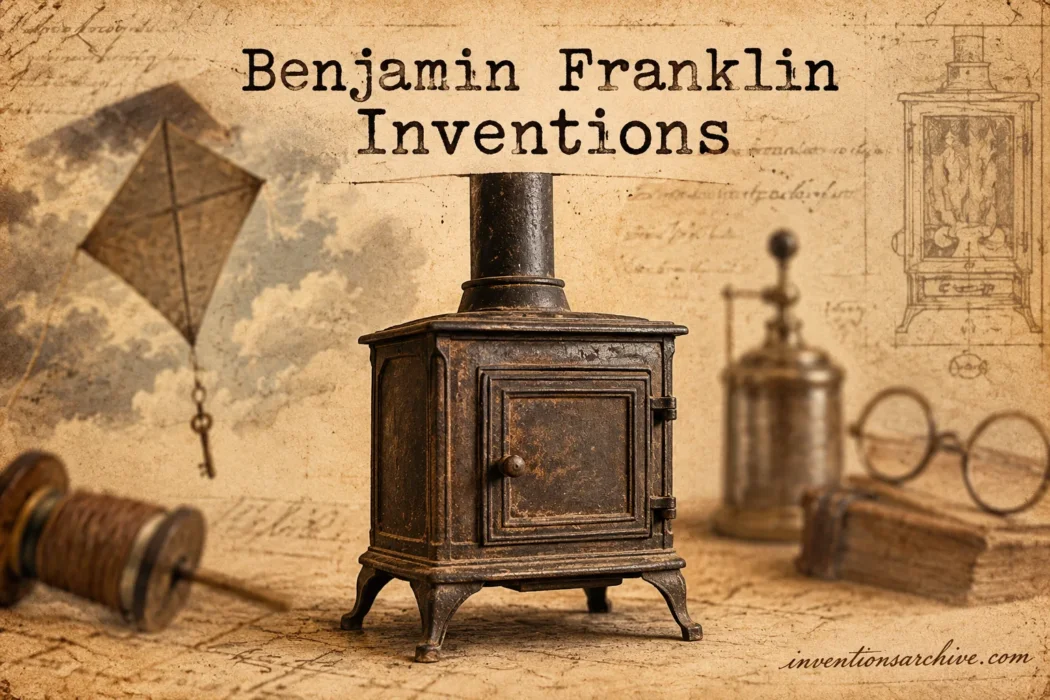
| Invention Name | Benjamin Franklin’s Inventions and Improvements |
|---|---|
| Short Definition | A group of devices and redesigns associated with Franklin, including the Pennsylvania Fireplace, lightning rod, glass armonica, bifocals, swimming paddles, and several practical improvements. |
| Approximate Date or Period | c. 1717–1780s; major documented inventive work concentrated in the 1740s–1760s |
| Geography | Primarily Philadelphia and London, within the wider eighteenth-century Atlantic scientific community |
| Inventor or Source Culture | Benjamin Franklin; colonial American and European Enlightenment-era science, craft, and instrument making |
| Category | Heating, electrical safety, optics, musical instruments, swimming aids, measurement, household design, and medical-device redesign |
| Importance | Converted observations and everyday problems into practical devices, several of which influenced technologies still used in related forms. |
| Evidence Status | Mixed evidence by device Strong documentary evidence survives for several designs; other attributions require qualification. |
| Main Problem Solved | Varied by invention: inefficient heating, lightning damage, inconvenient spectacles, cumbersome musical glasses, difficult swimming, distance measurement, poor lamp ventilation, and inflexible medical instruments. |
| Development Path | Existing device, observation, or physical effect → Franklin redesign or experiment → practical application → later refinement by others |
| Surviving Evidence | Franklin’s correspondence, printed technical descriptions, electrical publications, institutional collections, contemporary accounts, and surviving Franklin-associated objects |
Benjamin Franklin did invent several devices, but the familiar claim that every object associated with him was entirely his invention is too broad. The strongest cases include the Pennsylvania Fireplace, the lightning rod, the glass armonica, early swimming paddles, and the optical arrangement usually called bifocals. Other objects require more careful wording: he designed a flexible catheter for his brother, adapted an odometer to postal work, improved street lamps, and owned a transforming library chair that may have been his design.
The distinction matters because Franklin often worked by examining something that already existed and changing the part that caused trouble. Musical glasses existed before the armonica. Odometers existed long before Franklin. Catheters were ancient medical instruments. Street lighting was already established. His contribution in those cases was redesign rather than invention of the entire underlying technology.
Which Inventions Can Be Credited to Franklin?
| Device or Idea | Franklin’s Role | Evidence Status | Best Historical Description |
|---|---|---|---|
| Pennsylvania Fireplace / Franklin stove | Designed a new fireplace and heating arrangement | Confirmed | Franklin invention |
| Lightning rod | Proposed and developed practical lightning protection using grounded conductors | Confirmed | Franklin invention arising from his electrical research |
| Glass armonica | Reorganized musical glasses into a mechanically playable instrument | Confirmed | Franklin invention based on an earlier sound-making technique |
| Swimming paddles | Made hand paddles and experimented with foot-mounted swimming aids as a boy | Based on surviving evidence | Early Franklin swimming aids |
| Bifocals | Combined portions of distance and reading lenses in the same spectacles | Widely credited | Strongly attributed to Franklin; exact first-use date remains less certain |
| Flexible catheter | Designed a flexible silver catheter for his brother | Attribution varies | Documented Franklin design, but not securely the world’s first flexible catheter |
| Carriage odometer | Adapted distance-measuring equipment for postal route work | Confirmed improvement | Franklin postal adaptation, not invention of the odometer |
| Improved street lamp | Reworked lamp ventilation and pane construction | Confirmed improvement | Improvement to an existing street-lighting form |
| Library chair with steps | Owned the transforming chair; Franklin authorship is possible rather than certain | Attribution varies | Franklin-associated object, possibly designed by him |
| Daylight saving time | Proposed earlier waking in a satirical essay, not seasonal clock changes | Not a Franklin invention | Later misattribution |
The Pennsylvania Fireplace Was More Than a Metal Stove
Franklin’s heating invention is often reduced to the phrase “Franklin stove,” which can create the impression that he simply produced an early version of the later freestanding cast-iron stove. His own name for the design was the Pennsylvania Fireplace, and its purpose was to correct several weaknesses of conventional open fireplaces.
Open fireplaces sent much of their heat up the chimney with the exhaust. They could also produce drafts and smoke while consuming large quantities of firewood. Franklin designed a system of iron plates and internal passages that separated warmed room air from the smoke path and extracted more useful heat before combustion gases left through the chimney.
The design is commonly dated to about 1742, while Franklin’s detailed printed explanation, An Account of the New Invented Pennsylvanian Fire-Places, appeared in 1744. The Library of Congress preserves the publication and describes its partitioned iron plates, controlled airflow, reduced heat loss, and lower wood consumption.[a]
The original Pennsylvania Fireplace should therefore be distinguished from every later appliance sold under the loose name “Franklin stove.” Later manufacturers altered the layout, flue arrangement, and operating characteristics. Franklin’s contribution belongs to the earlier stage in which fireplace airflow and heat transfer were deliberately redesigned as parts of one heating system.
The Lightning Rod Came From Franklin’s Electrical Research Before the Kite Story
The lightning rod is among the clearest examples of Franklin turning experimental science into a practical device. During the late 1740s he studied static electricity, electrical charge, pointed conductors, and the possibility that lightning was an electrical phenomenon. His letters on electricity, published in London in 1751, included the proposal that a tall grounded metal rod could draw electrical charge from a storm and could be used to protect structures.[a]
This chronology matters because popular retellings often imply that Franklin first flew a kite, discovered electricity, and then invented the lightning rod. The sequence was more complicated. The grounded-rod experiment and the protective idea were already present in his electrical work before the famous 1752 kite episode.
French experimenters working from Franklin’s published proposal successfully drew electrical sparks from an elevated metal rod in May 1752. Franklin’s reported kite experiment followed soon afterward. Modern National Park Service material also notes a documentary problem: Franklin did not publicly identify himself as the person who conducted the kite experiment when he published his account months later, which has left room for historical doubt about details of the familiar story.[c]
None of that removes Franklin’s role in lightning protection. His electrical research connected pointed conductors, atmospheric electricity, grounding, and building protection in a practical system. The important invention was not “discovering electricity”; electrical phenomena had been studied long before him. Franklin’s contribution was experimental explanation followed by a workable method of reducing lightning-related fire damage.
The Glass Armonica Turned Musical Glasses Into a New Instrument
Franklin did not invent the fact that wet fingers can make glass resonate. Musicians were already performing on sets of drinking glasses, usually changing pitch by varying the glass or the amount of water it contained. Franklin encountered such performances in Britain and saw a mechanical problem: a large arrangement of separate glasses was awkward for rapid passages and chords.
His glass armonica, completed in 1761, reorganized the idea. Glass bowls of graduated sizes were tuned to different notes and mounted concentrically on a horizontal spindle. The spindle rotated while the player touched the rims with moistened fingers. Because many glass edges were positioned close together, both hands could move between notes more easily than on a table full of separate glasses.[b]
The inventive step was therefore architectural rather than acoustic. Franklin retained the known friction-on-glass sound principle but changed the physical arrangement into a purpose-built keyboard-like playing system. The result was an instrument in its own right, rather than a collection of household glasses pressed into musical service.
The distinction is useful when assessing Franklin generally: an invention does not always require discovery of a new physical effect. It can emerge when an existing effect is reorganized into a device capable of doing something more efficiently or with greater control.
Bifocals Solved Franklin’s Own Problem of Switching Spectacles
Franklin needed optical correction for different viewing distances and found it inconvenient to keep changing spectacles. His solution was to combine portions of two different lenses within the same frame. The upper part could be used for more distant objects while the lower portion served close work such as reading.
A particularly strong piece of evidence survives in a letter Franklin sent to George Whatley on May 23, 1785. The letter includes a drawing of divided spectacle lenses and explains how he had portions of two kinds of glass placed in the same frame. The Library of Congress preserves the manuscript and credits Franklin with the invention of bifocal glasses.[a]
The date of that surviving drawing should not automatically be treated as the date on which the device was first conceived. Franklin was already discussing his “double spectacles” in earlier correspondence. Historical research into competing bifocal claims has examined possible predecessors, but a detailed study of the early evidence concluded that the documentary record strongly supports Franklin’s authorship.[i]
The safest historical description is therefore that Franklin is strongly credited with bifocals, while the precise year in which he first began using them is less securely fixed than the attribution itself.
Franklin’s First Inventions Appeared in the Water
Franklin’s interest in devices began long before his electrical and heating work. The National Park Service records his account of making swimming aids at about age eleven, around 1717. These were not modern rubber or polymer swim fins.
He made two oval hand paddles resembling a painter’s palette, with openings that helped secure them to his hands. By increasing the surface pushing against the water, the paddles gave each arm stroke more effect. Franklin also experimented with sandal-like devices for his feet, although he was less satisfied with them.[c]
Calling these simply “swim fins” can blur the design. The better-documented and more technically understandable objects were hand paddles, conceptually closer to modern swimming training paddles. His foot attachments belong to the same experiment but were a separate part of the attempt.
Franklin also experimented with using a kite to let the wind pull him across water. That was an experiment in assisted movement rather than an ancestor of a modern motorized watercraft. The common thread was his effort to reduce the work required for movement by enlarging the force applied either to water or wind.
The Flexible Catheter Shows Why “Invented By Franklin” Needs Qualification
In 1752 Franklin’s older brother John was suffering from bladder stone and had difficulty with the rigid catheters then available to him. Franklin responded as he often did to a practical problem: he considered how the device itself could be changed.
His correspondence documents a flexible catheter made by a silversmith. The metal instrument used connected sections so that it could bend rather than behaving as a single rigid tube. This was a genuine Franklin design made for a specific medical need.
It is much less safe to call it the first flexible catheter ever invented. Historical commentary associated with The Papers of Benjamin Franklin notes that a flexible catheter may have been devised by Francesco Roncelli-Pardino around 1720, or possibly even earlier. Franklin’s letter proves that he conceived and commissioned his own flexible form; it does not establish global priority.[e]
The episode is still important to Franklin’s inventive record because it reveals his working method unusually clearly: identify the source of discomfort, change the mechanical form, have a skilled craftsperson manufacture it, and test whether greater flexibility solves the problem. It is a documented design contribution even when the “first inventor” label is removed.
Franklin’s Postal Odometer Was an Adaptation, Not the Invention of Distance Measurement
Odometers existed centuries before Franklin. What Franklin is associated with is a carriage-mounted odometer used in postal work, where measuring route distances had direct administrative value.
The device linked wheel movement to accumulated distance, allowing road mileage to be recorded more systematically than by rough estimation. Library of Congress research material describes Franklin devising an odometer attached to a carriage in connection with efforts to make postal routes more efficient.[f]
It is therefore misleading to say simply that “Benjamin Franklin invented the odometer.” His place in this history is better described as the adaptation or development of a carriage odometer for postal measurement.
This is a recurring pattern in lists of Franklin inventions. A useful device he modified becomes, over time, a device he is said to have originated. Separating the two produces a more accurate picture of what he actually did.
His Street Lamp Redesign Addressed Smoke, Airflow, and Repair
Franklin also examined the street lamps used in Philadelphia and found weaknesses in the globe-shaped lamps then imported from London. Their enclosed form restricted air movement. Smoke could circulate inside the glass, darkening it and reducing the light. A broken globe could also make the whole glass enclosure unusable.
In his autobiography Franklin described a different form made from four flat panes, with openings below to admit air and a long upper funnel that encouraged smoke to rise out of the lamp. The arrangement helped the glass remain cleaner. If the lamp was struck, a single flat pane could often be replaced instead of losing an entire globe.[h]
This is an example of an improvement rather than a claim to have invented street lighting. Franklin changed ventilation, maintenance, and construction while preserving the lamp’s basic purpose.
The Library Chair Is Associated With Franklin, but Its Designer Is Not Certain
A mahogany and leather library chair preserved by the American Philosophical Society has long been connected with Franklin. Its seat can lift to reveal a small set of steps, allowing the furniture to change from a chair into a means of reaching high shelves.
The object unquestionably belonged to Franklin. The stronger claim that he designed it is less secure. The American Philosophical Society describes the chair as one that “may have been designed by him”, which is a materially different level of evidence from the surviving technical publications for the Pennsylvania Fireplace or the documentary record for his spectacles.[d]
That makes the chair useful evidence for another reason: ownership, association, and invention are separate historical claims. A museum object linked to a famous inventor does not automatically prove that the owner conceived its mechanism.
A mechanical extension device for reaching high books, usually called Franklin’s “long arm,” has firmer institutional attribution and appears in the National Park Service chronology of his inventions. The same chronology also records other smaller mechanical projects, showing that Franklin continued devising tools for everyday use into the 1780s.[j]
Franklin Did Not Invent Electricity
Electricity is perhaps the most persistent category error attached to Franklin. Electrical effects and experiments predated him by centuries. Eighteenth-century researchers were already using electrostatic machines and Leyden jars when Franklin entered the field.
His work mattered because he developed electrical explanations, experimental methods, terminology, and practical applications. His writings helped establish the concepts of positive and negative electrical states; his experiments investigated charge storage and atmospheric electricity; his lightning work connected electrical theory with building protection.
The kite episode should therefore not be described as “the discovery of electricity.” Even the question of whether Franklin personally performed the familiar kite experiment exactly as later accounts describe is treated cautiously by the National Park Service.[c] The lightning rod does not depend on the children’s-book version of that story for its historical importance.
Franklin Did Not Invent Daylight Saving Time
Another common attribution comes from Franklin’s 1784 essay An Economical Project. While living in Paris, he humorously calculated how much artificial lighting could be saved if people rose earlier and made greater use of morning sunlight.
He did not propose moving clocks forward by an hour in spring and backward in autumn. The Franklin Institute identifies the daylight-saving claim as a misconception: Franklin suggested changing people’s waking habits, not changing civil clock time.[g]
The distinction is straightforward. An argument for waking earlier when the sun is already shining is not the same system as modern daylight saving time.
Scientific Work Should Not Be Counted as an Invention Simply to Make the List Longer
Franklin’s work on the Gulf Stream, storms, ocean temperatures, electrical terminology, charge behavior, and atmospheric electricity is central to his history as a scientist. It does not follow that each observation was an “invention.”
The same applies to institutions he helped establish and administrative systems he improved. Founding organizations, reforming postal routes, charting a current, developing a scientific explanation, and inventing a physical device are different types of accomplishment. Combining them into one numbered list makes Franklin appear to have invented more objects, but it reduces historical precision.
His actual record does not need that inflation. The Pennsylvania Fireplace, lightning rod, glass armonica, bifocal arrangement, swimming aids, and documented redesigns already show unusually broad mechanical interests.
Why Franklin’s Inventions Often Had No Patent
Franklin deliberately chose not to build his inventive career around exclusive patent rights. Library of Congress research material notes that he did not patent his inventions and connects that decision to the principle he later expressed in his autobiography: because people benefit from the inventions of others, inventors should be willing to serve others with their own ideas “freely and generously.”[f]
The Pennsylvania Fireplace gives a concrete example. Franklin described being offered the opportunity to obtain exclusive rights in connection with the design and refusing. The decision should not be explained by claiming that patents were unavailable or that Franklin simply neglected to apply. His own account presents the refusal as deliberate.
This choice also affects the surviving record. Patent specifications often supply later historians with formal dates, technical drawings, claims, and named inventors. Franklin’s work instead has to be reconstructed from printed descriptions, letters, autobiographical passages, surviving instruments, contemporary reports, and institutional collections. Some inventions are therefore documented with unusual clarity while others remain tied to qualified attribution.
A Pattern Across Franklin’s Best-Documented Designs
Franklin’s inventions do not fall into one technological field. Their connection is the way he approached practical problems.
With the Pennsylvania Fireplace, he treated heat loss and airflow as a system that could be rearranged. With bifocals, the problem was the repeated exchange of spectacles, so two optical functions were placed in one frame. With the armonica, the sound principle already worked, but the physical layout of separate glasses was cumbersome. With the street lamp, smoke movement and repairability mattered more than creating a new source of light. With the catheter, rigidity was the problem, so flexibility became the design target.
The lightning rod followed a different path but the same practical tendency. Franklin began with experiments and a theory about atmospheric electricity, then asked how the behavior of electrical charge could reduce damage to real buildings.
That pattern explains why the most accurate list of Benjamin Franklin’s inventions contains a mixture of new devices, redesigned devices, scientific applications, and qualified attributions. Treating every item as an entirely original invention hides the part of Franklin’s work that the surviving evidence shows most clearly: he repeatedly studied how something behaved, identified the part that caused difficulty, and changed the design around that problem.
Sources and Verification
- [a] Scientist and Inventor – Benjamin Franklin: In His Own Words — Verifies Franklin’s 1744 Pennsylvania Fireplace publication, the 1785 bifocal drawing, his electrical writings, and the grounded-rod proposal. Reliable because the Library of Congress presentation is based on manuscripts and rare books in its collections.
- [b] Benjamin Franklin’s Glass Armonica — Verifies the 1761 completion date, the earlier musical-glass practice, and the arrangement of graduated glass bowls. Reliable because it is a collection-focused page from the Franklin Institute.
- [c] Benjamin Franklin and Science — Verifies Franklin’s childhood swimming aids and provides the National Park Service’s account of his electrical work and the documentary uncertainty surrounding the kite experiment. Reliable because it is an official National Park Service historical resource.
- [d] Early America — Verifies the provenance and qualified design attribution of Franklin’s library chair with folding steps. Reliable because the American Philosophical Society owns and interprets the historical object.
- [e] Benjamin Franklin’s Place in the History of Medicine — Verifies Franklin’s 1752 catheter correspondence and the historical note that flexible-catheter designs may predate him. Reliable because the discussion is a specialist medical-history study built around documented Franklin correspondence.
- [f] Franklin and Science – Benjamin Franklin: Man of Business and Science — Verifies Franklin’s carriage odometer, his refusal to patent inventions, and the reasoning recorded in his autobiography. Reliable because it is a Library of Congress research guide drawing on Franklin material in institutional collections.
- [g] Did Ben Franklin Invent Daylight Saving Time? — Verifies that Franklin’s 1784 essay proposed altered waking habits rather than seasonal clock changes. Reliable because it is a Franklin Institute educational resource focused directly on the attribution.
- [h] The Autobiography of Benjamin Franklin — Provides Franklin’s own account of replacing globe lamps with four flat panes, lower air openings, and an upper funnel to improve ventilation and repairability. Reliable because the Library of Congress provides the digitized historical text.
- [i] The Invention and Early Manufacture of Bifocals — Reviews competing historical claims and the documentary evidence supporting Franklin’s bifocal attribution. Reliable because it is a historical study indexed by the U.S. National Library of Medicine’s PubMed database.
- [j] Benjamin Franklin’s Resume — Verifies the National Park Service chronology of Franklin-associated practical devices, including street-lamp improvements and the long arm for reaching high books. Reliable because it is an official Independence National Historical Park resource.