
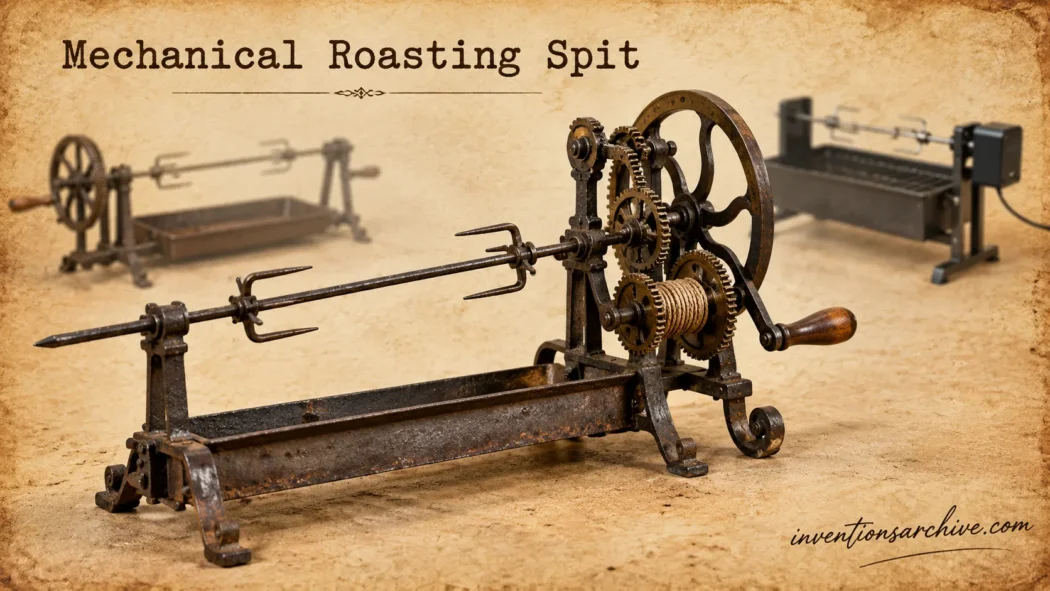
| Invention Name | Mechanical Roasting Spit / Roasting Jack / Spit Jack |
|---|---|
| Short Definition | A mechanism that automatically rotates meat at an open hearth instead of requiring continuous hand-turning. |
| Approximate Date or Period | Late 16th century onward for established weight-driven jacks; documented examples and records survive from the 17th century. |
| Geography | Western Europe, with especially strong surviving evidence from England. |
| Inventor or Source Culture | Attribution varies No single inventor is established for the mechanical roasting jack as a technology. |
| Category | Kitchen technology; mechanical automation; food preparation. |
| Importance | Transferred a repetitive kitchen task from continuous human or animal effort to stored or captured mechanical energy. |
| Evidence Status | Based on surviving evidence Museum objects, household records, technical descriptions, and later patents document several related mechanisms. |
| Main Problem Solved | Maintaining slow, repeated rotation of meat in front of a one-sided radiant heat source. |
| How It Works | Energy from a falling weight, spring, or chimney draught is transmitted through mechanical components to rotate the spit. |
| Technical Basis | Drums, shafts, gears, pulleys, cords or chains, regulating devices, and later wound springs. |
| Main Forms | Weight jack, smoke jack, spring jack, and bottle jack. |
| Surviving Evidence | 17th- to 19th-century brass, iron, steel, and wooden examples survive in museum collections. |
| Modern Descendant | Motor-driven rotisserie systems. |
| Development Path | Manual and animal-powered turning overlapped with weight-driven jacks; spring and bottle jacks followed, with electric motors later supplying rotary power. |
A roasting spit is the rod that carries food near a fire. A roasting jack is the mechanism that turns that rod, or in later forms rotates food suspended from a hook. Keeping those two objects separate matters because spits are far older than the machinery developed to drive them.
The mechanical roasting spit therefore has no convincing single-inventor story. Its history is a series of attempts to automate one repetitive action: keeping meat moving slowly and predictably in front of an open fire. Falling weights, chimney draught and wound springs all solved that problem in different ways.
Why an Open-Hearth Spit Needed Constant Motion
Open-fire roasting presented a simple mechanical problem. Most of the radiant heat reached the side of the food facing the fire. Leaving a large joint stationary would expose one surface much more intensely than the other. Rotation repeatedly moved each surface toward and away from the heat.
Before a powered jack, someone had to provide that rotation. Medieval and early modern kitchens used hand-turned spits, and larger households could assign the work to a dedicated turnspit. The task could continue for a long cooking period. Reading Museum also documents the use of dogs running inside wheels connected to roasting equipment.
The machine did not create spit roasting. It replaced the continuous supply of muscular effort with a mechanism able to release energy gradually.
The Weight Jack Turned Gravity into Kitchen Motion
The weight-driven jack became one of the defining mechanical forms of the roasting spit. University of Reading collection records describe weight jacks as developing in the late 16th century for slowly turning meat and poultry over open fires.
The principle resembled that of a weight-driven clock. A suspended mass provided stored gravitational energy. As it descended, a cord or chain turned a drum. The drum’s movement passed through the mechanism to a driving wheel, which was connected to the roasting spit.
Reading Museum describes an early arrangement in which the falling weight rotated a drum, the drum drove a simple clockwork movement, and a pulley transferred motion through a chain to a wheel on the end of the spit. This arrangement separated the cook from the repetitive turning action: the operator supplied energy periodically by raising the weight rather than supplying rotary motion continuously.
Drum, Gears, Pulley and Spit Wheel
The individual layouts varied, but surviving jacks reveal a recurring mechanical chain. The descending weight turned a drum or spindle. Gearing controlled how that movement reached the output. A pulley or driving wheel transferred rotation to the spit through a cord or chain.
Some later weight jacks included a fly or other regulating arrangement associated with the gear train. An 18th-century Sussex jack in the University of Reading collection, for example, contains a drum, cog wheels and a vertical spindle for a fly. Such features helped make the release of mechanical energy suitable for the slow motion required at the hearth.
The exact running time and turning rate were not universal properties of the invention. They depended on the particular jack, the available fall of the weight, its gearing, resistance in the mechanism and the load being turned.
The Evidence Points to Gradual Development, Not a Single Invention Date
Dating the mechanical roasting spit to one year would give a false impression of how it developed. University of Reading catalog records place the development of weight-driven jacks in the late 16th century. Reading Museum’s historical material describes spit jacks as appearing around 1600 and records an early written reference in a 1612 inventory from an inn at Bishopsgate in London.
A surviving 17th-century jack in the University of Reading collection gives physical evidence for the technology during that century. The object is made from brass and iron, carries the name P. Pearson, and came from Somerset. Its museum description identifies it as a weight-driven device whose gears turned an upper wheel connected with spit rotation.
This type of evidence supports a period of development rather than a named moment of invention. Household equipment could circulate before examples entered dated inventories, while surviving museum objects represent only a fraction of what once existed.
Why the Mechanism Was Described as Clockwork
A roasting jack could use mechanical ideas familiar from clockmaking without functioning as a timekeeper. Weight-driven clocks and weight-driven roasting jacks both needed to transform the slow release of stored energy into controlled mechanical movement.
The resemblance appears in their drums, gear trains, winding arrangements and regulating components. A roasting jack, however, delivered motion to cooking equipment rather than clock hands.
This distinction also explains why the term clockwork roasting jack should not be read as meaning that the appliance contained an ordinary clock. The Science Museum Group preserves a clockwork roasting jack made from brass, steel and tinplate, measuring 305 mm in height. Its compact mechanical construction reflects the close relationship between precision metal mechanisms and domestic machinery.
Several Power Systems Competed at the Hearth
Mechanical roasting did not develop along a single straight sequence. Manual, animal-powered, weight-driven, draught-driven and spring-powered systems overlapped. The most useful distinction between them is the source of energy used to produce rotation.
| System | Energy Source | Mechanical Arrangement | Practical Character |
|---|---|---|---|
| Hand-Turned Spit | Human muscle | Direct turning of the spit | Simple, but required continuing attention. |
| Turnspit Wheel | Human or animal effort | Wheel motion transmitted to the spit | Moved the operator away from direct hand-turning but still required living power. |
| Weight Jack | Raised weight | Drum, gear train, pulley, cord or chain | Provided mechanical operation until the available weight descent was used. |
| Smoke Jack | Rising chimney draught | Vanes, shaft, gearing and drive connection | Used airflow generated by the hearth, but worked best with a strong fire and chimney draught. |
| Spring Jack | Wound metal spring | Spring-powered clockwork | Removed the need for a long falling-weight path and allowed a more compact mechanism. |
| Bottle Jack | Wound spring | Compact hanging housing with a rotating lower hook | Well suited to suspended joints and domestic open-fire roasting. |
The Smoke Jack Drew Power from the Chimney
The smoke jack approached the same task from a different direction. Instead of storing energy in a raised weight, it placed vanes where rising hot air and chimney draught could make them rotate. That rotation passed through gearing and a chain or similar connection to the spit.
Reading Museum notes that Leonardo da Vinci illustrated a smoke jack in the late 1400s. That evidence is useful for the history of the concept, but it does not establish Leonardo as the inventor of mechanical spit turning as a whole. Weight jacks, smoke jacks and later spring systems belong to related but distinct branches of the technology.
The smoke jack also had a practical constraint. Reading Museum records that it required a large fire to work effectively, which made it more suitable to large kitchens than to ordinary households. Its energy source was convenient only where the hearth already produced enough draught to drive the vanes.
Joseph Merlin’s 1773 Spring Jack Removed the Falling Weight
Spring power changed the physical form of roasting machinery. A falling-weight jack needed vertical travel for the suspended mass. A wound spring could store energy inside a much smaller housing.
The Science Museum Group preserves Joseph Merlin’s 1770s trade card advertising his roasting machinery. Its collection record states that Merlin received British patent 1032 in January 1773 for a spring jack with a reflector intended to increase heat at the roast.
Reading Museum records that spring roasting jacks recognizable as bottle jacks had appeared by about 1790. Their name came from the tall, compact shape of the housing rather than from any connection with opening bottles.
This represented a useful change in domestic arrangement. Instead of a horizontal spit necessarily being driven from one end, a bottle jack could hang above the food. The wound mechanism inside the housing rotated a hook beneath it, and the joint turned while suspended in front of the fire.
Why Bottle Jacks Could Turn in Both Directions
Surviving bottle jacks show that rotation did not always continue endlessly in one direction. Reading Museum describes joints turning first one way and then the other. Smithsonian examples preserve the same mechanical behavior.
A John Linwood bottle jack in the Smithsonian’s National Museum of American History contains a spring-powered mechanism wound with a key. Its lower suspension hook rotates clockwise and counterclockwise. The museum dates the object to approximately 1810–1850 and identifies Birmingham as its place of manufacture.
Alternating motion was well suited to suspended roasting equipment because the food could rotate back and forth without requiring an indefinitely twisting suspension arrangement. It also shows that the engineering problem had shifted: later makers were no longer simply trying to make a horizontal rod rotate. They were adapting clockwork to a compact hanging appliance.
The Materials Reveal Different Generations of the Machine
Roasting jacks were exposed to a difficult environment. Heat, smoke, grease and soot surrounded machinery that depended on moving surfaces. Reading Museum notes that early spit jacks made by blacksmiths could be difficult to keep in working order.
Surviving objects show makers combining materials according to mechanical role. The University of Reading’s 17th-century P. Pearson jack is made from brass and iron. Another English weight jack in the collection combines wrought iron, brass and wood, with wrought-iron structural and drive components and wooden elements in the mechanism.
By the period of compact spring jacks, metal housings and spring steels became more prominent. The Smithsonian’s Linwood bottle jack uses brass for its housing, iron for hooks and hardware, and steel for the spring and other clockwork parts. A Science Museum clockwork jack combines brass, steel and tinplate.
The mixture was functional. Frames and shafts needed strength; gears and plates benefited from precise metalworking; springs required resilient metal; wooden drums and pulleys could still serve where their mechanical role allowed it.
Surviving Jacks Show What Written Descriptions Cannot
Museum objects make the mechanical evolution easier to see because their structure survives independently of later illustrations and retellings.
The 17th-Century P. Pearson Weight Jack
The University of Reading holds a brass-and-iron jack identified as a 17th-century object from Somerset and stamped with the name P. Pearson. Its visible gears and upper driving wheel place the transmission system in the open, unlike later bottle jacks whose workings are largely concealed inside a cylindrical housing.
The object is also useful for dating. It confirms that developed mechanical spit-turning equipment existed in 17th-century England, while the museum’s other weight-jack records place the technology’s development earlier, in the late 1500s.
An 18th-Century Sussex Weight Jack
A different University of Reading example from Sussex shows how the weight-jack form became mechanically elaborate. Its wrought-iron frame encloses a cord drum and cog wheels, while gearing leads to a vertical spindle for a fly. The drum and pulleys incorporate wood.
This was still recognizably a gravity-powered machine, but it used a structured gear train to control and transmit motion rather than simply allowing a suspended mass to pull directly on a spit.
The 19th-Century Bottle Jack
The Smithsonian’s John Linwood jack presents a very different silhouette. The spring and clockwork sit inside a cylindrical brass housing. A hanging loop is located above the mechanism, while the rotating hook projects beneath it. The museum records the object at approximately 38.1 cm high.
What had once been a relatively exposed hearth-side gear system had become a self-contained hanging appliance.
A Mechanical Jack Still Needed the Rest of the Hearth System
The jack supplied movement, but it did not perform every part of roasting. The meat still had to be positioned relative to the fire, dripping fat still had to be managed, and the heat reaching the food depended on the hearth arrangement.
Later open-fire systems could combine a bottle jack with a reflective metal enclosure sometimes called a hastener or Dutch oven. Science Museum Group records preserve a 19th-century arrangement consisting of a sheet-metal Dutch oven, a brass spring-driven bottle jack and a basting spoon. The bright interior reflected heat toward meat suspended in front of the fire.
This distinction matters when tracing the invention. A roasting jack automated rotation. Reflectors, dripping pans, hooks and other hearth equipment solved separate problems involving heat direction, positioning and fat management.
Why Mechanical Jacks Did Not Immediately Eliminate Older Methods
A working mechanical solution did not make every earlier method disappear. Weight jacks required winding, suitable mounting space and maintenance. Smoke jacks depended on a sufficiently strong fire and chimney draught. Spring mechanisms had to be wound and eventually serviced.
Cost also mattered. A large household with servants, an inn, a country house and a modest domestic kitchen operated under different constraints. This helps explain why hand-turning, animal-powered systems and different mechanical jacks could exist during overlapping periods rather than appearing as a clean sequence of replacement technologies.
The hearth itself imposed another limitation. These machines belonged to a cooking system based on an open fire and food positioned in front of it. Once enclosed ranges, ovens and other cooking appliances reduced dependence on the open hearth, the traditional roasting jack lost much of the environment for which it had been designed.
What Changed from Weight Jack to Bottle Jack
| Stage | Mechanical Form | What Changed |
|---|---|---|
| Manual Roasting | Hand-turned horizontal spit | The cook or turnspit supplied rotation directly. |
| Animal or Wheel Drive | Wheel linked to roasting equipment | Rotary effort could be supplied away from the spit itself. |
| Late 16th–17th Century Weight Jack | Falling weight, drum, gears and drive wheel | Stored gravitational energy replaced continuous muscular effort. |
| Smoke Jack | Chimney-driven vanes and gearing | Hearth draught itself became the energy input. |
| Late 18th-Century Spring Jack | Wound spring and compact clockwork | Energy storage moved inside the mechanism and no long weight drop was required. |
| Bottle Jack | Hanging spring mechanism with rotating hook | Compact vertical roasting arrangements became practical. |
| Motorized Rotisserie | Electric gearmotor driving a spit | An electric motor replaced weights, draught and wound springs while preserving controlled rotary cooking. |
The Lasting Mechanical Idea Was Controlled Repetition
The roasting jack belongs to a wider history of household mechanization because it converted a repeated bodily action into machine motion. Its engineering problem was narrow and clearly defined: provide enough rotary force, deliver it slowly, and keep doing so while the roast remained in front of the fire.
The weight jack answered that problem with stored gravitational energy and gearing. The smoke jack used moving air in the chimney. The spring jack stored energy inside a wound mechanism. Modern rotisseries use an electric motor, but the functional task remains recognizable: controlled rotation relative to a heat source.
That continuity also explains why the mechanical roasting spit is better treated as a family of related inventions than as a single object born on one date. The spit itself was old. The inventive work lay in finding different ways to make it turn without requiring a person to stand beside it and keep turning it by hand.
Sources and Verification
- University of Reading — Weight Jack, Object 51/512 — Museum collection record documenting late-16th-century development of the weight jack and its weight-clock operating principle.
- University of Reading — 17th-Century Spit Jack, Object 59/257 — Collection record for the P. Pearson brass-and-iron jack from Somerset and its weight-driven gearing.
- Reading Museum Service — Victorian Kitchen: Roasting — Museum educational material documenting hand turning, turnspit dogs, the early-17th-century weight-jack record, smoke jacks, Joseph Merlin’s spring jack and bottle-jack operation.
- Science Museum Group — Trade Card of Joseph Merlin — Collection record documenting Merlin’s roasting-machine advertisement and British patent 1032 of January 1773 for a spring jack with reflector.
- Smithsonian National Museum of American History — Bottle Jack — Object record describing John Linwood’s spring-powered Birmingham bottle jack, its materials, date range and clockwise-counterclockwise rotation.
- Science Museum Group — Clockwork Roasting Jack — Museum record for a surviving brass, steel and tinplate clockwork jack and its physical dimensions.
- Science Museum Group — Dutch Oven with Basting Spoon and Cylindrical Clockwork Jack — Collection record showing how a spring-driven bottle jack worked as part of a wider 19th-century open-fire roasting arrangement.