
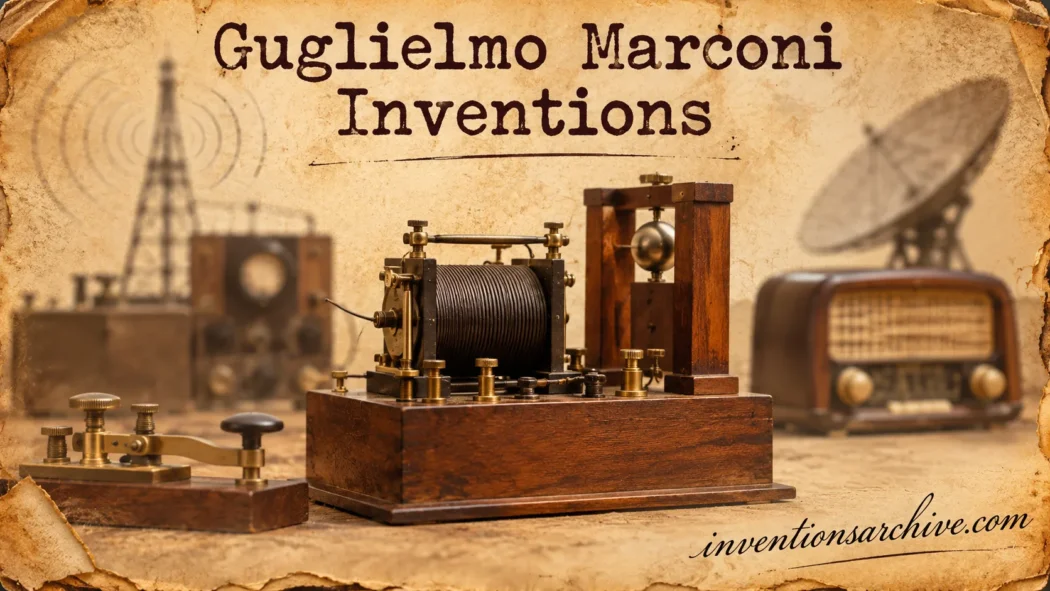
| Invention or Development | Date | Technical Contribution | Historical Status |
|---|---|---|---|
| Practical Wireless Telegraphy System | 1895–1897 | Combined a spark transmitter, elevated and grounded antenna arrangements, a coherer receiver, and telegraph signaling into a workable communication system. | Confirmed British Patent No. 12039, applied for in 1896 and granted in 1897. |
| Syntonic Wireless Telegraphy | 1900–1901 | Improved frequency selectivity through coupled, electrically tuned transmitting and receiving circuits. | Confirmed British Patent No. 7777; related priority claims were disputed. |
| Magnetic Radio Detector | 1902 | Detected wireless signals through changes in magnetization, allowing Morse signals to be heard through headphones without a coherer tapper. | Confirmed Patented apparatus; surviving museum examples. |
| Horizontal Directional Aerial | 1905 | Developed antenna arrangements that favored radio transmission and reception in selected directions. | Confirmed Patented directional antenna improvement. |
| Timed-Spark Transmission System | 1912 | Improved the generation and control of radio-frequency oscillations beyond the limitations of conventional spark transmitters. | Confirmed Patented transmitter development. |
| Shortwave Beam Communication System | 1923–1926 | Applied short wavelengths and directional antenna systems to long-distance commercial communication. | Confirmed Collaborative engineering, notably involving Charles Samuel Franklin. |
| Microwave Radiotelephone Link | 1932 | Used highly directional microwave transmission for voice communication between Vatican City and Castel Gandolfo. | Confirmed Documented operational installation. |
| Microwave Radio Navigation Beacon | 1934 | Used directional microwave signals to help a ship determine its course toward a coastal navigation point. | Confirmed Documented experimental demonstration at Sestri Levante. |
Guglielmo Marconi (1874–1937) was an Italian inventor whose work transformed wireless telegraphy from experimental electrical apparatus into a practical communication technology. His inventions addressed several distinct engineering problems: extending transmission range, making weak radio signals detectable, separating competing transmissions, improving transmitter performance, and directing radio energy toward distant receiving stations.
Marconi is frequently called the inventor of radio, although electromagnetic waves, coherer detectors, and electrical resonance had been investigated before his earliest patents. His documented inventions were particular apparatus arrangements and improvements developed from that earlier scientific work. They also formed part of a growing industry involving engineers, equipment manufacturers, coastal stations, and shipboard operators.
Born in Bologna on April 25, 1874, Marconi began experimenting with wireless signaling at his family’s estate near the city. He later established his principal commercial operations in Britain and shared the 1909 Nobel Prize in Physics with Karl Ferdinand Braun for their contributions to wireless telegraphy. His research continued into shortwave and microwave communication during the 1930s. [a]
1. Marconi’s Practical Wireless Telegraphy System (1895–1897)
Marconi’s first major invention was a practical arrangement for transmitting and receiving coded messages using electromagnetic waves. The apparatus was developed during experiments at Villa Griffone in Pontecchio, near Bologna, beginning in 1894.
At that time, electrical telegraph networks depended on physical wires. Submarine cables connected continents, but a moving ship could not maintain a continuous cable connection to shore. Wireless telegraphy offered a way to transmit messages across water and between locations where installing a direct electrical line was impractical.
The Components Marconi Combined
His early apparatus brought together several technologies that had previously been investigated in scientific laboratories:
- Spark-gap transmitter: Produced brief bursts of electromagnetic radiation through rapidly changing electrical currents.
- Telegraph key: Controlled the transmission of short and long signals representing Morse-code characters.
- Elevated antenna: Allowed radio-frequency energy to be radiated and received more effectively than with many short-range laboratory arrangements.
- Earth connection: Formed part of the antenna system and helped improve practical signaling performance.
- Coherer detector: Responded to incoming radio-frequency energy through a change in electrical resistance.
- Relay and recording mechanism: Converted the detector’s response into an indication that an operator could recognize.
The spark oscillator was related to experimental apparatus developed by Heinrich Hertz and Augusto Righi. The coherer drew on earlier work by Édouard Branly and others, including Oliver Lodge. Marconi’s contribution lay in developing and integrating particular arrangements of these components for communication over useful distances.
The Grounded Antenna Arrangement
One of Marconi’s most effective early improvements involved using elevated conducting wires together with an earth connection.
He experimented with changes in antenna elevation and the electrical arrangement of the transmitting and receiving equipment. These modifications increased the distance over which recognizable signals could be exchanged.
By 1895, Marconi had demonstrated wireless signaling over approximately 2–2.5 kilometers, including trials in which an intervening hill separated the stations. The experiments showed that wireless telegraphy could operate outside a laboratory and was not restricted to apparatus placed within direct visual range.
The exact distance varied among experiments. Surviving historical accounts describe the initial range as approximately one and a half miles.
British Patent No. 12039
Marconi traveled to Britain in 1896 and introduced his equipment to officials of the General Post Office, including William Preece, its Engineer-in-Chief.
His principal early British patent, No. 12039, was filed on June 2, 1896, and granted on July 2, 1897. Its title was Improvements in Transmitting Electrical Impulses and Signals, and in Apparatus Therefor.
The specification described methods for transmitting electrical signals by electromagnetic waves and detecting them at a receiving station. It included transmitter arrangements, receiving conductors, a metal-filings detector, and electrical mechanisms for operating signaling instruments.
Patent No. 12039 documents Marconi’s claimed technical arrangement, rather than establishing that every component was originally conceived by him. The filing and grant dates are recorded separately in the historical patent record. [b]
Demonstrations followed on Salisbury Plain, across the Bristol Channel, and at coastal locations. In July 1897, Marconi established the Wireless Telegraph and Signal Company, later known as Marconi’s Wireless Telegraph Company.
The equipment had progressed from privately constructed experimental apparatus into a technology that could be manufactured, installed, operated, and maintained for customers.
2. The Syntonic Wireless System and Patent No. 7777 (1900)
Marconi’s next major patented development addressed interference between wireless stations.
Early spark transmitters produced damped oscillations spread across a comparatively broad frequency range. As additional stations began operating, a receiving apparatus could respond to unwanted signals from transmitters other than the one it was intended to monitor.
The problem became especially relevant when ships and coastal installations operated within overlapping communication ranges.
How Marconi’s Tuning System Worked
Electrical resonance allows a circuit to respond particularly strongly to oscillations near its natural frequency. Radio engineers could use this property to distinguish one transmission from another.
Marconi developed a system using coupled and adjustable electrical circuits at both the sending and receiving stations.
Instead of treating the antenna and oscillator as one undifferentiated electrical arrangement, the system employed coupled circuits whose electrical properties could be adjusted. Inductance and capacitance influenced their resonant behavior.
Matching the transmitting and receiving arrangements improved the ability to detect the intended signal while reducing responses to some unwanted transmissions.
This was an important step toward managing several wireless stations within the same region. The degree of selectivity remained limited by the wide frequency spectrum of spark-generated signals and by the performance of contemporary receivers.
The Four Sevens Patent
On April 26, 1900, Marconi filed British Patent No. 7777, titled Improvements in Apparatus for Wireless Telegraphy. The patent was granted and published on April 13, 1901.
Commonly called the Four Sevens patent, it described improvements involving transformers, adjustable inductances, condensers, and the relationship between antenna and oscillating circuits.
The surviving specification includes arrangements for both transmitting and receiving apparatus. It refers to earlier patents and explains how its proposed circuit combinations modify preceding equipment. [c]
Marconi’s syntonic system was part of a wider development of electrical tuning. Oliver Lodge, Nikola Tesla, John Stone Stone, and other researchers had investigated resonant circuits and wireless signaling arrangements. Consequently, the history of tuned radio cannot be assigned exclusively to Patent No. 7777.
Nevertheless, the patent documents a specific stage in Marconi’s effort to make wireless equipment more selective and commercially useful.
3. The Magnetic Detector (1902)
Marconi’s magnetic detector was a distinct receiving apparatus developed to improve the detection of wireless telegraph signals.
His earliest receivers relied on coherers, which commonly contained small metal particles. When a radio signal was received, the electrical resistance of the particles decreased, allowing a local signaling circuit to operate.
After receiving a signal, the coherer generally needed a mechanical tap to restore it to a condition suitable for detecting the next signal. This resetting operation complicated the receiver and limited its performance.
How the Magnetic Detector Detected Radio Signals
The magnetic detector employed a moving band of soft iron, permanent magnets, and electrical windings.
A clockwork mechanism moved the iron through a magnetic field. A winding connected to the antenna carried the received radio-frequency signal, which influenced the magnetic condition of the moving iron.
Changes in magnetization induced an electrical response in another winding connected to headphones. Telegraph signals became audible as clicks, allowing an operator to interpret Morse code directly.
The apparatus did not rely on the metal-filings coherer and its associated mechanical tapper. It offered improved sensitivity and dependable operation for many contemporary wireless installations.
Patent and Surviving Examples
Marconi first patented his magnetic detector in 1902. Production began at the Marconi company’s Chelmsford works in 1903.
The Science Museum Group preserves a magnetic wireless detector identified as serial number 763. Its early serial number places its manufacture between approximately 1903 and 1907.
The museum describes the magnetic detector as a standard receiving instrument for spark telegraph signals aboard ships and at shore stations between 1903 and 1918. It was gradually replaced by crystal detectors and later thermionic valve receivers. [d]
Unlike experimental systems known principally through patent drawings, the magnetic detector survives as manufactured equipment. These instruments provide direct physical evidence of Marconi’s contribution to radio reception.
4. The Horizontal Directional Aerial (1905)
Early wireless stations frequently used antennas that radiated energy over broad areas. For some applications, especially long-distance communication between fixed locations, directing more of the transmitted energy toward the intended receiving station offered practical advantages.
In 1905, Marconi patented a horizontal directional aerial arrangement designed to improve radio signaling in selected directions.
The principle involved the relationship between antenna geometry and the direction in which radio signals could be transmitted or received most effectively.
Why Directional Transmission Mattered
A directional antenna changes the spatial distribution of radiated or received energy. The antenna’s geometry and electrical characteristics influence which directions are favored.
For a fixed communication path, directional behavior can improve signal strength at the intended station and reduce reception from some unwanted directions.
Marconi’s horizontal directional aerial contributed to his long-distance communication experiments. It preceded the more advanced shortwave beam systems developed during the following decades.
The Smithsonian Institution’s George H. Clark Radioana Collection identifies British Patent No. 14788 of 1905 with Marconi’s horizontal directional antenna. The collection includes extensive historical documentation concerning the development of radio engineering and the early wireless industry. [e]
This invention should be distinguished from later radio direction-finding equipment. A transmitter designed to favor one direction and a receiver designed to determine the bearing of an incoming signal solve related but different engineering problems.
5. Timed-Spark and Improved Radio Transmitters (1912)
Marconi continued investigating radio transmitters after developing his initial spark-gap apparatus.
Conventional spark transmitters generated brief trains of damped electrical oscillations. Their frequency spectrum was relatively broad, making it difficult to confine a transmission to a narrow radio channel.
Other engineers were also working on transmitter designs capable of producing more regular or sustained oscillations. Marconi contributed to this development through improvements in spark-discharge technology.
Marconi’s Timed-Spark System
In 1912, Marconi patented a timed-spark arrangement intended to generate more sustained radio-frequency oscillations than those produced by ordinary spark transmitters.
The system involved controlling the timing of electrical discharges so that oscillations could be maintained more effectively. This belonged to a broader series of improvements in the control of spark-generated radio signals.
Marconi had previously investigated improved dischargers, including arrangements employing rapidly moving metal surfaces. His transmitter research sought to overcome the losses and irregularities associated with early spark technology.
The timed-spark patent is documented in Marconi’s Nobel biographical record, which distinguishes it from his earlier magnetic detector and directional aerial patents.
Timed-spark technology did not become the final solution to stable radio transmission. Continuous-wave generators and later electronic oscillators offered better frequency control and gradually displaced spark systems.
6. Shortwave Beam Wireless Communication (1923–1926)
During the 1920s, Marconi returned to experiments involving relatively short radio wavelengths. Long-distance wireless services had originally relied heavily on large transmitting stations and wavelengths substantially longer than those later used for shortwave communication.
Shortwave signals could travel considerable distances under suitable atmospheric conditions. Directional antenna systems also offered a way to concentrate transmitted energy along a chosen communication path.
Experiments Aboard the Elettra
Marconi used his yacht Elettra as a research platform for wireless experiments. In 1923, trials were conducted between the Poldhu station in Cornwall and receiving equipment aboard the yacht as it traveled through the Atlantic and Mediterranean.
The experiments investigated the behavior of shortwave signals over considerable distances and the effectiveness of directional transmission.
Marconi collaborated with engineers including Charles Samuel Franklin, whose work on directional aerial systems contributed to the technical development of shortwave beam communication.
These installations were collaborative engineering developments. Their achievements should not be attributed entirely to Marconi without recognizing the engineers responsible for individual apparatus designs.
Commercial Beam Stations
In 1926, a commercial shortwave beam service opened between Britain and Canada. Additional international beam connections followed.
The installations used directional antennas and equipment designed for efficient communication over long distances. They provided an alternative to some of the large, expensive long-wave stations used in earlier transoceanic services.
Shortwave operation introduced its own difficulties, including changing atmospheric propagation conditions and variations in signal reliability. Engineers therefore needed to consider frequency selection, station location, antenna orientation, and operating schedules.
Marconi’s development of directional shortwave communication was a continuation of his earlier attempts to improve the practical reach and efficiency of wireless systems.
7. The Microwave Radiotelephone Link (1932)
Marconi’s later research moved beyond the wavelengths used for conventional long-distance wireless telegraphy.
In 1931, he began investigating the propagation of much shorter electromagnetic waves. This research led to the installation of a microwave radiotelephone connection between Vatican City and Castel Gandolfo in 1932.
The link connected Vatican City with the papal summer residence approximately 20 kilometers away. It demonstrated a practical application of directional microwave transmission for carrying speech.
How the Microwave System Differed From Early Wireless Telegraphy
Marconi’s first radio systems transmitted Morse-code signals by switching a spark transmitter on and off. The later microwave installation transmitted voice information using more advanced radio equipment.
Microwave wavelengths allowed the use of relatively compact directional antennas. However, they also introduced different propagation characteristics, with communication depending strongly on antenna alignment and the path between stations.
At the relatively short distances involved, a directional microwave link offered a way to establish communication without a physical cable between the two locations.
The Vatican’s historical account of the Apostolic Palace at Castel Gandolfo records Marconi’s 1932 microwave radiotelephone connection between the residence and Vatican City. [f]
The installation belongs to Marconi’s later research program rather than the original invention of wireless telegraphy. It shows how his work expanded from coded messages into different forms of radio transmission.
8. The Microwave Navigation Beacon (1934)
Another late Marconi development concerned the use of directional microwave signals to assist ships approaching a harbor.
In 1934, Marconi demonstrated a microwave radio navigation beacon at Sestri Levante, on the Italian coast near Genoa.
The experimental system used a shore-based transmitter and receiving apparatus aboard the Elettra. It was designed to help a navigator identify the appropriate approach direction even when visibility was poor.
Directional Signals as Navigation Guidance
A radio navigation beacon provides information about position or direction through a transmitted signal. Depending on the system, the receiver may use signal strength, directional characteristics, or differently identified radio fields to determine a course.
Marconi’s demonstrated arrangement used directional microwave transmission to provide guidance to a ship approaching a designated route.
This differed from ordinary wireless telegraphy. The radio signal was being used to establish directional information rather than carry a conventional written message.
The experiment represented an application of microwave engineering to maritime navigation. It also reflected growing interest in radio systems capable of assisting vessels under conditions that limited visual navigation.
The development was separate from radar, which detects objects by receiving radio energy reflected from them. Marconi had discussed the possible detection of distant objects through radio-wave reflection in 1922, but operational radar emerged through the subsequent work of multiple research groups.
What Marconi Invented and What He Demonstrated
Marconi’s name is attached to several famous radio milestones, but an experimental achievement is not necessarily a separate invention.
The distinction matters when evaluating his contributions. A new detector or circuit arrangement involves a technical design, while sending a signal farther than before demonstrates the capabilities of existing or modified equipment.
| Achievement | Date | Classification | What Was Established |
|---|---|---|---|
| Wireless signaling apparatus | 1895–1897 | Invention and patented system | Practical arrangement for transmitting coded wireless messages. |
| English Channel signaling | 1899 | Demonstration | Wireless communication across a substantial body of water. |
| Syntonic circuit system | 1900–1901 | Patented improvement | Greater selectivity through tuned electrical circuits. |
| Atlantic signal reception at Newfoundland | 1901 | Experimental claim | Reported reception of a predetermined Morse signal across the Atlantic. |
| Magnetic detector | 1902 | Invention | A new practical method of detecting radio signals. |
| Commercial transatlantic wireless service | 1907 | Commercial application | Regular paid wireless messaging between continents. |
| Shortwave beam network | 1926 | Collaborative system development | Commercial use of directional shortwave radio connections. |
| Microwave navigation beacon | 1934 | Experimental system | Radio-based directional guidance for maritime navigation. |
The English Channel Experiment of 1899
On March 27, 1899, Marconi established wireless communication across the English Channel between Wimereux in France and South Foreland in England.
The experiment demonstrated the effectiveness of his improving equipment over a distance that made wireless communication relevant to coastal services and ships.
It did not represent the invention of an entirely new category of radio apparatus. Instead, it demonstrated the expanding operating range of a wireless telegraph system already under development.
The Transatlantic Experiment of 1901
On December 12, 1901, Marconi reported receiving a wireless signal transmitted from Poldhu in Cornwall to Signal Hill at St. John’s, Newfoundland.
The signal consisted of the Morse-code letter S, represented by three short signals, transmitted repeatedly from England. The distance was approximately 3,500 kilometers.
The receiver used an elevated wire supported by a kite. Marconi and his assistant George Kemp reported hearing the expected signal through an earphone.
The original experiment has remained historically debated because the faint reception was not preserved as an independent instrumental recording. The possibility of confusing atmospheric disturbances with the expected three-dot signal has also been discussed.
The Oxford History of Science Museum’s Marconi exhibition describes both the reported reception and the difficulty of demonstrating it convincingly to observers. Stronger evidence for long-distance wireless operation came from subsequent tests, including transmissions received aboard the SS Philadelphia in 1902. [g]
The broader achievement of transatlantic wireless communication is well established. The precise interpretation of the original December 1901 reception deserves more care than a simple claim that a complete message had been transmitted across the ocean.
The Commercial Service of 1907
In October 1907, the Marconi company opened a regular transatlantic wireless telegraph service between Clifden in Ireland and Glace Bay in Nova Scotia.
Establishing the service required reliable large-scale installations, operators, power supplies, antennas, and procedures for handling paid messages.
It demonstrated that wireless telegraphy had become a working communication industry rather than a series of isolated experiments.
Marconi’s Inventions in Maritime Communication
Marconi’s commercial system became especially valuable aboard ships, where physical telegraph connections were impossible during voyages.
Wireless apparatus allowed vessels to contact coastal stations, exchange navigational and commercial messages, and request assistance when emergencies occurred.
The company often leased equipment to ship operators and supplied its own trained wireless personnel. These arrangements helped it control installation quality and commercial operations, although restrictions on communication with competing networks also became a source of international disagreement.
The SS Republic Rescue of 1909
In January 1909, the liner SS Republic collided with the SS Florida near Nantucket.
Wireless distress signals helped alert other ships and organize rescue efforts. The incident demonstrated the safety value of equipment that had originally been developed for exchanging coded information over long distances.
Wireless Telegraphy During the Titanic Disaster
When RMS Titanic struck an iceberg in April 1912, its Marconi wireless equipment was operated by John Phillips and Harold Bride.
The operators transmitted distress calls using CQD and SOS. Their transmissions helped alert RMS Carpathia, which subsequently rescued survivors.
The disaster demonstrated both the capabilities and limitations of early maritime wireless systems. Radio could transmit distress information across substantial distances, but its usefulness depended on listening stations, trained operators, communication procedures, and the availability of receiving equipment.
The accident contributed to the development of more stringent maritime communication rules, including international distress procedures and requirements for radio watchkeeping.
Marconi did not invent the SOS signal. That distress signal was standardized through international radiotelegraph agreements, reflecting the growing need for communication procedures that worked across different manufacturers and national networks.
Marconi, Tesla, and the Invention of Radio
The question of who invented radio is complicated by the different technologies involved in wireless communication.
Long before Marconi’s commercial success, researchers had developed the scientific and technical foundations needed to produce, transmit, and detect electromagnetic waves.
- James Clerk Maxwell established the mathematical theory describing electromagnetic waves.
- Heinrich Hertz demonstrated the existence and behavior of electromagnetic waves experimentally.
- Édouard Branly developed important principles used in early coherer detectors.
- Oliver Lodge investigated electromagnetic waves, coherer arrangements, and resonant electrical systems.
- Alexander Popov developed receiving equipment incorporating elevated conductors and detector-resetting mechanisms.
- Nikola Tesla investigated high-frequency currents, resonant electrical circuits, and methods of wireless energy and signal transmission.
- Jagadish Chandra Bose conducted microwave experiments and developed techniques for detecting electromagnetic radiation.
- Karl Ferdinand Braun contributed to improved wireless transmitters and tuned electrical systems.
- John Stone Stone developed wireless circuit arrangements later considered in disputes involving Marconi’s patents.
Marconi’s distinctive achievement was the development and commercialization of particular working wireless telegraph systems. His patents are evidence for his claimed inventions, but patents must be evaluated in relation to earlier disclosures and the exact technical features being claimed.
The 1943 U.S. Supreme Court Patent Ruling
On June 21, 1943, the United States Supreme Court decided Marconi Wireless Telegraph Co. of America v. United States.
Among the patents considered was U.S. Patent No. 763,772, granted to Marconi on June 2, 1904. It concerned an arrangement of four high-frequency circuits capable of being adjusted into electrical resonance.
The Court examined earlier work by several researchers, particularly John Stone Stone and Oliver Lodge, as well as Nikola Tesla.
It held the broad claims of Marconi’s tuned-circuit patent invalid because the relevant technical arrangements had been anticipated by earlier disclosures.
The judgment did not declare Tesla the sole inventor of radio. It also did not invalidate every Marconi patent or reject the historical achievements of his wireless installations.
The original British wireless system patent of 1896–1897 and the later American tuned-circuit patent concerned different claimed improvements. Their distinct technical and legal histories should not be merged. [h]
Why Marconi’s Early Inventions Were Eventually Replaced
Several of Marconi’s inventions remained in service for many years, but radio technology changed rapidly as electronic components and signal-generation methods improved.
From Spark Transmitters to Continuous-Wave Radio
Spark-gap transmitters produced damped oscillations that occupied relatively wide frequency ranges. The resulting interference made them poorly suited to the growing number of radio stations.
Continuous-wave transmitters, high-frequency alternators, arc systems, and later thermionic oscillators provided methods for generating more stable radio-frequency signals.
These developments supported improved frequency control, efficient transmission, and wireless telephony.
From Magnetic Detectors to Electronic Receivers
Marconi’s magnetic detector reduced the operational difficulties associated with coherers, but it still depended on a moving mechanical element.
Crystal detectors provided alternative means of detecting wireless signals without the same mechanical arrangement. Thermionic valves later made electronic amplification and more sensitive receiving circuits practical.
Receivers gradually became smaller, more selective, and easier to operate.
From Wireless Telegraph Networks to Digital Radio
Marconi’s early stations transmitted information as Morse-code signals. Later radio systems introduced voice transmission, broadcasting, frequency modulation, electronic switching, and digital signal processing.
Modern cellular networks, Wi-Fi, satellite communication, and digital maritime systems operate using equipment fundamentally different from the original Marconi apparatus.
Several technical problems remain recognizable across these generations: generating a controllable radio signal, radiating it through an antenna, selecting the desired transmission, detecting information, managing interference, and maintaining communication over a required distance.
The surviving Marconi patents, magnetic detectors, antenna designs, and documented communication installations provide the clearest evidence of his inventive work. His achievements can be understood through the individual systems he developed, their technical limitations, and the subsequent inventions that replaced or extended them.
Sources and Verification
-
[a]
NobelPrize.org — Guglielmo Marconi: Biographical — Official Nobel biographical record documenting Marconi’s life, early experiments, principal inventions, 1909 Nobel recognition, shortwave research, and later microwave developments. -
[b]
British Patent GB189612039A — Digitized historical patent specification recording Marconi’s early wireless telegraph apparatus, the 1896 application, the 1897 grant, and the technical components described in the invention. -
[c]
British Patent GB190007777A — Improvements in Apparatus for Wireless Telegraphy — Original patent record documenting the syntonic wireless system, coupled electrical circuits, and the application and grant dates of Marconi’s Four Sevens patent. -
[d]
Science Museum Group — Marconi Magnetic Wireless Detector — Official museum collection record describing the apparatus, its patented development, manufacturing history, operating principle, and use in ship and shore receiving stations. -
[e]
Smithsonian Institution — George H. Clark Radioana Collection — Institutional archive of early radio engineering and industrial history, including historical documentation of Marconi’s 1905 horizontal directional antenna patent. -
[f]
The Apostolic Palace — Ville Pontificie di Castel Gandolfo — Official Vatican-associated historical account recording Marconi’s 1932 microwave radiotelephone connection between Castel Gandolfo and Vatican City. -
[g]
History of Science Museum, Oxford — Wireless World: Atlantic Crossing — Museum exhibition documentation describing the Poldhu and Newfoundland experiment, the original receiving arrangements, surviving instruments, and difficulties in verifying the 1901 reception. -
[h]
Marconi Wireless Telegraph Co. of America v. United States, 320 U.S. 1 (1943) — The U.S. Supreme Court’s published decision, reproduced by Cornell Law School, establishing the patents examined, relevant earlier technical disclosures, and the legal scope of the ruling.