
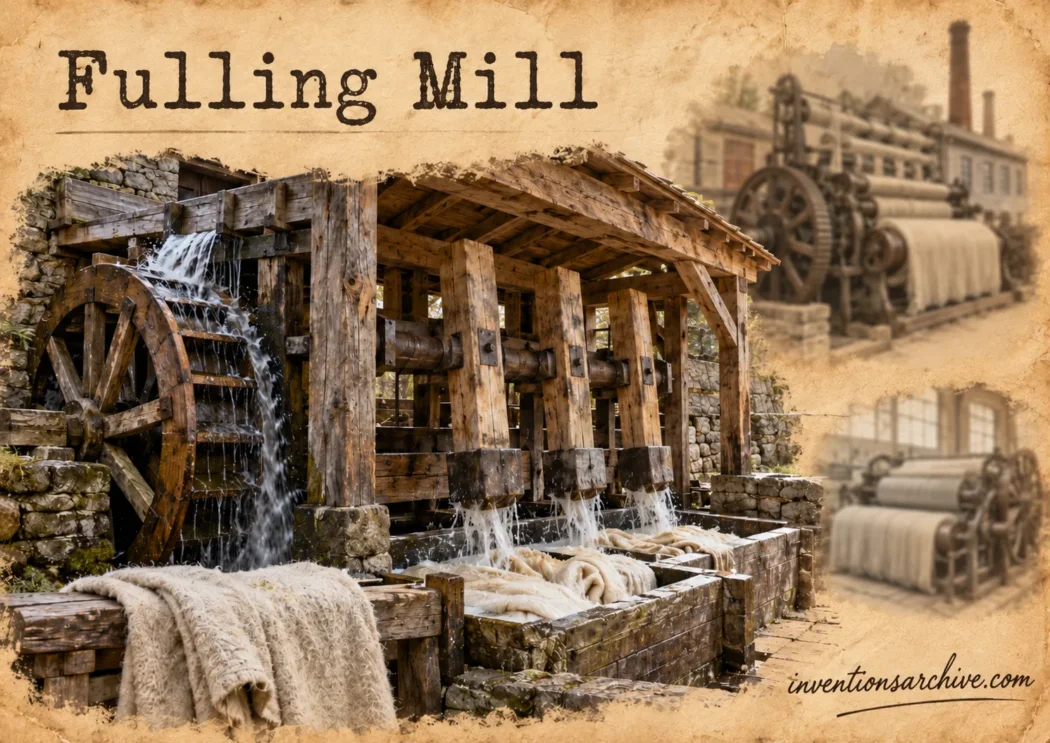
| Invention Name | Water-Powered Fulling Mill |
|---|---|
| Short Definition | A textile-finishing mill in which water power drives wooden stocks that repeatedly work wet woven wool cloth in a trough. |
| Approximate Date or Period | Based on surviving evidence Documented in Europe by the 10th century; proposed early Italian records include 962, 973, and 985. |
| Geography | Early documentary evidence in Italy; later widespread in western and northern European wool-producing regions. |
| Inventor or Source Culture | Attribution varies No known individual inventor; developed within medieval European watermill and textile traditions. |
| Category | Water-powered machinery; textile finishing |
| Importance | Mechanized a labor-intensive stage of wool finishing and adapted rotary water power to repeated hammer motion. |
| Evidence Status | Debated Early dates depend on the interpretation of documentary records; no single invention event is known. |
| Main Problem Solved | Reduced reliance on prolonged foot- or hand-powered pounding of woven wool during fulling. |
| Development Path | Manual fulling → cam-driven water-powered stocks → later mechanized milling and wool-finishing machinery. |
| How It Works | Waterwheel → rotating shaft → cams or tappets → lifting and release of fulling stocks → repeated working of cloth in a trough. |
| Technical Basis | Waterwheel, shaft, cams, timber stocks, trough, hydraulic channels, masonry or timber mill structure. |
| Early Use Context | Finishing woven woollen cloth after it left the loom. |
| Surviving Evidence | Medieval records, mill earthworks, wheel pits, water channels, later technical drawings, surviving mills, and preserved machinery. |
A fulling mill did not spin wool or weave cloth. It acted on fabric after weaving, when a length of woollen cloth still contained processing oils and had a relatively open structure. Fulling cleaned that fabric while controlled moisture, pressure, friction, and repeated mechanical action compacted its fibres.
The medieval machine replaced much of the physical force previously supplied by people trampling or pounding cloth in a tub. Its defining mechanical idea was the conversion of a waterwheel’s continuous rotation into repeated movement of heavy wooden stocks. That conversion made the fulling mill an early example of a watermill adapted for industrial work other than grinding grain.
Why Woven Wool Needed Fulling
Woollen cloth did not normally leave the loom in its final commercial condition. Oils and other processing aids helped fibres survive preparation, spinning, and weaving, while the woven structure itself could remain looser than the dense finished cloth desired for many garments and furnishings.
Fulling addressed both problems. Scouring removed grease, dirt, and processing residues. Milling subjected the wet fabric to controlled mechanical action so that the structure contracted and became denser.
The behaviour is closely connected to the physical structure of wool. Untreated wool fibres have overlapping surface scales. Under moisture and agitation, neighbouring fibres can move against one another and become progressively entangled. Modern wool science describes this as the basis of felting shrinkage. In a controlled finishing process, the same tendency can be used to consolidate a woven fabric rather than being treated as an unwanted laundry defect.
A simplified production sequence therefore looks like this:
Fibre preparation → spinning → weaving → fulling or milling → rinsing and drying → later surface finishing
This position in the production chain matters. A fulling mill was a finishing installation, not a complete medieval textile factory.
The Mechanical Idea: Turning a Waterwheel Into Repeated Blows
A grain mill could use a rotating waterwheel to turn millstones. Fulling demanded a different movement. Its working members had to strike or press wet cloth repeatedly and then withdraw so the cycle could begin again.
The cam supplied that transformation. Projections fixed to a rotating shaft, or to a tappet arrangement connected with it, engaged the fulling stocks as the shaft turned. Each cam raised or displaced a stock. Once the cam passed the contact point, the stock returned and acted on the cloth. Repetition of the cycle produced a regular sequence of blows without requiring a worker to provide the main motive force.
- Flowing or stored water turned the waterwheel.
- The wheel rotated its axle or a connected shaft.
- Cams or tappets on the rotating assembly engaged the wooden stocks.
- The stocks were raised or displaced from their resting position.
- After release, they returned against the cloth in the fulling trough.
- Continued wheel rotation repeated the sequence.
This mechanism is mechanically different from simple rotary milling. The wheel supplied continuous rotation; the cams translated that rotation into intermittent reciprocal action. Historical studies of medieval fulling machinery indicate that many installations retained much of the normal water-control system of other mills while replacing the grain-grinding equipment with cam-operated stocks and cloth troughs.
The Cloth Was Worked in Water, Not Struck Dry
The wooden stocks acted on wet cloth held in a trough or stock. Water softened the conditions under which the fabric was worked and formed part of the washing process. The mill therefore combined hydraulic power, mechanical agitation, and wet textile finishing.
Historical fullers used cleaning materials that differ from modern textile detergents. Fuller’s earth, an absorbent clay material, was used to assist the removal of oils. Historical evidence also records the use of stale urine, valued because ammonia produced under those conditions contributed to alkaline cleaning. These substances belonged to the scouring side of the operation rather than serving as the source of the mechanical fulling action.
The objective was controlled treatment rather than indiscriminate hammering. Fabric had to be worked evenly. Operators inspected it, rearranged folds when necessary, regulated the process, and judged when sufficient cleaning and consolidation had occurred.
Modern wool finishing retains the distinction between cleaning and consolidation. Industrial wool processing still uses scouring to remove oils and contamination, followed where appropriate by controlled milling that tightens the fabric structure. The medieval stock mill is obsolete as a normal production machine, but the textile process it mechanized did not disappear.
Why the Invention Cannot Be Reduced to the Year 1086
The history of the fulling mill is often simplified into a single medieval date, yet the surviving documentary evidence does not support such a neat invention story.
Economic historian John H. Munro’s study of industrial water power lists documented fulling mills in Abruzzo in 962, Parma in 973, and Verona in 985. He identifies Argentan in Normandy in 1086 as an early northern European example. The same study also notes that other historians have preferred later candidates, including a documented mill at Lodi near Milan in 1008.
The disagreement is useful rather than inconvenient. Medieval records may identify a mill by terminology whose technical meaning has to be interpreted, and evidence is distributed unevenly between regions. A surviving reference establishes that a technology existed by that date; it does not automatically identify the first machine ever built.
Why No Individual Inventor Is Known
The mill combined technologies that already had separate histories: the waterwheel, rotating axle, cam, hammer or stock, hydraulic channel, and the established craft of fulling wool. The innovation lay in combining these elements into a workable textile machine.
That form of development rarely leaves the documentary trail associated with later patented inventions. Medieval millwrights modified machines for particular sites, owners, water supplies, and trades. A fulling mill could emerge from practical adaptation rather than from a single inventor producing a named prototype.
This also explains why identifying the earliest documentary reference is not the same task as identifying an inventor. One concerns surviving evidence; the other would require proof of authorship that has not survived.
Water Served Twice: As Power and as Part of the Process
The mill’s dependence on water extended beyond the wheel. Water had to be managed as an energy supply and was also needed for wet cloth processing.
A typical water-powered site could include a diverted channel or leat, sluices controlling flow, a pond or other storage arrangement, a wheel pit, the waterwheel itself, and a tailrace carrying spent water away. The exact arrangement depended on terrain, stream flow, wheel type, and local engineering.
This hydraulic infrastructure is one reason fulling became tied to fixed locations. Manual fulling could be performed wherever workers, tubs, and water were available. A mechanized mill required a usable hydraulic site and investment in channels, structures, wheel equipment, and machinery.
Ousethorpe Shows What Can Survive When the Machinery Is Gone
A medieval fulling mill is recorded at Ousethorpe in Yorkshire in 1241. The wooden stocks and other working parts have not survived, but the site preserves a different form of evidence. Historic England records an overspill channel, a wheel-pit depression, an embanked tailrace, traces of a leat, and the remains of an artificial millpond.
The earthworks indicate that the wheel used a water fall of at least one metre. The case demonstrates why the archaeology of mills cannot depend on finding an intact medieval machine. Hydraulic earthworks, building foundations, documentary references, wheel pits, and channel systems can reveal the function and layout of a vanished installation.
Falling Stocks and Driving Stocks Did Not Move in the Same Way
Fulling machinery was not frozen into one universal design. Surviving descriptions and later illustrations show different arrangements of stocks, particularly forms usually described as falling stocks and driving or hanging stocks.
| Feature | Falling Stocks | Driving or Hanging Stocks |
|---|---|---|
| General Motion | More nearly vertical descent toward the cloth. | Pivoted movement producing a more angled or forward-directed action. |
| Drive Principle | Cams or tappets raise or displace the stock before release. | Cams or tappets act on a suspended or pivoted stock. |
| Interaction With Cloth | Produces a comparatively direct downward working action. | Some forms used shaped feet and trough geometry to help shift and turn the cloth while it was worked. |
| Historical Interpretation | Terminology and the exact division of scouring and milling duties vary between periods, regions, and surviving technical descriptions. | |
The distinction matters because successful fulling depended on even treatment. If the cloth remained folded in one position, some areas could receive more mechanical action than others. Designs that helped move the fabric inside the trough reduced that problem, although workers still had to supervise and rearrange cloth.
Why Fulling Was Mechanized Earlier Than Many Other Textile Tasks
Fulling was particularly well suited to water power because much of its physical work consisted of heavy, repetitive motion. Once a millwright could make a rotating shaft lift and release stocks, the water supply could provide the repeated force that human fullers had previously supplied with their feet or tools.
Spinning and weaving posed different mechanical problems. Both depended on controlled handling of fibres or threads, and their large-scale mechanization required other machine systems. Fulling could be mechanized while much of the surrounding textile production still took place through hand spinning, hand weaving, and distributed workshop labor.
The resulting mill therefore did not remove the need for skilled workers. It changed their task. The machine supplied the repeated physical action, while people managed cloth loading, water, cleaning materials, folds, treatment time, and the condition of the fabric.
This is also why describing every medieval fulling mill as a “factory” can be misleading. One mechanized finishing stage could operate in a fixed mill while spinning and weaving remained dispersed among households and specialist workshops.
The Mill Connected Textile Production to a Hydraulic Landscape
Mechanization changed where one part of cloth production could take place. A working fulling installation needed access to dependable water, an engineered route for that water, and enough fall or flow to drive its wheel. Valleys, streams, existing mill sites, and artificial channels therefore became part of textile infrastructure.
Existing grain-mill technology could sometimes be adapted. Studies of medieval machinery describe fulling mills that used familiar water-feed and drive arrangements but substituted cam-operated stocks and troughs for the gearing and stones associated with grain grinding.
This reuse of watermill engineering is an important part of the invention’s history. The waterwheel was becoming a general mechanical energy source capable of driving equipment whose required movement differed from the wheel’s own rotation.
Regional Names Record Different Textile Traditions
The technology acquired several names as it spread through European cloth-producing regions. English records use terms such as fulling mill, walk mill, and tuck mill. Scottish usage includes waulk mill, while Welsh fulling mills are known as pandy. Spanish historical studies use batán, and Italian sources use gualchiera, with the plural gualchiere.
The terms do not prove that every regional machine had an identical internal arrangement. They identify related traditions built around the same general task: using repeated mechanical action to scour, compact, and finish woollen cloth.
Gualchiere di Remole Preserves the Scale of Late-Medieval Fulling
The Gualchiere di Remole near Florence provides a rare surviving architectural example of fulling on a larger medieval scale. Research published by scholars from the University of Florence dates the complex to 1327, when it was built by the Albizzi family for wool fulling within the Florentine textile economy.
The site is especially useful because it preserves far more than a documentary mill name. Its architecture and hydraulic setting allow researchers to study how a substantial fulling installation related to the watercourse and to reconstruct the operation of its hydraulic stocks.
Recent investigation has added a modern layer to that evidence. A research program that began with terrestrial laser scanning in 2009 returned to the complex with drone-based photogrammetric recording in 2024. Comparing the surveys allowed researchers to document changes in the condition of the surviving structures and their hydraulic context. The study reports that the complex remains in an advanced state of decay despite its value as surviving industrial heritage.
Remole also illustrates the distance between the basic mechanical principle and the scale at which it could eventually be applied. A fulling mill might be a relatively small rural installation, while a major cloth-producing economy could support a much larger complex containing several water-powered working units.
What the Camshaft Added to Watermill Technology
The waterwheel alone explains only where the energy came from. The cam mechanism explains how that energy became useful for fulling.
A rotating wheel naturally supplies rotary motion. Fulling stocks require repeated displacement and return. By placing projecting cams on a shaft, millwrights could make each revolution trigger a sequence of mechanical events: engagement, lift, release, strike, and recovery.
The same broad principle later appeared in other water-powered machinery that required repeated rather than purely rotary work. Fulling therefore belongs to the history of mechanisms as well as the history of textiles. It demonstrates how a general energy source could be coupled to a motion-conversion system designed for a particular production task.
From Fulling Stocks to Controlled Wool Milling
Later textile engineering replaced the traditional stock mill with machinery capable of more controlled and continuous treatment. Rotary milling machines and other finishing systems reduced dependence on the large cam-operated wooden hammers associated with historic fulling mills.
The underlying textile objective survived. Modern woollen finishing still uses wet treatment to remove processing residues and, where the product requires it, to consolidate the fabric. The Woolmark Company describes present-day woollen finishing as a sequence that can include scouring, milling, rinsing, drying, and dry finishing. Milling is performed as controlled washing that allows the fabric structure to contract and develop the desired surface and handle.
Modern shrink-resistant wool also helps explain the physics that historical fullers deliberately exploited. Untreated wool carries microscopic overlapping scales. Moisture and mechanical agitation can cause fibres to migrate and interlock, producing irreversible felting shrinkage. Modern treatments often attempt to suppress that behaviour; historical fulling used controlled mechanical treatment to make it part of cloth manufacture.
The fulling mill therefore represents a particular stage in the history of machinery: a mature hand process was coupled to hydraulic energy, rotary motion was converted into repeated hammer action, and one demanding step of textile finishing became tied to purpose-built mechanical infrastructure. Its surviving records, hydraulic earthworks, machinery, and mill buildings show that mechanized textile production began long before the better-known spinning and weaving machines of the later industrial period.
Sources and Verification
- Industrial Energy from Water-Mills in the European Economy, 5th to 18th Centuries: the Limitations of Power — John H. Munro’s University of Toronto economic-history study provides the early Italian dates, the Argentan evidence, discussion of competing early datings, and the role of cams in converting waterwheel rotation into reciprocal motion.
- Ousethorpe medieval settlement, moat and mill 310m south of Ousethorpe Farm — Historic England’s official National Heritage List record verifies the 1241 fulling-mill reference and the surviving wheel pit, leat, millpond, overspill channel, and tailrace earthworks.
- SOURCE 3: Fulling — Museum Wales educational material documents manual fulling, fulling stocks, the cleansing role of the process, and historical use of fuller’s earth and urine.
- Los batanes hidráulicos de la cuenca del Guadalquivir a fines de la Edad Media. Explotación y equipamiento técnico — Ricardo Córdoba de la Llave’s peer-reviewed study in the CSIC journal Anuario de Estudios Medievales examines medieval hydraulic fulling machinery, including dams, channels, vertical waterwheels, camshafts, stocks, and troughs.
- Windermere Reflections on History – Fulling Mills: Community Archaeology Survey Report — Oxford Archaeology’s survey discusses the early mechanization of fulling, cam-driven stocks, later technical drawings, and the limitations of surviving medieval machinery.
- Finishing — The Woolmark Company’s technical processing material explains modern wool scouring and milling and how controlled wet finishing consolidates woollen fabric.
- Machine Washable Wool — Woolmark’s fibre-science explanation verifies how wool’s microscopic surface scales interlock under moisture and mechanical agitation, producing felting and shrinkage.
- The Gualchiere di Remole in Bagno a Ripoli (Firenze) — The University of Florence research team documents the 1327 Remole complex, its use for wool fulling, the 2009 laser-scanning campaign, the 2024 photogrammetric survey, and the current condition of the surviving site.