
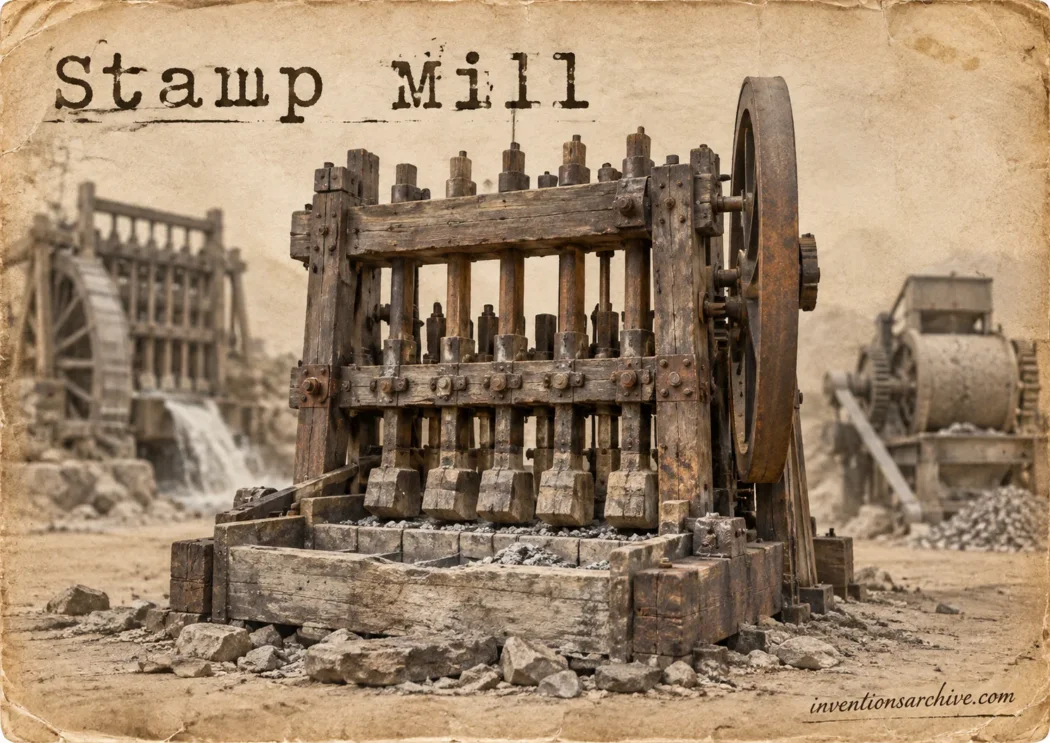
| Invention Name | Stamp Mill (also called a stamp battery or stamping mill) |
|---|---|
| Short Definition | A machine that repeatedly lifts and drops heavy stamps to crush mineral ore. |
| Approximate Date or Period | No single invention date; ancient evidence precedes detailed European documentation in the 16th century. |
| Geography | Early evidence in Roman mining regions; later documented across European and global hard-rock mining districts. |
| Inventor or Source Culture | Unknown; developed through cumulative mining and water-power engineering rather than one identifiable inventor. |
| Category | Mining machinery; ore processing; mechanical engineering |
| Importance | Mechanized repeated ore crushing and supported the expansion of hard-rock mining. |
| Evidence Status | Attribution varies Based on surviving evidence |
| Main Problem Solved | Reducing hard ore into smaller particles so valuable minerals could be exposed for later recovery. |
| Development Path | Manual pounding → powered ore stamps → water-driven stamp mills → Cornish systems → California stamp batteries → later crushing and grinding machinery |
| How It Works | A rotating shaft and cams lift vertical stamps; gravity supplies the crushing blow when each stamp drops. |
| Technical Basis | Rotary drive, cam-controlled lifting, repeated impact, replaceable crushing surfaces, and screened discharge. |
| Major Historical Documentation | Georgius Agricola’s De Re Metallica, first published in Latin in 1556. |
| Major Later Form | The standardized California stamp battery used in hard-rock gold milling. |
| Surviving Evidence | Archaeological crushing stones, historic mill remains, preserved machinery, photographs, and measured engineering drawings. |
A stamp mill crushed ore by repeating one mechanically controlled action: lift a heavy stamp and let it fall onto rock held below. The individual blow was simple. The invention lay in turning that blow into a continuous machine process. A rotating shaft, cams, vertical stamp stems, a mortar and a discharge system allowed the same impact cycle to continue with far less dependence on human hammering.
That distinction matters because ore crushing was an intermediate operation. A stamp mill did not create metal and, by itself, did not separate gold from waste rock. Its task was to break mineral-bearing rock finely enough to expose particles that later processes could recover.
Why Hard-Rock Mining Needed Repeated Mechanical Crushing
Loose placer gold could often be separated from sand and gravel through gravity-based washing. Hard-rock deposits presented another problem. Gold, silver, tin and other valuable minerals could occur inside quartz or other rock. Before miners could separate the valuable material, they first had to reduce the rock and expose the mineral grains.
Hand crushing with hammers, pestles and similar tools could perform that task on a small scale, but output depended directly on human labor. As mines produced larger quantities of hard ore, crushing could become a bottleneck between extraction underground and mineral recovery at the surface.
The stamp mill mechanized this repetitive stage. Rather than requiring a worker to deliver every blow, a prime mover supplied rotary motion. The mill then converted rotation into a sequence of vertical lifts and gravity-driven impacts.
The Stamp Mill Has No Secure Single Inventor
Assigning the stamp mill to one inventor and one date would hide the way the technology developed. Repeated pounding was far older than mechanized mining, while waterwheels, cam mechanisms and powered hammers appeared in several technical traditions. The mining stamp emerged when those ideas were applied to ore reduction.
Roman mining provides some of the oldest evidence considered in discussions of mechanized ore stamping. Archaeologists have studied mineral-processing remains at mining complexes such as Dolaucothi in Wales, including the Carreg Pumsaint stone with repeated depressions. The interpretation is not completely settled. Research at the site has strengthened the case for Roman ore-processing activity, but heritage records also note that the dating and exact relationship between the stone, a possible mill and the Roman deposits remain debated. [a] [b]
This uncertainty illustrates an important distinction in invention history. An archaeological object interpreted as part of a stamping system is evidence for technological use, not automatically proof of the first stamp mill. Surviving remains are incomplete, machines were rebuilt, and later mining often disturbed earlier workings.
Agricola Documented a Mature Stamping Technology in 1556
One of the clearest early technical descriptions comes from Georgius Agricola’s De Re Metallica, published in Latin in 1556. Agricola described mining and metallurgical machinery in enough detail to show that powered ore stamping was already an established technology rather than a new device appearing in his own workshop.
His descriptions include waterwheels connected to camshafts, stamps raised by cams, mortar boxes and systems for both dry and wet crushing. In wet operation, water entered the mortar while the stamps worked the ore. Agricola also described arrangements in which a waterwheel drove a shaft whose cams operated multiple stamps. [c]
Agricola therefore occupies a different place in the history of the machine from an inventor. His 1556 work is a documentation milestone: it preserves a detailed written and illustrated record of a technology that already had a history.
How the Camshaft Turned Rotation Into Repeated Impact
The defining mechanical conversion in a stamp mill is straightforward. A waterwheel, steam engine or later motor turns a shaft. Cams fixed to that shaft pass beneath projections attached to the vertical stamp stems. As a cam rotates upward, it raises a stamp. When contact ends, the stamp is released and falls under gravity.
The cycle can be expressed as a sequence of energy and motion:
rotary drive → cam engagement → vertical lift → release → gravitational impact → repeated crushing
This arrangement separates the drive from the individual blow. The prime mover does not need to reverse direction for every impact. It continues rotating while the cams convert that continuous motion into intermittent lifting.
The Stamp, Tappet, Shoe and Die
A developed stamp assembly used several parts with different jobs. The stem provided the vertical member. A tappet gave the cam a surface to engage. At the lower end, the stamp head carried a replaceable shoe. Beneath it, a fixed die formed the opposing crushing surface.
The shoe and die absorbed repeated contact with abrasive ore and therefore belonged to the parts most exposed to wear. Making the working surfaces replaceable allowed a mill to renew worn crushing faces without replacing the entire stamp mechanism.
The Mortar Controlled the Crushing Zone
The stamps worked inside a mortar rather than dropping onto exposed rock on an open floor. The mortar confined the ore near the impact surfaces and formed part of the path through which crushed material left the battery.
Later mortars could incorporate screens across an outlet. Rock that remained too coarse stayed in the working zone, while particles small enough to pass through the screen left the battery. The screen therefore performed a second function beyond simple containment: it helped determine when material could leave the crushing stage.
Why Several Stamps Worked as a Battery
A stamp mill did not have to consist of one falling weight. Grouping stamps into a battery allowed several units to share a drive system, mortar arrangement and structural frame. Large mills could then expand by repeating batteries rather than enlarging one stamp indefinitely.
The cams were arranged so the stamps did not all rise and fall at the same moment. Staggered operation spread the impacts through the machine cycle and maintained a more continuous crushing action. In mature California practice, five stamps became a common battery arrangement, and two batteries could be associated with the same general shafting system. The Historic American Engineering Record’s study of the Standard Gold Mill at Bodie documents this developed form in detail. [d]
The staggered sequence also shows why a stamp mill was more sophisticated than a row of powered hammers. Timing mattered. Shaft rotation, cam position, vertical movement, ore feed and discharge all had to function as parts of one repeated mechanical process.
Dry Stamping and Wet Stamping Changed the Material Flow
Historic stamp mills could crush ore dry or with water in the mortar. Agricola described both approaches, showing that the distinction was established by the 16th century.
| Process Feature | Dry Stamping | Wet Stamping |
|---|---|---|
| Material in the Mortar | Ore was crushed without a continuous water flow through the working material. | Water mixed with the crushed ore inside the mortar. |
| Discharge | Crushed material required dry handling or transfer after reduction. | Fine material could leave as a water-borne pulp or slurry. |
| Dust | Dry crushing could generate heavy mineral dust. | Water suppressed much of the airborne dust at the crushing stage. |
| Connection to Later Processing | Material could require another transfer step. | Slurry could flow directly toward screening, concentration or recovery equipment. |
Wet stamping was especially well suited to mills in which crushed ore needed to move continuously toward another treatment stage. Water became part of material transport as well as part of the crushing environment.
The Screen Made the Battery Partly Self-Classifying
The screen fitted to the mortar outlet created a simple form of size control. A particle that could not pass through remained in the mortar and received further impacts. Once reduced enough to pass the openings, it could leave with the discharge.
This feature helped transform stamping from a batch-like pounding operation into a continuous flow system. Ore entered, stamps repeatedly reduced it, and sufficiently fine material departed. The exact product still varied with ore characteristics and mill practice, but the principle linked comminution and classification inside the same machine stage.
From Cornish Stamps to the California Stamp
When hard-rock gold mining expanded in California during the 1850s, miners did not begin with an entirely new crushing concept. Stamp technology already had a long mining history, and Cornish practice was one of the important technical predecessors adopted in North American mining.
The Historic American Engineering Record notes that Cornish stamp mills typically grouped four stamps in a battery and used stamp stems that did not rotate freely. California mechanics altered that arrangement during the development of the local gold-milling industry.
Self-Rotating Stamps Reduced Uneven Wear
A stamp that always landed in exactly the same orientation tended to concentrate wear on the same parts of its crushing face. California designs used round, unkeyed stems and cam contact that caused the stamp to turn slightly during successive lifts. This distributed wear more evenly across the working surfaces.
The HAER history credits machinist Isaac Fisk, working with C. P. Stanford’s mill on the Cosumnes River, with the idea of introducing this rotation. The same study identifies self-rotation as the defining mechanical feature that distinguished the developed California stamp from its Cornish predecessor. [d]
Five-Stamp Batteries Became a Standard Industrial Module
California mill builders experimented with cam shapes, stamp arrangements, feeding systems, mortar design and other details. By the late 19th century, the five-stamp battery had become a familiar standardized unit in the region.
That modular form made capacity easier to scale. A mining company could operate several batteries in the same plant, all connected to common ore-handling and drive systems. The machine was therefore both an individual crushing mechanism and a repeatable unit within a larger industrial plant.
A Gold Stamp Mill Was a Processing Line, Not a Single Machine
By the mature California period, the term stamp mill could refer to an entire building and processing installation rather than only the stamps. Ore moved downward through successive machines and treatment stages, often taking advantage of gravity within a multi-level structure.
The Standard Gold Mill documentation at Bodie describes two distinct crushing stages in developed California practice: coarse reduction by a jaw crusher or similar machine, followed by finer crushing in stamp batteries. The crushed material then moved into gold-recovery operations. [d]
| Machine | Main Mechanical Action | Typical Role Relative to a Stamp Mill |
|---|---|---|
| Arrastra | Grinding by dragging heavy material around a circular bed | An older or simpler ore-grinding method used in some mining districts. |
| Jaw Crusher | Compression between opposing jaws | Could break larger rock before ore reached the stamp batteries. |
| Stamp Mill | Repeated vertical impact | Reduced ore further and exposed mineral particles for later treatment. |
| Ball or Tube Mill | Tumbling media produce impact and abrasion | Later grinding technology capable of finer and more continuous reduction in many processing circuits. |
This sequence explains why a jaw crusher should not automatically be described as a direct replacement for a stamp battery. In many historic plants, the two performed different size-reduction jobs within the same flow.
Mercury Amalgamation Was a Recovery Process After Crushing
Gold stamp mills are often associated with mercury because many historic operations combined stamping with amalgamation. The two processes should remain mechanically distinct.
In California practice, finely crushed gold-bearing pulp could encounter mercury inside the battery, on mercury-coated copper plates after leaving the mortar, or in later amalgamating equipment. Mercury formed an amalgam with free gold and allowed part of the metal to be collected from the crushed material. The HAER study of Bodie records several such arrangements and shows that mill operators changed their recovery circuits over time. [d]
Some ores did not respond well to simple amalgamation. Gold could be associated with sulfide minerals or occur in forms that made direct mercury recovery ineffective. This encouraged mining companies to preserve or reprocess tailings and helped drive adoption of other metallurgical processes.
Water, Steam and Electricity Could Drive the Same Basic Mechanism
Early documented stamp mills were closely associated with waterpower because a waterwheel supplied continuous rotary motion that could be transferred directly to a camshaft. The mechanical principle did not depend permanently on the waterwheel, however.
Steam engines later freed some mills from direct dependence on a suitable stream and allowed motive power to be supplied in mining districts where waterpower was inconvenient or unreliable. Electrical drive later changed the prime mover again. At Bodie, electrical power became part of the mine-and-mill system during the 1890s, while the stamp battery continued to perform the same basic task of repeated impact crushing. [d]
The useful continuity is mechanical: the source of rotation could change while the stamp principle remained recognizable.
The Mill Building Had to Function With the Machinery
A large stamp installation imposed repeated dynamic loads on its surroundings. Heavy stamps struck dies continuously, shafts turned above the batteries, ore moved through bins and chutes, and wet pulp left the mortars. The building therefore formed part of the operating system rather than serving as a simple weather enclosure.
Historic California mills used substantial foundations and framed structures to hold the stamps and shafting in alignment while absorbing repetitive vibration. Multi-level layouts also let gravity move ore through storage bins, preliminary crushing, stamp batteries and later treatment stages with less mechanical conveying.
The surviving Standard Gold Mill at Bodie is especially useful for understanding this relationship because the Historic American Engineering Record documented the site with photographs, written data and measured drawings. The Library of Congress describes the 1898–1899 structure as an intact example of the developed California stamp-mill form at the turn of the 20th century. [d]
Wear, Noise and Ore Feed Shaped Daily Mill Operation
Repeated impact made wear unavoidable. Shoes and dies were sacrificial working surfaces, while cams, tappets, guides, shafting and other moving components also needed maintenance. The machine’s productivity depended on keeping several interacting parts aligned while abrasive rock passed continuously through the batteries.
Ore feed presented another mechanical problem. Too little material could allow crushing surfaces to strike with inadequate ore between them. Excess material could interfere with effective stamp movement. Historic mills therefore developed mechanical feeding equipment to replace much of the judgment previously required from workers feeding batteries by hand.
Noise was one of the clearest human costs. Large groups of heavy stamps striking ore repeatedly created an intense working environment. Historical engineering accounts cited in the Bodie record describe hearing loss among stamp-mill workers, showing that the machine’s industrial efficiency came with occupational hazards that were poorly controlled by modern standards.
Stamp Batteries Allowed Mining Plants to Scale by Repetition
The battery arrangement made expansion relatively direct. Instead of inventing a completely different crusher for every increase in mine output, companies could install additional groups of stamps and enlarge the supporting ore-handling system.
California’s Empire Mine illustrates that industrial scale. The California Office of Historic Preservation records that new works erected there in 1865 included a 30-stamp mill. [e] Such installations show how a mechanism based on one falling stamp could be multiplied into a large processing plant.
The same modular character helped the technology travel. Stamp mills could be manufactured in mining-equipment centers, transported in sections and assembled in distant hard-rock districts. Local foundries could later repair, copy or modify the equipment.
Gold Rushes Spread Stamp-Mill Engineering Far Beyond California
The California stamp became one branch of an international exchange of mining machinery. Hard-rock gold districts compared equipment from Britain, Australia, North America and local manufacturers, adapting machines to the ore, available power and industrial supply networks of each region.
New Zealand provides a well-documented example. Archaeological research from the University of Otago describes the arrival of stamp mills after hard-rock mining began in Otago and Coromandel during the 1860s. Early improvised machines were followed by engineered mills imported from Melbourne, Britain and America, while a domestic manufacturing industry also developed. Surviving batteries now provide evidence for both technological transfer and local modification. [f]
This pattern is more useful than treating the stamp mill as a machine belonging to one gold rush. Its history consists of repeated adaptation: older European stamping practice influenced overseas mining, mining districts modified the machinery, and successful features entered later commercial designs.
Why Stamp Mills Eventually Lost Their Leading Position
Stamping remained useful for a long period because its mechanism was understandable, modular and compatible with several power sources. Its limitations became clearer as mineral-processing plants demanded greater throughput, finer grinding and tighter control over particle size.
Jaw and gyratory crushers improved coarse reduction, while ball, tube and rod mills offered other ways to grind material continuously. New chemical recovery methods also changed what mill operators required from the grinding stage. A plant designed around cyanidation, for example, might benefit from finer material than a traditional stamp-and-amalgamation circuit produced economically.
Bodie’s own history shows this transition occurring inside an existing stamp-mill system rather than through an instant replacement. During later processing changes, the Standard company used additional grinding equipment to treat material more finely for cyanide processing. The stamp battery remained part of the plant while newer machinery took over tasks for which it was better suited. [d]
What Surviving Stamp Mills Reveal About the Invention
Preserved stamp mills allow historians to study details that written descriptions alone can obscure: the relationship between camshaft and stamp, the spacing of batteries, the scale of timber framing, ore-bin placement, screen discharge and the way an entire mill building directed material from one stage to another.
Bodie preserves one of the strongest American examples because the surviving plant has been recorded as an engineering system rather than merely as an isolated machine. Empire Mine provides another California context for the growth of large stamp installations. Elsewhere, archaeological surveys of abandoned batteries document how the technology was adapted to different goldfields.
The evidence also discourages a simple invention story. Roman-period mining archaeology raises questions about very early mechanical ore crushing; medieval and Renaissance evidence shows powered stamping before the industrial age; Agricola recorded mature water-driven systems in 1556; Cornish practice supplied a later mining tradition; and California engineers altered stamp movement, battery organization and processing layouts for hard-rock gold production.
The Mechanical Idea That Endured
The lasting contribution of the stamp mill was the conversion of continuous rotary motion into automatically repeated impact for mineral processing. Once connected to a suitable drive, the camshaft could lift several stamps in sequence while gravity delivered each crushing stroke.
That mechanism supported a larger production logic. Ore could enter continuously, remain in the mortar while still coarse, leave through a screen after sufficient reduction and move directly toward later separation processes. Groups of stamps could be repeated as batteries, and batteries could be repeated as an industrial plant.
For that reason, the stamp mill belongs in the history of mechanized mining as a developed machine system rather than an oversized hammer. Its history links waterpower, cam mechanisms, replaceable wear surfaces, modular machinery and continuous material flow—ideas that remained central to mineral processing even after other crushers and grinding mills replaced the stamp itself.
Sources and Verification
- [a] Roman Mining at Dolaucothi: the Implications of the 1991–3 Excavations near the Carreg Pumsaint — Barry C. Burnham’s archaeological study in Britannia, published by Cambridge University Press, examines the Roman mining and ore-processing evidence at Dolaucothi.
- [b] MNA132271 | National Trust Heritage Records — The National Trust heritage record documents the proposed mill complex near Carreg Pumsaint and explains why the dating and interpretation of the possible stamping remains require caution.
- [c] The Project Gutenberg eBook of De Re Metallica, by Georgius Agricola — English translation of Agricola’s 1556 work, preserving his descriptions of waterwheels, camshafts, dry stamps, wet stamps and mortar arrangements.
- [d] Standard Gold Mill, East of Bodie Creek, Northeast of Bodie, Bodie, Mono County, CA — Historic American Engineering Record documentation held by the Library of Congress, including written history, photographs and measured drawings of a developed California stamp mill.
- [e] EMPIRE MINE — California Office of Historic Preservation landmark record confirming the Empire Mine’s history and the construction of a 30-stamp mill in 1865.
- [f] The Archaeology of the New Zealand Stamp Mill — University of Otago doctoral research examining stamp-mill engineering, importation, local manufacture, adaptation and surviving archaeological evidence in New Zealand goldfields.