
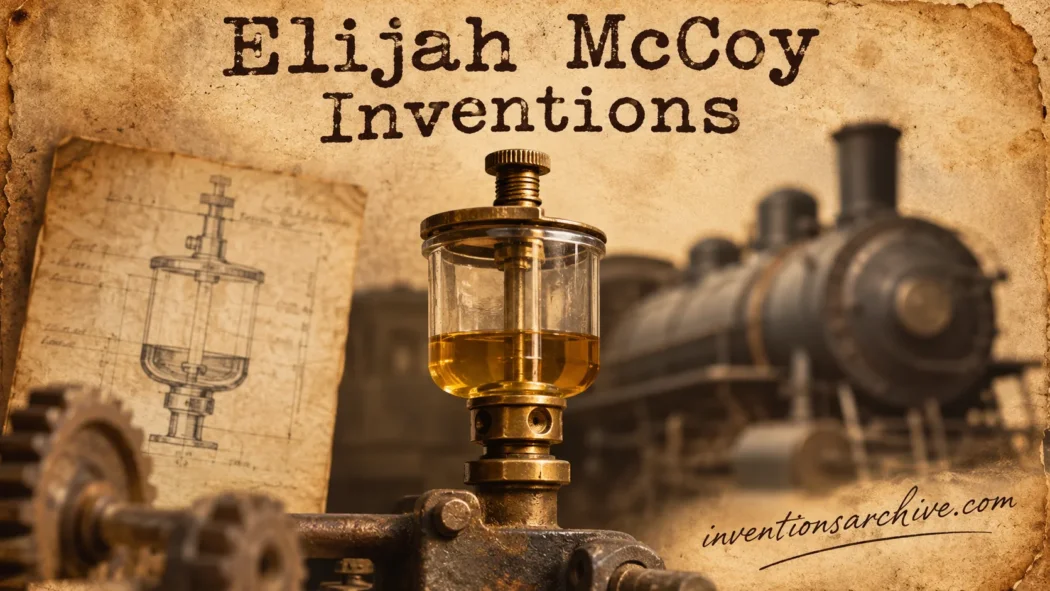
| Invention or Development | Patent / Year | Purpose and Technical Contribution |
|---|---|---|
| Automatic Steam-Engine Lubricator | US129843 1872 | Used steam pressure, a piston, and a spring-loaded valve to control lubricant delivery to a steam-engine cylinder. |
| Cab-Controlled Steam Lubricator | US130305 1872 | Combined oil reservoirs, steam pipes, and coordinated valves to let the engineer control lubrication from the locomotive cab. |
| Folding Ironing Table | US150876 1874 | Introduced a folding support arrangement with braces and a secured ironing surface for compact storage. |
| Adjustable Condensation Lubricator | US255443 1882 | Improved control of oil delivery through an adjustable chamber, an external position indicator, and a protected sight glass. |
| Heavy-Oil and Compound-Engine Lubricator | US470163 1892 | Used steam heating and multiple discharge arrangements to manage lubrication in compound steam engines. |
| Sight-Feed Oil Cup | US614307 1898 | Provided an additional passage for supplying oil to a bearing if the normal feed failed. |
| Lawn-Sprinkler Design | USD31549 1899 | Protected an ornamental sprinkler configuration resembling a turtle shell. |
| High-Pressure Engine Lubricator | US903306 1908 | Addressed variations in oil delivery caused by pressure, temperature, and lubricant supply conditions. |
| Locomotive Graphite Lubricator | US1136689 1915 | Allowed graphite-containing lubricants to enter a steam-engine lubrication system without obstructing its restricted oil passage. |
| Supplemental Graphite Lubricator | US1192083 1916 | Addressed lubricant blockage, unwanted siphoning, and fluctuating back pressure. |
| Powdered and Flaked Lubricant Feeder | US1558266 1925 | Used fluctuating steam pressure to help introduce graphite or other powdered lubricants into a fluid lubrication system. |
Elijah McCoy (1844–1929) was a Canadian-born American inventor and mechanical engineer whose inventions concentrated on automatic lubrication, steam-engine maintenance, and controlled oil delivery. His best-known development was a steam-operated lubricating cup patented in 1872, but his inventive work continued for more than five decades and included machinery components, a folding ironing table, and a lawn-sprinkler design.
McCoy is commonly credited with approximately 57 U.S. patents. Most concerned lubrication systems or related mechanical improvements. His patent record documents changes in how oil was delivered, measured, heated, observed, and combined with solid lubricants as steam machinery developed.
His contributions are documented through original patent specifications, historical institutional records, and surviving equipment, including an 1882 lubricator preserved by The Henry Ford. [a]
Elijah McCoy’s Early Life and Engineering Training
Elijah McCoy was born on May 2, 1844, in Colchester, Canada West, now part of Ontario, Canada. His parents, George and Mildred McCoy, had escaped slavery in Kentucky and settled in Canada. The family subsequently moved to Michigan, where Elijah grew up around the tools and machinery used in his father’s work.
His mechanical interests led his parents to send him to Scotland for engineering education and apprenticeship training. After returning to the United States, McCoy settled in Ypsilanti, Michigan.
Racial discrimination prevented him from obtaining employment that matched his training. He instead worked for the Michigan Central Railroad as a fireman and oilman. These duties involved maintaining the locomotive’s fire and attending to the lubrication needs of its moving machinery.
The position brought him into direct contact with the practical problems of steam-engine operation. Pistons, valves, connecting rods, bearings, and other moving components required lubrication to limit friction and wear. Some parts needed attention while the locomotive was in service, and conventional maintenance practices could interrupt operation.
McCoy applied his engineering knowledge to improving the equipment that supplied lubricant to working engine components. The first results appeared in his 1872 patent filings. [b]
McCoy’s First Invention: The Automatic Steam-Engine Lubricator
On July 23, 1872, McCoy received U.S. Patent 129,843, Improvement in Lubricators for Steam-Engines. This patent is the foundation of his reputation as an inventor of automatic lubrication equipment.
The invention addressed the delivery of lubricant to a steam-engine cylinder. Its distinguishing mechanism used steam pressure to operate a valve that regulated the passage of oil.
How the 1872 Lubricating Cup Worked
The device contained an oil reservoir connected to the engine through a hollow stem. Inside the mechanism, a central tube formed a lubricant passage. A valve at the upper end of the tube controlled the opening, while a rod connected the valve to a piston or disk at the lower end.
A spring acted against the piston and valve mechanism. Under normal conditions, the spring maintained the valve in its closed position. When steam pressure acted on the piston, it moved the connected rod and lifted the valve, allowing lubricant to pass through the controlled opening.
The device therefore used steam pressure already available in the engine to actuate lubricant delivery. The principle avoided the need for a separate electrical drive or an operator continuously applying oil by hand.
McCoy also included an adjustable thumb-screw positioned above the valve. This limited the valve’s movement and allowed the amount of lubricant passing through the opening to be regulated. A small faucet provided a means of draining accumulated condensation when necessary.
The combination of the steam-operated piston, spring, valve, and adjustable passage formed the specific improvement described in the patent. It was designed for steam-cylinder lubrication rather than as a single centralized system serving every axle and bearing on a locomotive. [c]
Why Automatic Oil Delivery Was Useful
Steam engines depended on lubrication to maintain a protective film between working surfaces. Without an adequate oil supply, metal surfaces could experience excessive friction, heating, and wear.
Frequent manual oiling required labor and could create operational interruptions. McCoy’s arrangement offered a way to provide lubricant during engine operation while regulating its passage mechanically.
The practical advantage depended on the machinery and the particular lubricator. A controlled oil supply could reduce manual intervention, but the reservoir still required maintenance, and the mechanism could experience obstruction, leakage, or other faults.
McCoy’s Second 1872 Invention: Lubrication From the Locomotive Cab
McCoy received another steam-engine lubrication patent on August 6, 1872, numbered US130305. It described a different arrangement based on coordinated valves, oil reservoirs, and steam pressure.
The mechanism consisted of a principal oil vessel, an intermediate reservoir, connecting pipes, and stopcocks controlling the movement of lubricant. A separate steam pipe supplied pressure from the locomotive’s boiler or steam dome.
The intermediate reservoir could collect oil from the main container. When the valve configuration changed, steam pressure forced the collected oil toward the cylinder.
The patent also described a steam pipe passing through the oil vessel. This helped keep the lubricant from becoming too thick or congealing under cold operating conditions.
McCoy proposed connecting the stopcocks to operating rods so that the engineer could control the lubricators from the cab. Similar arrangements could be installed near the cylinders on opposite sides of the locomotive.
The two patents represented separate mechanical solutions. Patent 129,843 used steam pressure to actuate a spring-loaded valve. Patent 130,305 used coordinated valve positions and steam-assisted oil transfer, with an element of direct operator control.
Both sought to improve lubrication during machinery operation, but they should not be treated as identical forms of an automatic oil-drip cup. [d]
Did Elijah McCoy Invent Automatic Lubrication?
McCoy is often described as the inventor of the automatic lubricator. His documented contribution is more specific: he developed and patented improvements to automatic and steam-assisted lubrication mechanisms that already had historical predecessors.
Steam-operated lubrication equipment existed before McCoy’s 1872 patents. For example, Isidore Dreyfus received U.S. Patent 109,118 on November 8, 1870, for an improvement to lubricators using the condensation of steam to assist oil delivery.
Dreyfus’s patent discussed an existing operating problem. When steam admission ceased, such as while a locomotive traveled with steam shut off, some lubricators could stop delivering oil even though moving components continued to require lubrication.
The earlier patent establishes that steam-assisted lubrication was not introduced for the first time by McCoy. His own patents contributed particular valve configurations, control mechanisms, and improvements in the regulation of oil delivery. [e]
This distinction also applies to his later work. McCoy frequently improved an established category of machinery by addressing a particular operating weakness. His originality is documented in the mechanical arrangements claimed by each patent.
The 1882 Lubricator: Adjustable Oil Delivery and Condensation Control
McCoy’s inventions became more elaborate as he developed mechanisms for controlling lubrication under different operating conditions.
On March 28, 1882, he received U.S. Patent 255,443 for a lubricator incorporating an adjustable internal chamber, a position indicator, and a protective arrangement for an oil-level observation tube.
Regulating Lubricant Delivery Through Condensation
In a condensation-type lubricator, steam enters a chamber and condenses into water. Because oil and water have different densities and occupy space within the reservoir, the accumulating water can displace lubricant toward an outlet.
McCoy’s design incorporated an adjustable plunger separating part of the oil chamber from an upper space. Moving the plunger changed the available volume and influenced the quantity of lubricant that could accumulate above the discharge opening.
The arrangement was intended to give the engineer greater control over the amount of oil drawn out under particular operating conditions, including periods when the steam supply was interrupted.
McCoy also discussed temperature-related changes in condensation. By adjusting the chamber, the operator could accommodate differences between warmer and colder operating conditions.
Making the Lubricator Easier to Observe
The patent included an external graduated indicator connected with the adjustable plunger. This enabled the operator to determine its position without dismantling the device.
A glass indicator tube provided a visible indication of oil and water levels. To protect the glass, McCoy designed stationary and movable metal casings with openings that could be aligned for observation or rotated to cover the tube.
The design also included provisions for isolating the sight glass and accommodating changes in the dimensions of components caused by temperature.
These features addressed practical requirements beyond oil delivery: controlling the amount supplied, observing the mechanism, and protecting vulnerable components. [f]
The Surviving 1882 McCoy Lubricator
The Henry Ford, in Dearborn, Michigan, preserves an example identified as Steam Engine Lubricator, 1882. The object is cataloged as 31.2039.2, with artifact identifier THF152419.
The museum attributes the device to Elijah McCoy and describes its ability to deliver measured quantities of oil automatically. Its historical significance lies in providing a surviving physical example of the lubrication equipment associated with his developments.
The artifact also shows that McCoy’s work involved manufactured mechanical devices rather than patent drawings alone. [g]
Later Lubricator Inventions for Heavy Oils, Bearings, and High-Pressure Engines
During the late 19th and early 20th centuries, McCoy continued developing lubrication systems for machinery with different operating requirements. His later patents addressed lubricant viscosity, failures in oil-feed passages, and changes in steam pressure.
The 1892 Heavy-Oil Lubricator
U.S. Patent 470,163, granted on March 1, 1892, concerned lubrication equipment suitable for heavy oils and compound steam engines.
Heavy oils could flow differently under changing temperatures. McCoy incorporated a heating arrangement that used steam to warm the lubricant, helping it pass through the delivery system.
The patent also described multiple sight-feed and discharge arrangements for delivering lubricant to different cylinders in compound engines. Such engines used successive stages of steam expansion, creating lubrication requirements that differed from those of simpler machinery.
McCoy’s design addressed oil distribution and temperature-related flow behavior within that operating environment. [h]
The 1898 Sight-Feed Oil Cup
On November 15, 1898, McCoy received U.S. Patent 614,307 for an improved oil cup intended for bearings and similar mechanical parts.
The device employed a sight-feed arrangement through which lubricant delivery could be observed. Its distinguishing feature was an independent passage that could supply oil when the regular feed became inoperative.
An emergency supply route was useful because a bearing could still require lubrication even if the primary mechanism was obstructed or otherwise unable to deliver oil normally.
The supplementary passage could also carry excess lubricant toward the bearing rather than allowing it to overflow onto the outside of the oil reservoir.
The invention demonstrates McCoy’s attention to maintaining lubrication when ordinary delivery mechanisms failed. [i]
The 1908 High-Pressure Lubricator
McCoy received U.S. Patent 903,306 on November 10, 1908, following an application filed in March 1903.
This invention concerned lubricators designed for engines operating at high steam pressures. The patent described difficulties maintaining uniform oil delivery when several operating conditions changed.
Temperature could affect oil viscosity. The height of the oil in a supply tank could influence the amount reaching a pump. Pressure within an engine cylinder could also vary and sometimes exceed the pressure available to the oil-feeding mechanism.
McCoy’s design combined pumping and regulating arrangements intended to maintain more consistent delivery despite these variations.
The invention illustrates a progression from controlling an individual valve to addressing a wider relationship between lubricant supply, pressure differences, and mechanical pumping. [j]
McCoy’s Graphite Lubricators: New Solutions for Solid Lubricants
McCoy’s later inventions included equipment for delivering graphite and other lubricants containing suspended solid particles.
Graphite has a layered crystal structure that allows adjacent layers to slide over one another. Under suitable conditions, this property makes it useful for reducing friction. Introducing graphite into an oil-delivery system, however, created difficulties that did not arise in the same way with free-flowing liquid oil.
Restricted passages could become obstructed by solid particles. Machinery operating under fluctuating pressure could also cause unintended lubricant movement.
The 1915 Locomotive Graphite Lubricator
On April 20, 1915, McCoy received U.S. Patent 1,136,689, describing a locomotive lubricator that could introduce graphite or similar suspended lubricants without blocking the normal oil supply.
Conventional locomotive lubricators often included a restricted passage known as a choke plug, located near the steam chest. This passage was appropriate for controlling the flow of ordinary oil, but thicker lubricants containing suspended particles could obstruct it.
McCoy proposed a supplementary chamber surrounding the main passage. The graphite-containing lubricant could enter through a separate controlled route, avoiding the most restricted part of the ordinary oil feed.
The design also included a pressure-equalizing passage connecting the chamber with the main flow route. This supported the intended movement of lubricant without unnecessarily interfering with the existing oil supply. [k]
The 1916 Lubricator for Fluctuating Back Pressure
McCoy’s U.S. Patent 1,192,083, granted July 25, 1916, addressed another problem associated with supplemental graphite lubrication.
Locomotive steam chests could experience pulsating back pressure. Pressure changes influenced the movement of oil and other lubricants through connected passages, potentially causing irregular delivery or unwanted siphoning.
The patented arrangement used a supplemental lubricant chamber, controlled passages, and a pressure-responsive valve mechanism. Its objectives included maintaining the normal oil feed while introducing graphite and reducing the risk of unintended lubricant movement.
McCoy also included a valve feature intended to help keep a passage from becoming obstructed.
These developments show that the design requirements of lubrication equipment changed when the lubricant itself changed. The problem was no longer limited to controlling liquid oil; it also involved managing particles, restricted passages, and fluctuating pressure. [l]
The 1925 Powdered Lubricant Feeder
McCoy continued working on graphite lubrication after the First World War. On October 20, 1925, he received U.S. Patent 1,558,266 for another lubricator intended to feed graphite or other powdered and flaked materials into a liquid lubricant stream.
The patent described using pressure fluctuations associated with the steam chest to influence the movement of lubricant within the device. The mechanism was designed to help introduce solid particles into the lubrication flow rather than relying on a conventional oil-only feed.
Filed in December 1922, this patent demonstrates that McCoy was still developing mechanical solutions to lubricant-delivery problems decades after his first invention. [m]
McCoy’s Inventions Outside Railroad Engineering
Although lubrication equipment accounted for most of his patented work, McCoy also developed inventions associated with household equipment and ornamental industrial design.
The Folding Ironing Table of 1874
McCoy patented an improvement in ironing tables on May 12, 1874, under U.S. Patent 150,876.
The design used folding legs connected by crossbars, hinged braces, and an ironing surface supported by a frame. A strip beneath the ironing board fitted into grooves in the upper supports, limiting unwanted sideways movement.
The braces stabilized the table during use. When the table was no longer needed, the supporting structure could be folded into a compact arrangement for storage.
McCoy’s invention concerned this particular folding and retaining mechanism. Ironing boards and ironing tables existed before his patent, so the document does not establish him as the original inventor of ironing equipment.
The National Archives preserves the original patent drawing among the historical records of the U.S. Patent and Trademark Office. [n]
The Lawn-Sprinkler Design of 1899
McCoy received U.S. Design Patent D31,549 on September 26, 1899, for an ornamental lawn-sprinkler configuration.
The design resembled a turtle shell, with a curved upper surface and markings associated with the appearance of a turtle’s carapace.
This patent protected the sprinkler’s visual design rather than claiming the invention of lawn irrigation or all mechanical sprinkler systems. It is an example of McCoy’s work extending into product appearance as well as mechanical function. [o]
How Many Patents Did Elijah McCoy Receive?
Elijah McCoy is commonly credited with 57 U.S. patents. The Detroit Historical Society reports that he filed 57 patents during his lifetime, while The Henry Ford describes at least 52 patents and design registrations.
These institutional figures are not expressed using identical counting descriptions. A patent list may include utility patents, design registrations, and several improvements to an existing type of equipment.
McCoy’s repeated patents for lubricators therefore do not mean that each document represents a completely unrelated invention. Many record refinements to valves, oil cups, pressure controls, flow passages, and other components serving a common purpose.
Patents could also be assigned to another individual or company. Such an assignment concerns ownership of patent rights and does not change the inventor identified in the original record.
McCoy’s career included work as an engineering consultant, and he established the Elijah McCoy Manufacturing Company in Detroit around 1920. His work remained closely associated with Michigan’s railway and industrial engineering activities. [p]
What Made McCoy’s Engineering Approach Distinctive?
McCoy’s patents reveal a recurring interest in controlling mechanical processes that were difficult to manage through manual attention alone.
His earliest documented lubricator used steam pressure to move a valve. Another 1872 design gave an engineer mechanical control over oil delivery from the cab. Later inventions introduced adjustable condensation spaces, visible indicators, heated oil reservoirs, emergency feed passages, and mechanisms intended to accommodate pressure fluctuations.
Each development responded to a particular operating condition.
Control of lubricant quantity: The 1872 valve mechanism and later adjustable lubricators provided ways to influence how much oil reached the machinery.
Operation under different temperatures: Condensation chambers and steam-heated oil reservoirs helped address changes in lubricant behavior.
Protection against interrupted oil delivery: The 1898 oil cup included an additional route for supplying lubricant when the normal feed became unavailable.
Adaptation to changing engine conditions: The 1908 patent addressed irregular feed caused by temperature, supply level, and pressure variation.
Compatibility with different lubricating materials: The graphite patents dealt with solid particles that could obstruct conventional oil passages.
These features illustrate an engineering practice based on identifying mechanical weaknesses and modifying the equipment to address them. McCoy’s inventions were not limited to a single automatic lubricator model.
Elijah McCoy and the Expression “The Real McCoy”
The expression the real McCoy refers to something genuine rather than an imitation.
A widely repeated explanation associates the phrase with the reputation of McCoy’s lubricators. According to this account, competing manufacturers offered similar devices, and railroad engineers or buyers requested McCoy’s original equipment by name.
The association appears in biographies and historical discussions of his work. However, the origin of the expression has not been conclusively established.
The Detroit Historical Society acknowledges that the phrase is sometimes connected with McCoy’s lubricating cup but identifies its true origin as unknown.
The story should therefore be treated as a traditional attribution rather than proof that McCoy’s customers originated the expression. His original patent records provide stronger evidence for evaluating his inventions than the uncertain history of the saying.
McCoy’s Inventions and Modern Automatic Lubrication
Modern industrial machinery uses lubrication equipment that differs substantially from McCoy’s steam-operated devices. Automatic systems may include electric pumps, metering units, centralized distribution networks, pressure sensors, and electronic monitoring.
Some systems supply oil to individual components at controlled intervals. Others distribute lubricant through several connected outlets, allowing multiple machine locations to receive oil or grease through one installation.
McCoy’s mechanisms relied on steam pressure, mechanical movement, condensation, and controlled fluid passages. Modern equipment can use different energy sources and control methods, but several engineering objectives remain recognizable.
Lubricant must reach the intended surfaces, the quantity supplied must suit the operating conditions, and the delivery system must function without unnecessary interruption. Monitoring is also important because an automatic device can fail or become obstructed.
These similarities do not establish that every modern automatic lubricator directly descends from McCoy’s patented designs. Lubrication technology developed through the work of many inventors and manufacturers.
McCoy’s documented role lies in the particular mechanisms he patented and in the sustained development of lubrication equipment for changing industrial needs.
Recognition and Surviving Evidence of McCoy’s Work
Elijah McCoy died on October 10, 1929, in Michigan. His surviving patent documents span several decades and provide detailed descriptions of the problems he addressed and the mechanisms he developed.
The Henry Ford preserves an 1882 steam-engine lubricator associated with his improvements, along with historical photographs and related material. Patent records also preserve the technical drawings and claims for his inventions, including designs not represented by surviving physical objects.
In 2001, McCoy was inducted into the National Inventors Hall of Fame for his automatic engine lubricator. The institution identifies his 1872 patent, US129843, as the invention associated with his induction.
In July 2012, the United States Patent and Trademark Office opened its first regional office in Detroit, named the Elijah J. McCoy Midwest Regional United States Patent and Trademark Office.
His recognition reflects a documented career in mechanical invention, particularly the development of equipment that improved control over lubrication in steam-powered machinery. [q]
Sources and Verification
- [a] Elijah McCoy’s Steam Engine Lubricator — The Henry Ford — Museum research documenting his patent activity, engineering developments, and surviving lubricator.
- [b] Elijah McCoy — National Park Service — Federal historical biography documenting his family background, education, railroad employment, and engineering career.
- [c] U.S. Patent 129,843 — Improvement in Lubricators for Steam-Engines — Original patent specification granted July 23, 1872, establishing the components and operation of McCoy’s pressure-actuated lubricator.
- [d] U.S. Patent 130,305 — Improvement in Lubricators for Steam-Engines — Original August 1872 patent describing coordinated valves, an intermediate reservoir, steam-assisted oil delivery, and cab controls.
- [e] U.S. Patent 109,118 — Improvement in Lubricators — Isidore Dreyfus’s 1870 patent providing direct evidence of steam-assisted lubrication systems preceding McCoy’s inventions.
- [f] U.S. Patent 255,443 — Lubricator — Original 1882 patent documenting the adjustable chamber, position indicator, and protective sight-glass arrangement.
- [g] Steam Engine Lubricator, 1882 — The Henry Ford — Official museum catalog entry documenting the surviving object, its identification, construction, and historical function.
- [h] U.S. Patent 470,163 — Lubricator — Original 1892 patent concerning heavy-oil delivery, steam heating, and lubrication arrangements for compound engines.
- [i] U.S. Patent 614,307 — Oil Cup — Original 1898 specification documenting a sight-feed oil cup with an independent emergency oil passage.
- [j] U.S. Patent 903,306 — Lubricator — Original patent granted in 1908 describing controlled oil feeding under high-pressure engine conditions.
- [k] U.S. Patent 1,136,689 — Locomotive-Lubricator — Original 1915 specification concerning graphite-containing lubricants and prevention of restricted-passage obstruction.
- [l] U.S. Patent 1,192,083 — Lubricator — Original 1916 patent describing supplemental graphite delivery under pulsating back pressure and protection against siphoning.
- [m] U.S. Patent 1,558,266 — Lubricator — Original 1925 patent documenting a feeding arrangement for graphite and other flaked or powdered lubricants.
- [n] E. McCoy Ironing-Tables — National Archives DocsTeach — Official archival record of McCoy’s 1874 ironing-table patent drawing, preserved among the records of the U.S. Patent and Trademark Office.
- [o] U.S. Design Patent D31,549 — Design for a Lawn-Sprinkler — Original 1899 design patent establishing the ornamental configuration associated with McCoy.
- [p] McCoy, Elijah — Detroit Historical Society — Institutional historical account of McCoy’s patent activity, manufacturing company, Detroit career, and the uncertain origin of the expression “the real McCoy.”
- [q] Elijah McCoy — National Inventors Hall of Fame — Official inductee record confirming his life dates, principal invention, 1872 patent, and induction in 2001.