
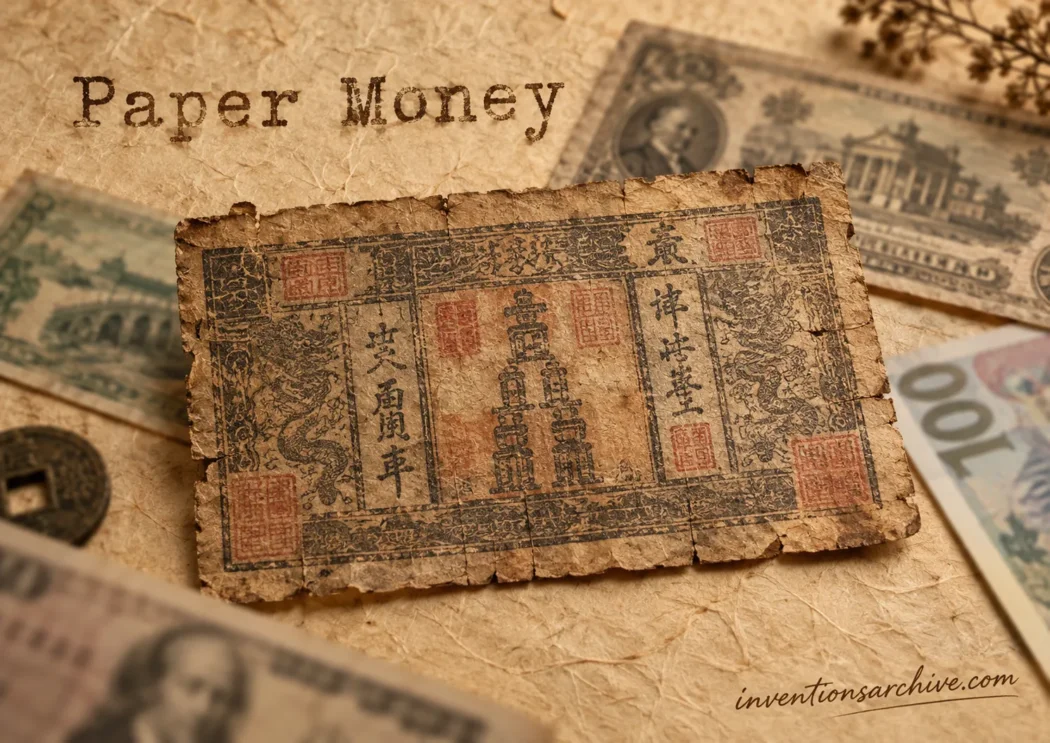
| Invention Name | Paper Money |
|---|---|
| Short Definition | A transferable paper instrument accepted as money because of the value assigned by an issuer, monetary system, or state authority. |
| Approximate Date or Period | Approximate Private jiaozi in Sichuan in the 990s; state takeover in 1024. |
| Geography | Sichuan, China, especially the Chengdu region; later expanded through other parts of Song, Jin, Yuan, and Ming China. |
| Inventor or Source Culture | Attribution varies No single known inventor; developed through merchants in Sichuan and later the Northern Song state. |
| Category | Monetary technology, printing, finance, and public administration. |
| Importance | Allowed monetary value to circulate without requiring the equivalent metal coin to travel with every payment. |
| Evidence Status | Based on surviving evidence Strong written documentation; no specimens of Song paper money are known to survive. |
| Main Problem Solved | Reduced the burden of transporting large quantities of low-value, heavy coin, especially iron cash in Sichuan. |
| Development Path | Tang remittance bills → private jiaozi → state jiaozi → wider Song paper currencies → Yuan and Ming paper currency → later banknotes. |
| System Principle | A paper claim could pass between holders because users trusted its denomination, issuer, convertibility, legal acceptance, or a combination of these. |
| Technical Basis | Paper, printing, seals, accounting, controlled issue, denomination, and institutional enforcement. |
Paper money did not begin when someone first wrote a monetary value on a sheet. The decisive change came when a paper claim could pass from one holder to another and settle payment without the underlying coins moving with it. The clearest early route runs through late Tang remittance instruments and then to Sichuan, where private merchants issued jiaozi in the 990s. The Northern Song government took over the system in 1024.
That sequence matters because several different instruments are often compressed into one origin story. Tang-era “flying cash” helped move value across distance, private jiaozi became circulating money, and state jiaozi turned that private innovation into a public monetary system. Paper money therefore has no credible single inventor and no single moment that explains the whole invention.
Paper Currency Emerged in Three Distinct Steps
Flying Cash Moved Value Without Moving the Coins
From the late eighth century, the Tang state used paper remittance bills commonly known as feiqian, or “flying cash,” to transfer large sums over long distances. A person could deliver money in one place and use a paper instrument connected to payment elsewhere. This reduced the need to move cumbersome low-value coin across long routes.
Flying cash was an ancestor of paper currency, but it was not yet the same thing as a banknote circulating freely in ordinary exchange. Its main function was remittance. The underlying achievement was administrative: a written claim could represent value at a distance and could be honored through a network rather than by carrying the metal itself.
Private Jiaozi Crossed the Line Into Circulating Money
In the 990s, merchants in Sichuan began issuing paper bills called jiaozi. These instruments first served regional commerce, but their importance came from their ability to circulate among users. A merchant did not have to be the original party behind a note to accept it. Once a paper claim could be transferred again and again in payment, it began to perform the work of money rather than merely record a private obligation.
The Northern Song State Turned Jiaozi Into Public Currency
Private issue created a new problem: an issuer could promise more than it could redeem. Many private issuers became insolvent, and attempts at regulation did not solve the instability. In 1024, the Northern Song state took over the jiaozi system in Sichuan. State jiaozi then became a regional monetary standard used in both public and private payments, while iron coin moved into a secondary role.
| Stage | Form | What Changed |
|---|---|---|
| Late 8th century onward | Tang “flying cash” | Paper represented value transferred across distance, reducing the need to transport coin. |
| 990s | Private jiaozi in Sichuan | Merchant-issued paper bills circulated within regional commerce and could pass between users. |
| 1024 | State jiaozi | The Northern Song government took control of issue and tied paper currency to public finance as well as private payment. |
| 1160s onward | Huizi and other Song regional currencies | Paper currency spread beyond its earlier Sichuan base and became central to broader regional monetary systems. |
| 1260 onward | Yuan paper currency | Khubilai Khan established a unified paper-currency system and made paper legal tender across a much larger imperial economy. |
Why Sichuan Produced the First Circulating Paper Currency
The geography of the invention was not accidental. At the beginning of the Song dynasty, western Sichuan relied heavily on iron coin. Iron cash was even more cumbersome than the bronze coin used elsewhere. A payment of high value could therefore require an awkward mass of low-value metal. Moving money became a transport problem.
Sichuan also had enough commercial activity to make that burden costly. Merchants needed to settle transactions, move purchasing power, and conduct trade without repeatedly hauling large quantities of coin. Deposit and remittance practices supplied an institutional base. Paper supplied the lightweight medium. Printing and written accounting made repeated issue and verification practical.
The resulting monetary solution grew from several conditions working together: heavy coin, active trade, trusted intermediaries, paper records, and transferable claims. Paper was useful because an economy already existed in which written claims could be recognized and honored.
When a Receipt Became Money
A receipt normally refers back to one transaction. Money must do more. For a jiaozi note to function in exchange, another person had to be willing to accept the claim without being the original party to it. That transferability changed the economic role of the document.
The monetary process can be understood as a chain:
- An issuer created a paper claim tied to a stated monetary value.
- The holder could use the paper rather than move the corresponding quantity of cumbersome coin.
- Another person accepted the note because the issuer and monetary arrangement were trusted.
- The new holder could use it in another transaction instead of immediately converting it back into coin.
- The note could continue circulating or eventually return through redemption, exchange, taxation, or another settlement process.
The material itself was inexpensive. What made it monetary was the surrounding system: recognizable denomination, issuer credibility, records, acceptance by other users, and a believable route back to value. Paper money therefore depended on information and institutions as much as on paper and printing.
The Difference Between Flying Cash and Jiaozi
| Feature | Flying Cash | Early Jiaozi |
|---|---|---|
| Primary Function | Remittance across distance | Regional payment and exchange |
| Relationship to Coin | Avoided physically moving coin during transfer | Allowed paper claims to circulate in place of repeated coin movement |
| Circulation Between Private Holders | Not its defining function | Central to its development as money |
| Place in the Invention Story | Direct predecessor | Early circulating paper currency |
Private Jiaozi Exposed the Hard Part of the Invention
Printing a monetary claim was easier than maintaining confidence in it. The private jiaozi system demonstrated this quickly. If too many notes were issued relative to an issuer’s ability to honor them, holders had reason to doubt redemption. Once confidence weakened, the paper could fall below its stated value or become difficult to pass on.
This explains why the invention cannot be reduced to printing a denomination on paper. The difficult part was controlling issue, preserving acceptance, and ensuring that people expected the instrument to retain value when it changed hands.
The Northern Song takeover in 1024 addressed that institutional problem by placing issuance under state authority. The resulting system also connected paper money to what historians describe as fiscal circulation: taxes, movement of government revenue between regions, procurement, and public expenditure could all help return and redistribute currency through the economy. Jiaozi worked because it was useful to merchants and embedded in state finance.
Printing Became Part of Monetary Security
Paper money created a new technical problem. A coin had metal, weight, shape, and minting characteristics that made imitation costly. A paper note had little material value of its own, so its printed identity had to carry much more of the burden of authentication.
Historical paper currencies therefore relied on combinations of official printing, controlled designs, inscriptions, seals, denominations, issue rules, and penalties against counterfeiting. Designs could also change over time. These features did not guarantee safety, but they helped distinguish authorized notes from imitations and connected a sheet of paper to a recognized issuer.
The same technical problem remains in later banknotes. Watermarks, security threads, fine printing, specialized substrates, transparent polymer windows, and other anti-counterfeit devices address the same basic imbalance: the monetary value of a note is far greater than the raw material from which it is made.
What Surviving Objects Can Actually Tell Us
The absence of surviving Song notes does not mean the history rests on guesswork. Written records document the currencies, their issue, and their place in public finance. Material evidence becomes stronger for later periods.
The Shanghai Museum, for example, holds a printing plate for a two-guan banknote from the Yuan dynasty, dated broadly to 1271–1368. The object demonstrates the physical relationship between printing technology and currency production. For Yuan paper money more generally, surviving note specimens also exist.
A later paper note in the British Museum shows how much information could be built into the printed surface. Its Ming-dynasty one-guan banknote, dated to 1375, represents one string of 1,000 cash. The design depicts the coin strings, names the denomination, bears official seals, and includes a warning against counterfeiting. The note measures about 34 by 21.8 centimeters, far larger than many modern banknotes.
Such objects should not be used as stand-ins for the lost Song jiaozi. They preserve later stages of the same technological family: printed denomination, visual authentication, official authority, and a paper object expected to circulate at a value far above the worth of its material.
Paper Money Expanded Beyond Sichuan
During the Northern Song period, paper currency remained centered on Sichuan rather than becoming one uniform national currency. That changed after the political and fiscal disruptions of the twelfth century. In the 1160s, the Southern Song court authorized huizi for circulation across much of its territory, while other regional paper currencies served frontier zones.
Huizi could maintain public confidence when issuance was restrained and the wider monetary system supported their value. In the thirteenth century, however, repeated fiscal pressure and excessive issue drove depreciation. War against the Jin and then the Mongol invasions placed heavy demands on state finance. Even so, documentary evidence from contracts, wills, and contemporary testimony shows that paper money remained a major means of payment and store of value.
The Yuan Experiment Went Further
In 1260, Khubilai Khan created a unified Yuan paper-currency system. Under his rule, paper currency moved beyond the earlier model of a regional substitute for cumbersome coin. The Yuan government made its fiat paper currency legal tender across a much larger imperial territory while using silver units for fiscal accounting.
This was a different monetary arrangement from early private jiaozi. The Sichuan bills grew from commercial paper instruments and systems in which confidence in the issuer and redemption mattered. Yuan currency depended far more directly on state authority and legal acceptance. When Mongol rule weakened in the fourteenth century, private commerce shifted toward uncoined silver, showing that legal status alone could not preserve confidence indefinitely.
The Same Convenience Created a New Monetary Risk
Metal currency placed a physical constraint on issue. New coin required metal, labor, and minting. Paper currency loosened that constraint. A government or bank could produce claims much faster than it could acquire an equivalent mass of coin.
That flexibility made paper money useful during periods of expanding trade and public expenditure, but it also made overissue possible on a much larger scale. When the quantity of notes rose faster than confidence in their value, depreciation followed. The history of Song huizi, Yuan notes, and later Ming baochao shows repeated versions of that problem.
The Ming case is especially clear. The Hongwu government issued baochao as legal tender, but very large issues caused rapid loss of market value. By the 1420s, the notes had largely ceased to function in private trade, where silver became more important. The failure did not show that paper could never serve as money. It showed that paper currency required credible control over supply and acceptance.
Europe Reached a Related Solution Through Heavy Copper Money
Europe did not simply copy the first Song jiaozi system centuries later. Its early banknotes emerged from a different institutional path. Yet Sweden produced a strikingly similar practical pressure: money made from metal could become physically burdensome.
In 1661, Stockholms Banco under Johan Palmstruch issued what Sveriges Riksbank identifies as the first real banknotes in Europe. Sweden had used large and cumbersome copper money, and paper notes offered a far lighter means of payment. These credit notes were not tied one-for-one to a particular deposit; they circulated because users expected the bank to honor them in coin.
| Issue | Sichuan, 10th–11th Centuries | Sweden, 17th Century |
|---|---|---|
| Physical Burden | Heavy iron cash | Heavy copper money |
| Paper Solution | Merchant jiaozi, later state-issued jiaozi | Stockholms Banco credit notes |
| Basis of Acceptance | Issuer credibility, redemption, market use, and later state fiscal use | Confidence that the bank would redeem notes in coin |
| Main Failure Risk | Issuer insolvency and excessive note issue | Excessive note issue and inadequate coin reserves |
Stockholms Banco then repeated a danger already familiar from Chinese paper-currency history. It issued more notes, their value fell, holders demanded redemption, and the bank could not meet the demand with available coin. The episode shows that portability was only half of the invention. A durable paper currency also needed rules governing issue and redemption.
Paper Money Changed What Had to Travel in a Payment
Before circulating paper currency, a large payment based on coin often required the physical monetary asset to accompany the transaction. Remittance bills separated movement of value from movement of metal across distance. Circulating notes pushed that separation further: the paper instrument itself could change hands repeatedly.
This altered several features of monetary technology:
- Weight: large nominal values no longer required an equivalent transport burden in coin.
- Information: denomination, issuer, seals, design, and written promises became central to identifying value.
- Trust: users had to judge an institution and monetary system, not merely a piece of metal.
- Supply: currency could be issued without acquiring the same physical volume of coin metal first.
- Counterfeiting: printing and document authentication became monetary technologies.
- Public finance: taxes and government spending could reinforce the circulation of state-issued paper.
Coins did not disappear. Chinese economies could use paper currency, copper or iron cash, silver, credit instruments, and other forms of payment at the same time. The history is therefore not a clean replacement of old coin by new paper. It is a history of overlapping monetary systems in which paper acquired a larger share of transactions when institutions could preserve confidence in it.
From Redeemable Claims to Fiat Banknotes
Early paper instruments often derived credibility from a claim on coin, an expectation of redemption, or another recognized monetary asset. Later systems could place more weight on the issuing state itself. The Yuan experiment under Khubilai Khan is an early example of paper currency operating as fiat legal tender without hard-currency backing.
Modern banknotes carry this principle much further. Their face value does not come from the market value of the sheet. It comes from the monetary system in which the note is issued and accepted. Central-bank authority, legal rules, taxation, payment networks, monetary policy, and public confidence all support that value.
“Paper money” has also become an imperfect material description. Many banknotes use specialized cotton-based paper, mixed fibers, or polymer rather than ordinary writing paper. The lasting invention is therefore not a particular sheet material. It is the ability to make a lightweight, standardized, transferable object serve as accepted monetary value through printing, institutional control, and shared trust.
Why the Invention Is Better Understood as a System
No single component created paper money on its own. Papermaking supplied a light medium. Printing made repeated official forms practical. Accounting linked a note to a denomination and issuer. Deposit and remittance practices taught merchants to treat documents as claims on value. Transferability allowed those claims to pass beyond the original transaction. State administration then tied paper currency to taxation, revenue transfers, public purchasing, and legal authority.
The invention appeared when those elements worked together well enough that a person could accept a piece of paper from someone else and expect another person to accept it later. That expectation turned a document into a circulating monetary instrument. The history of jiaozi also shows the limit of the idea: once confidence in the issuer or supply rules failed, the paper could stop functioning as money even though the printing technology itself remained unchanged.
Sources and Verification
- Paper Bills and State Finance in Tang and Northern Song China — Cambridge University Press chapter by Richard von Glahn documenting late Tang flying cash, remittance bills, bills of exchange, and their role as predecessors of paper currency.
- Northern Song Monetary Policy and the Invention of Paper Currency in Sichuan — Cambridge University Press chapter documenting Sichuan’s iron-coin system, private jiaozi in the 990s, issuer insolvency, the 1024 state takeover, and fiscal circulation.
- Formation of Multiple Currency Regions in the Song Ecumene — Cambridge University Press chapter documenting the later spread of Song paper currencies, including huizi and regional monetary zones.
- Emergence of a Paper Currency Monetary Standard — Cambridge University Press chapter documenting huizi circulation, depreciation, overissue, and the role of paper money as a means of payment and store of value.
- Visualizing Paper Money — Cambridge University Press chapter establishing that no Song paper-money specimens survive and assessing documentary evidence, designs, and surviving printing plates.
- Yuan Paper Currencies and the Transition to the Silver Standard — Cambridge University Press chapter documenting Khubilai Khan’s 1260 unified paper-currency system, fiat legal tender, and the later shift toward silver.
- Printing Plate for the Two-guan Banknote Circulated in the Zhiyuan Reign — Shanghai Museum object record for a Yuan-dynasty banknote printing plate.
- British Museum banknote record — Museum documentation for a 1375 Ming one-guan note showing denomination, coin-string imagery, official issue, paper construction, dimensions, and anti-counterfeiting text.
- First banknotes in Europe — Sveriges Riksbank history documenting Stockholms Banco’s 1661 notes, their relation to cumbersome copper money, overissue, loss of confidence, and bank failure.