
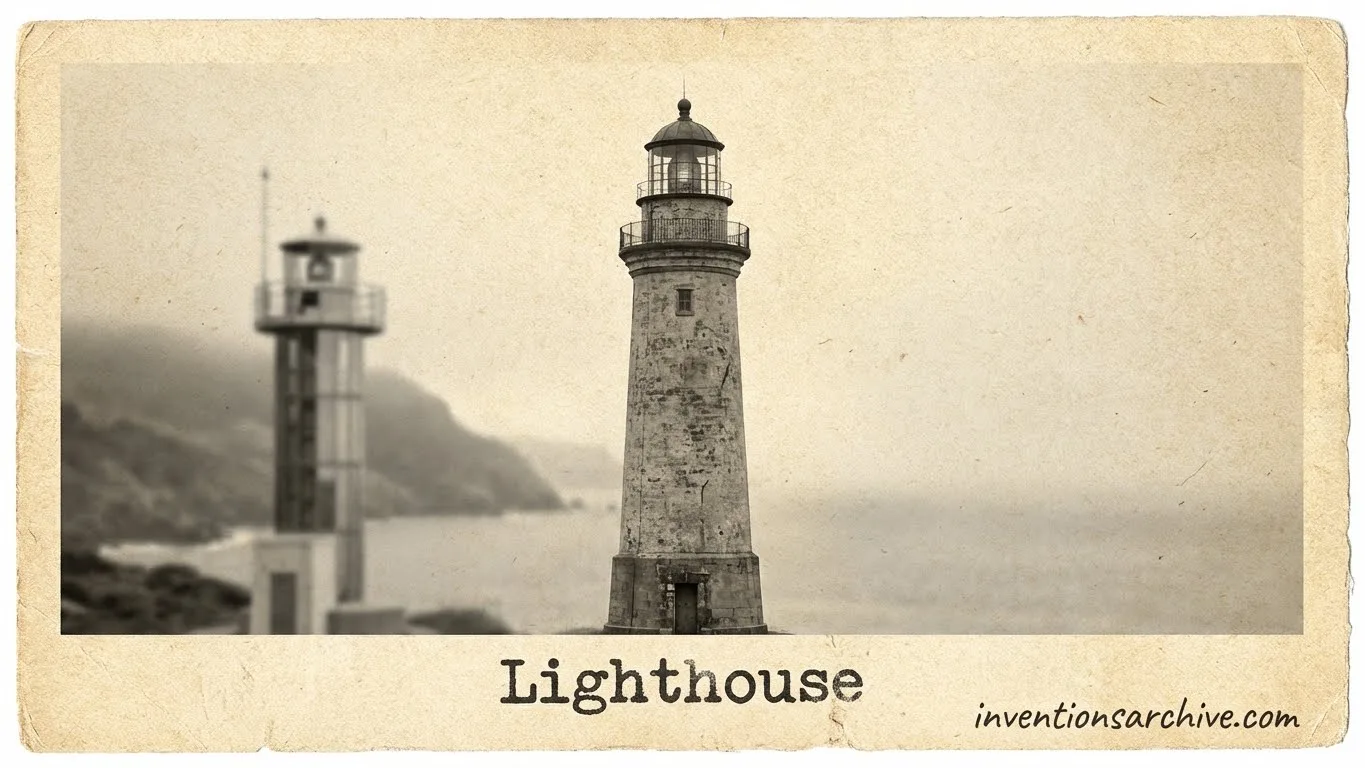
| Invention Name | Lighthouse |
|---|---|
| Short Definition | A fixed maritime signal structure that uses light, and sometimes sound or daymarks, to help vessels identify coasts, harbors, rocks, reefs, and channels. |
| Approximate Date / Period | Organized light towers are known from antiquity; the Pharos of Alexandria is usually dated to the late 4th or early 3rd century BCE Approximate [a] |
| Geography | Mediterranean harbors first; later Roman, Atlantic, North Sea, Baltic, American, and global coastlines |
| Inventor / Source Culture | Anonymous / collective maritime practice; early monumental example linked with Ptolemaic Alexandria Attribution varies |
| Category | Navigation, maritime safety, measurement, communication, coastal infrastructure |
| Main Problem Solved | Helping mariners identify land, harbor entrances, shoals, rocks, and safe approach lines in poor visibility or darkness |
| How It Works | Raises a visible signal above the coast; optics focus or pattern the light so it can be recognized from a distance |
| Materials / Technical Base | Stone towers, masonry, metal lanterns, fuel lamps, mirrors, reflectors, glass lenses, Fresnel optics, electric lamps, solar power, automated controls |
| Early Use | Harbor marking, coastal identification, warning of reefs and rocks, night approach to ports |
| Evidence Status | Ancient texts, coins, surviving towers, official lighthouse records, museum objects, engineering records Based on surviving evidence |
| Surviving Evidence | Roman lighthouse fabric at the Tower of Hercules; depictions of the Pharos on ancient coins; later written records; preserved Fresnel lenses |
| Development Path | Harbor fires → raised beacon towers → masonry lighthouses → reflector lamps → Fresnel lens lights → electric and automated aids |
| Related Inventions | Beacon fire, oil lamp, mirror reflector, Fresnel lens, fog signal, buoy, lightship, radio beacon, GPS navigation |
| Modern Descendants | Automated coastal lights, LED navigation lights, solar-powered beacons, sector lights, range lights, electronic aids to navigation |
| Why It Matters | It turned dangerous coastlines and harbor approaches into more readable maritime spaces, especially before electronic navigation. |
What a Lighthouse Is
A lighthouse is a fixed aid to navigation. Its basic idea is simple: place a visible signal high enough and distinct enough that mariners can identify their position in relation to land or danger.
The structure may be a tall coastal tower, a harbor light on a pier, a low light on a headland, or a compact modern beacon mounted on a metal frame. What makes it a lighthouse is not only the tower. It is the combination of location, visibility, signal pattern, and maritime purpose.
Modern authorities often treat lighthouses as part of a wider family of aids to navigation that includes buoys, daybeacons, range lights, sound signals, and electronic systems. The U.S. Coast Guard, for example, describes lighthouses as one form of fixed aid within a broader navigation system for marking channels and harbors. [f]
The Problem It Answered
Before dependable coastal lights, a vessel approaching land faced several limits. A dark coastline could look almost empty from the sea. A harbor entrance might be hard to distinguish from cliffs or dunes. A reef, sandbank, or isolated rock could remain invisible until a ship was already too close.
A lighthouse answered this problem by giving the coast a readable signal. It helped mariners ask three practical questions:
- Where am I? A known light could confirm a vessel’s position near a coast.
- What should I avoid? A light could mark a reef, rock, shoal, or dangerous headland.
- Where should I steer? Harbor lights and range lights could support safer approaches.
The invention was not a replacement for skill. It worked with charts, pilots, landmarks, soundings, stars, and later compasses. Its value came from making coastal information visible at a distance.
| Before the Invention | What Changed After It |
|---|---|
| Mariners relied heavily on natural landmarks, daylight, local pilots, stars, and memory of the coast. | Coasts and harbor entrances gained visible night marks that could be recognized from offshore. |
| Hazards such as rocks, reefs, shoals, and headlands were harder to identify in darkness or poor weather. | Danger points could be marked by lights with known positions and later by distinctive flash patterns. |
| Harbor approach was often slower and more dependent on daylight or local knowledge. | Ports could support more predictable arrivals, especially where the light was paired with charts and pilotage. |
| Simple fires and beacons were visible but easily confused and limited by fuel, height, and weather. | Purpose-built towers, lantern rooms, reflectors, lenses, and later electric lights improved reach and recognition. |
Early Beacons and the Pharos
The lighthouse began as a practical answer before it became a famous architectural type. A fire on a hill, a brazier near a harbor, or a raised beacon could help vessels find a landing place. The step from beacon to lighthouse came when the signal became fixed, maintained, elevated, and tied to navigation.
The Pharos of Alexandria shows this step on a large scale. According to the Centre d’Études Alexandrines, construction is associated with the Ptolemaic period, with the project initiated under Ptolemy I and completed under Ptolemy II. Ancient coins and later records are among the evidence used to reconstruct its form and role. The exact position of the fire and the details of any mirror remain debated, which is why careful descriptions avoid treating every later legend as fact.
This matters because the Pharos gave the lighthouse more than a function. It gave it a model: a tower at a strategic harbor, visible from the sea, connected to state power, commerce, and the management of maritime routes. The word pharos later became associated with lighthouses in several languages.
How a Lighthouse Worked in Simple Terms
A lighthouse worked by solving three related problems: height, brightness, and recognition.
Height
A light placed higher above sea level can be seen from farther away, within the limits of weather, terrain, and the curve of the Earth. This is why many lighthouses stand on headlands, islands, harbor walls, or tall towers.
Brightness
Early lights used open fires, oil lamps, or groups of lamps. Later systems used reflectors and lenses to reduce wasted light. A beam did not need to shine in every direction with equal strength. It needed to send useful light toward the water.
Recognition
A light had to be identifiable. Mariners needed to know which light they were seeing. Over time, lighthouse authorities used color, rhythm, flash sequence, height, location, and charted descriptions to make one signal different from another.
The Fresnel lens changed lighthouse optics by using rings and prisms to concentrate light into a stronger beam without the weight of a thick solid lens. The National Park Service notes that Augustin Fresnel completed his flashing lens design in 1822, and that the lens used specially cut glass to focus light that would otherwise scatter. [b]
Main Materials and Technical Principles
The lighthouse combined architecture, fuel, optics, maintenance, and later electrical control. Its visible form changed by coast, climate, and engineering need.
- Masonry and stone: used for durable towers on coasts, islands, and harbor entrances.
- Wood and iron: used in some pier lights, skeletal towers, and exposed coastal structures.
- Fuel systems: included open fires, oil lamps, mineral oil lamps, gas systems, and later electric lamps.
- Reflectors: helped redirect light from lamps toward the sea.
- Fresnel optics: used stepped glass rings and prisms to focus light more efficiently.
- Rotation and timing: created flash patterns that helped distinguish one lighthouse from another.
- Automation: reduced the need for resident keepers and allowed remote monitoring.
The Library of Congress explains the basic optical idea clearly: a lighthouse light becomes useful at long range because lenses and reflectors concentrate scattered light into a stronger beam. It also notes that Fresnel’s concentric glass-ring design influenced later uses such as headlights, traffic signals, and projectors. [c]
From Earlier Tools to Later Forms
The lighthouse belongs to a longer line of navigation tools. It did not replace earlier methods all at once. It added a visible, place-based signal that worked beside charts, pilots, compasses, buoys, and soundings.
| Stage | Form | What Changed |
|---|---|---|
| Earlier Tool | Hilltop fires, harbor beacons, natural landmarks | Visible guidance existed, but it was less standardized and often limited by weather, height, and maintenance. |
| Early Lighthouse | Raised tower with fire or lamp | The signal became fixed, elevated, and connected to a known maritime location. |
| Improved Light | Lantern room, oil lamps, reflectors | Light became more controlled and more useful for night navigation. |
| Optical Lighthouse | Fresnel lens and rotating mechanism | More light reached the sea, and flash patterns made identification easier. |
| Modern Descendant | Electric, solar, LED, automated, and remotely monitored aids | The lighthouse became part of a wider network of physical and electronic navigation aids. |
Roman and Medieval Continuity
Roman ports used lighthouse-like structures as part of a wider maritime system. The best surviving example is the Tower of Hercules in A Coruña, Spain. UNESCO describes it as the only fully preserved Roman lighthouse still used for maritime signaling, with a Roman core protected by later restoration. [d]
This surviving tower helps correct a common mistake. Ancient lighthouses were not only symbols. They were working infrastructure. They served routes, harbors, and coastlines where trade and movement depended on repeatable navigation marks.
In medieval and early modern Europe, coastal lights varied widely. Some were maintained by religious houses, port authorities, local rights holders, or maritime institutions. Many were simple by later standards. Their value came from location and continuity: mariners could learn that a certain coast, rock, or harbor had a known light.
Related articles: Electric light arc lamp [Industrial Age Inventions Series], Reinforced Concrete [Industrial Age Inventions Series]
Rock Lighthouses and Engineering Change
A major change came when engineers began placing lighthouses on isolated rocks rather than only on easier headlands or harbor structures. A rock lighthouse had to resist waves, storms, access problems, and constant maintenance pressure.
Eddystone Lighthouse off Plymouth is a useful example because it shows repeated improvement rather than one perfect design. Trinity House records that the present Eddystone Lighthouse was built in 1882 and was the fourth lighthouse used to mark the Eddystone Rocks. It also records earlier phases and later automation. [e]
Rock lighthouses pushed designers toward stronger masonry, better interlocking stonework, improved lanterns, and more disciplined maintenance systems. The invention became less about one tower and more about a complete coastal service.
Main Types and Variations
Lighthouses vary because coastlines vary. A harbor entrance, an offshore reef, a broad headland, and a narrow channel do not ask for the same structure.
| Type or Variation | Typical Purpose |
|---|---|
| Harbor Lighthouse | Marks a port entrance, pier, breakwater, or safe approach to a harbor. |
| Coastal Lighthouse | Helps vessels identify a shoreline, headland, or major landfall from offshore. |
| Rock Lighthouse | Warns of isolated rocks or reefs where a shore-based tower would not be close enough. |
| Range Lights | Uses two aligned lights to guide vessels along a safe line through a channel. |
| Sector Light | Shows different colored or bounded sectors to indicate safe and unsafe areas. |
| Lightship | Places a floating light where a fixed tower would be difficult or impossible. |
| Automated Beacon | Uses compact lighting, power, and control systems with little or no resident staff. |
What Changed Because of Lighthouses
The lighthouse changed maritime life by making certain coastal risks easier to read. The change was practical, not magical. A light could not remove fog, storms, poor charts, or human error. It could give a vessel one more reliable piece of information.
Several areas felt the effect:
- Harbor access: vessels could identify approaches more confidently when a light was known and maintained.
- Coastal trade: repeated routes became easier to manage when dangerous points were marked.
- Cartography: charts could pair coastal lights with positions, ranges, and light characteristics.
- Engineering: tower design, masonry, optics, lamp fuels, and maintenance systems improved together.
- Public infrastructure: many governments and maritime authorities built lighthouse services as part of coastal administration.
Common Misunderstandings
The Pharos Was Not the Whole Invention
The Pharos of Alexandria is the most famous ancient lighthouse, but the wider invention includes many smaller and less documented beacon traditions. Its fame should not erase local maritime practice.
A Lighthouse Is More Than a Tall Tower
A tower without a navigation role is not the same thing as a lighthouse. The important parts are the signal, the location, the charted identity, and the way mariners used it.
The Fresnel Lens Did Not Invent the Lighthouse
The Fresnel lens improved lighthouse lighting in the 19th century. It made beams stronger and more efficient, but lighthouses existed long before Fresnel optics.
The Earliest Surviving Evidence Is Not Always the First Use
Stone towers, coins, and written records survive better than simple fires or wooden structures. Evidence shows what can be documented, not every early use that once existed.
Related Inventions
These related inventions and systems help place the lighthouse inside the wider history of navigation and coastal safety:
- Beacon fire: the earlier visible signal behind many lighthouse traditions.
- Oil lamp: a controlled light source used before electric systems.
- Mirror reflector: an optical aid used to direct more lamp light outward.
- Fresnel lens: the 19th-century optical improvement that shaped many modern lighthouse beams.
- Fog signal: an audible aid used where light could be blocked by fog or weather.
- Buoy: a floating aid that marks channels, hazards, and routes.
- Lightship: a floating lighthouse used where fixed construction was difficult.
- Radio beacon and GPS: later navigation systems that reduced dependence on visual lights but did not erase their value.
Frequently Asked Questions
Who invented the lighthouse?
The lighthouse does not have one secure inventor. It developed from older beacon fires and harbor signals. The Pharos of Alexandria is the most famous early monumental example, but the broader invention came from collective maritime practice.
Was the Pharos of Alexandria the first lighthouse?
It is one of the earliest and most famous documented monumental lighthouses. It is safer to call it a major early example rather than the absolute first, because simpler beacon systems may have existed without leaving strong evidence.
How did lighthouses help sailors?
They helped sailors identify coasts, harbor entrances, reefs, rocks, and safe approach lines. A lighthouse gave mariners a known visual mark that could be matched with charts, local knowledge, and later formal light lists.
Why was the Fresnel lens important for lighthouses?
The Fresnel lens focused light more efficiently than earlier thick lenses. Its stepped glass design allowed a stronger, more recognizable beam without the same weight and light loss found in older optical systems.
Are lighthouses still useful today?
Yes, many remain useful as visual aids, backups, heritage structures, or parts of official navigation systems. Electronic navigation has changed their role, but it has not made every coastal light meaningless.
Sources and Verification
- [a] The Lighthouse of Alexandria – Centre d’Études Alexandrines — Used to verify the Ptolemaic dating, ancient evidence, coin depictions, and uncertainty around the Pharos of Alexandria. (Reliable because it is an institutional research source focused on Alexandrian archaeology and history.)
- [b] Fresnel Lens (U.S. National Park Service) — Used to verify Augustin Fresnel’s 1822 lighthouse lens design and the way Fresnel optics focused lighthouse light. (Reliable because it is an official U.S. National Park Service educational source.)
- [c] How Is the Light of a Lighthouse Magnified So That It Can Be Seen Many Miles Out at Sea? | Library of Congress — Used to verify the basic optical principle of concentrating lighthouse light and the later influence of Fresnel’s concentric glass-ring design. (Reliable because it is an official Library of Congress science reference page.)
- [d] Tower of Hercules – UNESCO World Heritage Centre — Used to verify the Tower of Hercules as a preserved Roman lighthouse still used for maritime signaling. (Reliable because it is the official UNESCO World Heritage Centre listing.)
- [e] Eddystone Lighthouse | Trinity House — Used to verify the Eddystone Lighthouse sequence, the 1882 present tower, and later automation details. (Reliable because Trinity House is a statutory General Lighthouse Authority and maintains the official lighthouse record.)
- [f] ATON — Used to verify that modern aids to navigation include lighthouses, ranges, fixed structures, buoys, daybeacons, and related maritime signals. (Reliable because it is an official U.S. Coast Guard page.)