
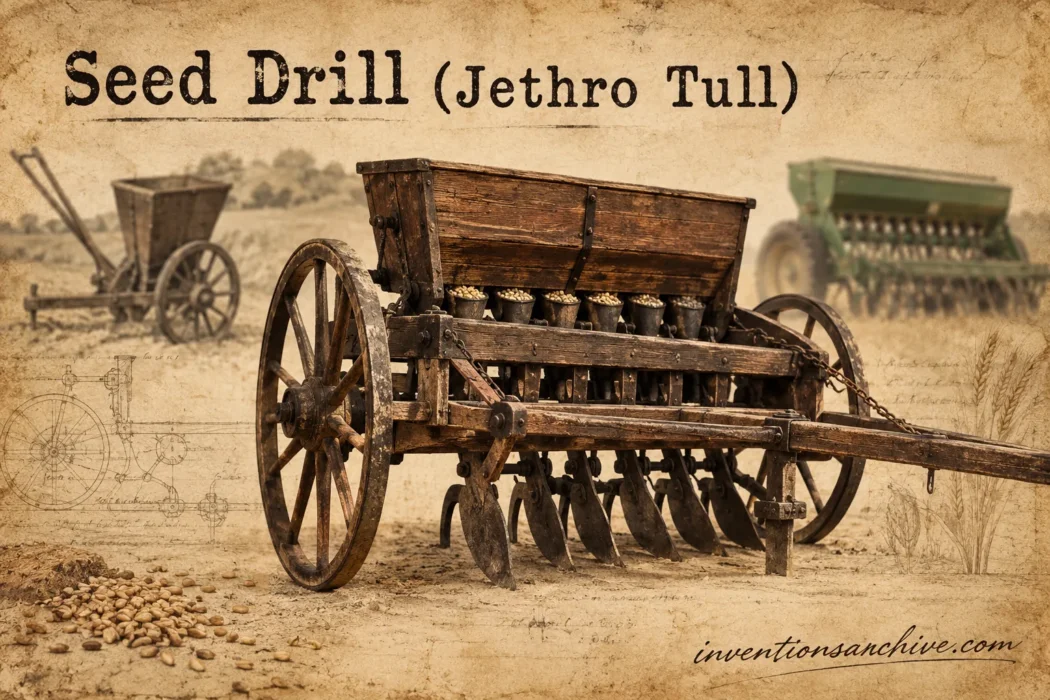
| Invention Name | Jethro Tull’s Seed Drill |
|---|---|
| Short Definition | A horse-drawn sowing machine that opened furrows, mechanically metered seed into rows, and covered the seed with soil. |
| Approximate Date or Period | Approximate c. 1701 for Tull’s first drill; later versions were developed and described during the early eighteenth century. |
| Geography | England |
| Inventor or Source Culture | Attribution varies Jethro Tull is closely associated with the practical development and promotion of the seed drill in English agriculture, but mechanical drill sowing predates him. |
| Category | Agricultural engineering; sowing machinery |
| Importance | Helped make controlled row sowing practical and linked mechanical planting with cultivation between crop rows. |
| Evidence Status | Based on surviving evidence Tull’s published descriptions document his system. A well-known Science Museum model is a 1955 reconstruction rather than an original 1701 machine. |
| Main Problem Solved | Reduced dependence on hand broadcasting by placing seed more deliberately in prepared furrows. |
| Development Path | Earlier drill-sowing ideas and machines → Tull’s c. 1701 drills → horse-hoeing row system → nineteenth-century grain drills → modern grain and no-till drills |
| How It Works | Ground motion operated a seed-feeding mechanism; coulters opened channels, guides delivered seed, and a rear harrow covered it. |
| Early Use Context | Sowing sainfoin and wheat in controlled rows. |
| Surviving Evidence | Published descriptions and illustrations, later editions of Horse-Hoeing Husbandry, and museum reconstructions based on those records. |
| Modern Descendants | Grain drills and no-till drills that meter seed, open a seed slot, deliver seed, and close or firm the soil behind it. |
Jethro Tull’s seed drill is often reduced to a simple statement: Tull invented the seed drill in 1701. The history is more precise than that. Mechanical drill sowing existed before Tull, and earlier writers had already proposed ways of putting seed into ordered lines. Tull’s place in the history of agricultural machinery rests on the particular machine he developed, the way he combined controlled sowing with row cultivation, and the detailed farming system he later published.
His mature drill did several jobs during one pass across a prepared field. It opened channels in the soil, released seed through a mechanically controlled feed, guided the seed into those channels, and covered it again. More important for Tull’s wider farming method, the resulting crop grew in straight, separated rows. That geometry allowed a horse-drawn hoe to cultivate the spaces between plants without passing directly through the crop.
Why Tull Wanted to Replace Broadcast Sowing
Hand broadcasting distributed seed by throwing it across the surface of a prepared field. An experienced sower could work quickly, but the method offered limited mechanical control over the exact position of each grain. Seeds could land at different densities, remain near the surface, or require later soil-working operations to incorporate them.
Tull wanted sowing to become a controlled operation. The Science Museum Group’s collection documentation records another practical incentive: the price of seed had risen from five shillings to twelve shillings around the time he developed his first drill. A machine that could establish a crop while using seed more selectively therefore addressed a direct farm expense as well as an agronomic problem.
In 1701, Tull produced an early drill intended for sainfoin and wheat. Museum documentation summarizes his description of the machine as one that made channels, drilled the seed, and covered it. He continued altering the design rather than treating the first version as a finished machine.
An Organ Mechanism Inspired the Seed Feed
One of the most unusual details in the development of Tull’s drill came from outside agriculture. Tull was a musician, and Science Museum documentation links his seed-feeding mechanism to the groove, tongue, and spring arrangement of an organ soundboard. The connection was mechanical rather than decorative: a controlled repeating motion in one machine suggested a way to regulate material moving through another.
Tull had an early seed box made by a mathematical instrument maker in Soho and tested it on a wheelbarrow. This stage matters because the central difficulty was not merely building a container for seed. The machine needed to convert forward movement across the field into a predictable release of grain.
The seed box therefore became the controlling part of the system. Instead of allowing seed to fall freely from a hopper, the drill used a moving feed associated with the wheel shaft. In the Science Museum interpretation, a grooved or toothed section worked with a spring-held tongue so that seed could be released at intervals as the machine advanced.
How the Three-Row Wheat Drill Worked
The developed form represented in Tull’s published work and reconstructed by the Science Museum was a four-wheeled, horse-drawn machine capable of sowing three rows of wheat. Its operation can be understood as a sequence of connected mechanical tasks rather than as a single seed-dropping device.
The Wheels Supplied Motion as Well as Support
The wheels carried the machine across the field, but movement also drove the seed-delivery system. This connection between ground travel and seed release meant the metering mechanism operated as the drill advanced.
The museum reconstruction has two larger front wheels supporting the unit that supplied the central coulter and two smaller rear wheels associated with the outer seed feeds. The design therefore coordinated multiple planting lines within one machine.
The Hopper Held Seed Above the Feed Mechanism
Seed was carried in boxes or hoppers positioned over the delivery mechanism. Gravity brought grain toward the metering area, but the controlled feed determined how it left the box. This distinction separated drilling from simply allowing seed to pour continuously into a furrow.
The Grooved Feed Controlled Seed Release
Grooves in the axle beneath the seed boxes helped regulate the delivery of seed. Another Science Museum description explains the mechanism in terms of a toothed part of the wheel shaft acting against a spring-held tongue. The number and arrangement of these feed features affected the intervals at which seed was released.
The exact mechanical form changed as Tull revised his equipment, but the governing idea remained consistent: forward travel should produce measured seed delivery rather than uncontrolled flow.
Coulters Opened the Planting Channels
Sharp coulters entered the soil ahead of seed placement. Their task was to create narrow channels so the grain could be put below the surface rather than scattered across it. In the Science Museum reconstruction, the central and outer feeds supplied three separate coulters.
Guides then directed seed downward into the channels. The path from hopper to feed mechanism to guide to furrow turned sowing into a coordinated mechanical sequence.
The Harrow Closed the Operation
A harrow at the rear moved soil back over the deposited grain. Tull’s drill therefore combined three basic actions within one pass: open the soil, deposit the seed, and cover it.
This sequence remains recognizable in later grain-drilling machinery even though modern drills use different opener systems, materials, depth controls, feed mechanisms, and closing components.
Why Straight Rows Changed More Than Seed Placement
The strongest reason to view Tull’s drill as part of a farming system rather than an isolated machine is the relationship between drilling and hoeing. Straight rows created open lanes in which another implement could work.
Tull developed his approach around repeated cultivation with a horse-drawn hoe. With broadcast grain, plants occupied the field without regular lanes for a horse and implement to pass between them. Once crops were arranged in separated rows, mechanical cultivation could target the spaces between those rows while reducing direct contact with the crop itself.
The drill therefore changed the geometry of the field. Seed placement determined where the future plants would stand, and their location determined where later mechanical cultivation could occur.
This relationship explains why Tull’s writings give so much attention to drilling, spacing, hoeing, soil preparation, weeds, and implements together. For him, the drill was one component in a larger method of husbandry.
Was Jethro Tull the First Person to Invent a Seed Drill?
The safest historical answer is no, not in the absolute global sense in which the claim is often presented. Tull’s contribution is well documented, but the concept of drill sowing did not begin with him.
Science Museum collection documentation notes evidence for a Babylonian drill plough dating roughly from 1700 to 1200 BCE. Whatever the exact ancestry of later European machines, that evidence alone makes a universal claim that mechanical drill sowing first appeared in England in 1701 untenable.
There were European precedents as well. In 1600, Sir Hugh Platt discussed setting or dibbling wheat in The Setting of Corn. In 1669, the English agricultural writer John Worlidge described the idea of drilling wheat and outlined a machine for the purpose. Science Museum documentation states that Worlidge’s design did not work successfully when constructed.
Modern historical scholarship is therefore cautious about assigning Tull the status of first inventor. Agricultural historian Laura B. Sayre notes that whether Tull was the first person to experiment with a mechanical seed drill is doubtful. His stronger claim is that he developed, used, described, and promoted a form of mechanical drilling that became influential within the later history of British agriculture.
| Stage | Form or Evidence | What It Shows |
|---|---|---|
| c. 1700–1200 BCE | Babylonian drill-plough evidence noted by the Science Museum Group | The basic idea of placing seed with a drilling implement is far older than Tull. |
| 1600 | Sir Hugh Platt discusses setting wheat | English farmers and writers were already seeking alternatives to ordinary broadcasting. |
| 1669 | John Worlidge outlines a wheat-drilling machine | A mechanical European drilling proposal predates Tull, although the described construction was unsuccessful. |
| c. 1701 | Tull develops a drill for sainfoin and wheat | Controlled drilling becomes part of Tull’s experimental farming practice. |
| Early eighteenth century | Tull develops multi-row drilling and horse-hoeing methods | Row sowing becomes closely connected with later mechanical cultivation. |
| Nineteenth century | Seed drills receive further mechanical refinement | Drilling spreads more widely and develops toward recognizable modern machinery. |
Tull’s Reported Seed Savings Were Large, but They Need Context
The Science Museum’s demonstration model documentation preserves striking figures associated with Tull’s method. It states that he used approximately three-quarters to one bushel of seed per acre, compared with about two and a half to four and a half bushels per acre under customary hand broadcasting. The same record gives yields claimed by Tull of about 45 to 80 bushels per acre, compared with 20 to 40 bushels previously.
| Measure | Tull’s Drilling Method | Customary Hand Broadcasting |
|---|---|---|
| Seed Used | About ¾–1 bushel per acre | About 2½–4½ bushels per acre |
| Reported Yield | About 45–80 bushels per acre | About 20–40 bushels per acre |
Those numbers help explain why contemporaries and later agricultural writers could find drilling attractive. They should not, however, be treated as a universal performance ratio for the machine. Crop variety, soil, weather, field preparation, measurement practice, cultivation, and other conditions were not controlled in the manner expected of a modern agronomic field trial.
The more defensible mechanical point is simpler: putting seed deliberately into rows gave a farmer more control over the quantity and position of seed than throwing it broadly across the field.
The Famous Museum Drill Is a Reconstruction, Not Tull’s Original Machine
Images of an elaborate Tull seed drill can give the impression that an intact machine from about 1701 has survived. The well-documented example in the Science Museum Group collection has a different history.
It is a one-quarter-scale model made in 1955 by H. Agutter. The model was constructed from information in Tull’s published Horse-Hoeing Husbandry material. It therefore provides a carefully documented physical interpretation of the historical design, but it is not an original eighteenth-century drill built or handled by Tull.
The museum also holds a demonstration model of the seed-box mechanism. Such reconstructions are especially useful for machinery that is difficult to understand from prose and engraved plates alone, provided the distinction between a surviving original and a later evidence-based model remains clear.
This distinction also affects the 1701 date. That date refers to Tull’s early design and experiments, not to the manufacturing date of the museum model.
Horse-Hoeing Husbandry Preserved the Mechanical System
Tull’s ideas reached a wider audience through Horse-Hoeing Husbandry. An early form of the work appeared in 1731, while the Science Museum identifies its reconstruction with material published in the 1733 version. Tull continued revising and expanding his work; a digitized third edition published by A. Millar in 1751 contains detailed discussions of drill boxes, coulters, hoe-ploughs, tillage, weeds, crop spacing, and other parts of his agricultural method.
The publication record matters because it preserved far more than the claim that a drill existed. Tull described components and operating ideas closely enough for later readers and model makers to reconstruct the machinery.
His text also shows why separating the seed drill from the rest of his husbandry can distort what he was trying to achieve. The drill placed plants in the arrangement required for repeated hoeing. The hoeing was then meant to control weeds and work the soil. Crop spacing, machine design, and Tull’s ideas about soil fertility were therefore intertwined.
The Machine Outlasted Tull’s Theory of Plant Nutrition
Tull’s mechanical observations were accompanied by an agricultural theory that did not survive later advances in plant and soil science. He assigned an excessive role to finely pulverized earth as plant nourishment and argued that repeated tillage could substitute for the fertility benefits usually associated with manure.
Laura B. Sayre’s study of Tull’s work describes his rejection of manure as one of the most controversial parts of his system. Tull believed that repeated stirring and pulverization of the soil could perform functions that other agricultural writers associated with manure and decomposition.
His later reputation often separated the useful machinery from these weaker agronomic claims. That distinction is important when evaluating historical inventors. A workable mechanical idea can remain influential even when the theory used to explain its benefits is incomplete or wrong.
The seed drill did not depend on Tull being correct about the nutritional role of soil pulverization. Its practical value came from mechanical control over furrow formation, seed delivery, row arrangement, and covering.
Why the Drill Did Not Transform Farming Overnight
A machine can be technically workable without being rapidly adopted. Tull’s drilling system required farmers to change more than the act of sowing. It worked best as part of an ordered row-cultivation system, and that meant reorganizing how a field was planted and later worked.
Early agricultural machinery also imposed practical costs. Equipment had to be constructed accurately enough for the feed mechanism to operate, maintained in usable condition, matched to local soils and crops, and justified economically against familiar hand methods. Tull’s own repeated redesigns show that the machine was not a static device perfected in one attempt.
Historical research describes Tull as important to the long-term acceptance of drilling rather than as the cause of an immediate conversion to mechanized sowing. Science Museum documentation similarly places much of the later growth of interest in seed drills in the early nineteenth century and notes that by the 1860s their basic design contained many features recognizable in later machines.
That slower trajectory is more plausible than the common picture of a 1701 invention suddenly replacing broadcasting across British agriculture.
What Remains Recognizable in a Modern Grain Drill
Modern grain drills bear little visual resemblance to Tull’s wooden horse-drawn equipment, yet several functional tasks remain familiar. A drill still needs to carry seed, regulate its delivery, open soil in a controlled line, place the seed, and leave conditions suitable for germination.
Penn State Extension distinguishes modern drills from precision planters. Drills are commonly used for small grains, forage crops, and cover crops, while planters are designed for more exact depth and individual seed spacing in crops such as corn and soybeans. Modern drills can use fluted feeds or other metering systems, disk openers, seed tubes, depth-control components, firmers, and press or closing wheels.
No-till drills extend the same general sequence into untilled ground. They must penetrate soil and crop residue, open a seed slot, deliver seed into it, and close or firm the slot sufficiently to establish seed-to-soil contact.
The similarity should not be overstated: a modern drill is the result of centuries of engineering changes rather than a scaled-up copy of Tull’s apparatus. What persists is the mechanical logic of replacing broad scattering with controlled delivery into prepared planting lines.
What Jethro Tull’s Seed Drill Actually Changed
Tull’s strongest historical claim is not that no one before him had imagined or used drill sowing. Earlier evidence makes that position difficult to defend. His contribution lies in the way he developed mechanical seed delivery within an English farming system and tied row sowing directly to later horse cultivation.
The machine gave the sowing process a repeatable physical structure. A furrow could be opened at a planned location, seed could pass through a regulated feed, and soil could be returned over the planted line. Once several such lines were arranged in parallel, the field itself became organized for subsequent machine work.
That is why the three-row drill deserves attention beyond the familiar 1701 date. It joined seed metering, furrow opening, row spacing, covering, and later cultivation into a connected method. Tull’s soil theory would be challenged, his exact priority would be questioned, and adoption would take generations, but the mechanical problem he worked on remains recognizable in grain drilling today.
Sources and Verification
- 1:4 scale model of Jethro Tull’s seed drill — Science Museum Group collection record documenting the c. 1701 design attribution, three-row arrangement, organ-inspired mechanism, seed-box development, coulters, wheels, rear harrow, horse-hoeing connection, and the 1955 reconstruction.
- Demonstration model of seed box — Science Museum Group record covering Tull’s seed-feed mechanism, the reported seed-use and yield figures, his sainfoin and wheat drill, earlier drill-sowing precedents, and later development of seed drills.
- The pre-history of soil science: Jethro Tull, the invention of the seed drill, and the foundations of modern agriculture — Laura B. Sayre’s historical study examining the doubtful claim that Tull was the first mechanical seed-drill inventor, his role in later acceptance of drilling, and the disputed plant-nutrition and manure theories attached to his system.
- Horse-hoeing Husbandry: Or, An Essay on the Principles of Vegetation and Tillage — Digitized 1751 third edition of Tull’s work, preserving his discussions of drill boxes, coulters, hoeing equipment, tillage, crop arrangement, weeds, and plant nourishment.
- Planter and Drill Maintenance — Penn State Extension material explaining the functions and components of present-day drills and the distinction between drills and more precise row planters.