
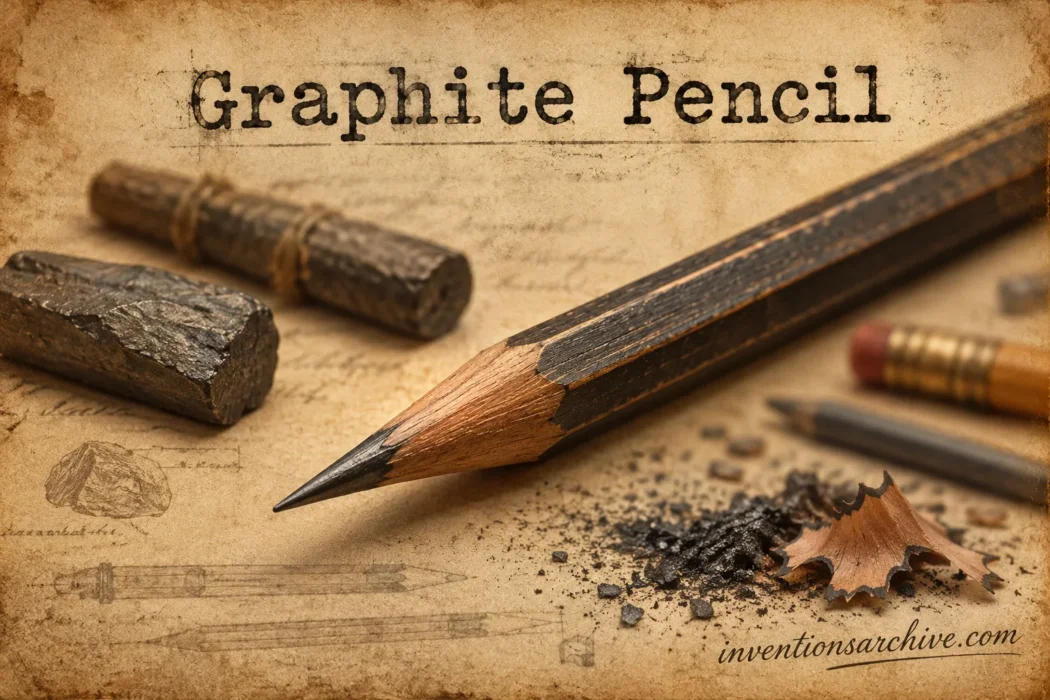
| Invention Name | Graphite Pencil |
|---|---|
| Short Definition | A writing and drawing instrument that deposits graphite onto a surface, usually from a graphite-based core protected by a wooden casing. |
| Approximate Date or Period | Based on surviving evidence Graphite writing instruments are documented by 1565; the manufactured graphite-clay core dates to 1795. |
| Geography | Borrowdale, Cumbria, England; later France and other European manufacturing centers |
| Inventor or Source Culture | No single known inventor for the earliest graphite pencil; Nicolas-Jacques Conté is associated with the documented 1795 graphite-clay process. |
| Category | Writing, drawing, materials technology, manufacturing |
| Importance | Converted graphite writing from dependence on unusually pure natural material into a repeatable manufactured product with controllable hardness. |
| Evidence Status | Confirmed 1565 printed evidence and 1795 Conté patent documentation survive. |
| Main Problem Solved | Portable dry marking without ink; later, reliable pencil production without dependence on large pieces of premium natural graphite. |
| Material or Technical Basis | Graphite; in modern-type cores, graphite combined with clay and processed into a fired rod. |
| Development Path | Natural graphite pieces → protected graphite sticks → wood-cased pencils → manufactured graphite-clay cores → graded industrial pencils |
The history of the graphite pencil contains two different inventions that are often compressed into a single date. People were using pieces of natural graphite for writing and drawing long before 1795. What changed at the end of the eighteenth century was the manufacture of the writing core itself: powdered graphite could be combined with clay, shaped, fired, and adjusted to produce different writing properties.
This distinction matters because Nicolas-Jacques Conté did not discover graphite and did not create the first object capable of making a graphite line. His documented contribution was a method that reduced dependence on rare, exceptionally suitable natural graphite and turned the pencil core into an engineered material.
Borrowdale Graphite Made the Early Pencil Possible
One of the most important places in the pencil’s early history is Seathwaite in Borrowdale, in the English Lake District. The British Geological Survey describes the deposit there as unusually pure and exceptionally uncommon in Britain. Mining is documented from at least the sixteenth century and continued intermittently until 1891.[a]
The physical quality of this material mattered. Borrowdale graphite occurred in compact masses and nodules that could yield usable pieces rather than only loose flakes or impure powder. That made it possible to cut natural graphite into writing material. A user did not yet need a manufactured composite core: the mineral itself could serve as the marking substance.
This early system had an obvious limitation. A pencil industry based on pieces of naturally suitable graphite depended on finding deposits with the right purity, structure, and working properties. Most graphite sources could not simply be cut into strong, consistent writing rods.
The 1565 Evidence Shows a Pencil Before Conté
An important surviving piece of documentary evidence appears in a work published by the Swiss naturalist Conrad Gesner in 1565. The New York Public Library catalogues an illustration from Gesner’s De rerum fossilium under the title Lead pencil and identifies it as an image from the 1565 edition.[b]
The evidence is useful because it establishes that a writing implement consisting of a dark marking material held in a supporting body was known in Europe more than two centuries before Conté’s patent. It does not prove that Gesner invented the pencil. His publication is best treated as an early surviving record of the technology rather than a reliable birth certificate for the object itself.
Early graphite writing tools could take forms less refined than a modern pencil. Pieces of graphite could be wrapped or placed in holders to keep the soft mineral from breaking and to reduce contact with the user’s fingers. The Metropolitan Museum of Art notes that high-quality Borrowdale graphite was cut into sticks and could be wrapped with twine or placed in a holder.[c]
The Early Pencil Was Still Dependent on the Mine
A natural-graphite pencil was fundamentally a mineral product. Its quality depended heavily on what came out of the ground. If a deposit supplied compact, clean graphite, useful pieces could be cut from it. If the material was more powdery, impure, brittle, or structurally unsuitable, making comparable cores became harder.
That dependence created several manufacturing problems. Natural pieces varied. Small fragments and graphite powder were harder to turn into durable leads. Hardness could not be adjusted with the precision later manufacturers achieved. A producer also remained exposed to the availability and price of a particular mineral source.
By the late eighteenth century, this had become more than a quality-control issue in France. English graphite was an important raw material for pencil manufacture, and wartime disruption created pressure to develop an alternative.
Why Conté’s 1795 Process Changed Pencil Manufacture
The French National Institute of Industrial Property records that an economic blockade in 1794 caused a pencil shortage in France because graphite used for pencil leads was imported from England. Nicolas-Jacques Conté was tasked with developing a lead that did not depend on English raw material. His solution used graphite mixed with clay, fired, and enclosed in wood.[d]
This changed the technical problem. Manufacturers no longer needed every finished core to begin as a naturally occurring rod of exceptionally good graphite. Graphite could be processed into a powder, combined with another mineral material, formed into slender cores, and hardened through firing.
The result was more repeatable. It also made previously inconvenient material useful: graphite that was not available as ideal solid pieces could contribute to a manufactured core.
The Manufactured Core Was the Real Technical Breakthrough
The central change was not simply placing graphite inside wood. Protective holders already existed. The new feature was the ability to manufacture the part that actually made the mark.
In the composite method, graphite and clay are processed into a formable mass. The material is shaped into long, narrow rods, dried, and fired. The Museum of Modern Art describes the late-eighteenth-century replacement for natural graphite in essentially these terms: graphite and clay are formed into rods and fired until hard.[f]
Firing gives the clay-containing core mechanical stability. The graphite remains responsible for the dark deposit on the paper, while the mineral binder changes the core’s hardness and handling characteristics. Manufacturers can therefore adjust the behavior of the pencil through formulation and processing instead of accepting whatever properties a natural graphite piece happens to possess.
| Feature | Early Natural-Graphite Pencil | Manufactured Graphite-Clay Pencil |
|---|---|---|
| Writing core | Piece cut from suitable natural graphite | Formed mixture based on graphite and clay |
| Raw-material requirement | Strong dependence on graphite with suitable natural form and purity | Powdered graphite can be processed into a new core |
| Hardness control | Limited by the natural material | Adjusted through composition and processing |
| Use of small graphite particles | Difficult to turn directly into a durable rod | Useful as feed material for a manufactured mixture |
| Consistency | More dependent on individual mineral pieces | Better suited to repeatable production |
| Relationship to modern pencils | Historical predecessor | Direct basis of conventional modern graphite cores |
Hardness Became an Engineered Property
The graphite-clay system did something that a cut piece of natural graphite could not do easily: it allowed manufacturers to produce families of pencils with deliberately different writing behavior.
More clay generally produces a harder core and a lighter mark. A higher graphite share generally produces a softer core and a darker mark. Modern manufacturers still describe pencil grades through this relationship.[g]
| Grade Family | Typical Core Behavior | Typical Mark | Common Use |
|---|---|---|---|
| H | Harder | Lighter and more precise | Fine lines, technical drawing, controlled drafting |
| HB | Intermediate | Balanced darkness and point retention | General writing |
| B | Softer | Darker and broader under pressure | Sketching, tonal drawing, shading |
The letters should not be mistaken for an exact international formula. Faber-Castell notes that pencil hardness designations were never definitively standardized worldwide, so an HB pencil from one manufacturer does not necessarily have exactly the same composition or feel as an HB from another.[h]
This lack of absolute standardization does not make the system useless. The grades still provide a practical sequence within a manufacturer’s range. What changed after composite-core manufacture was the ability to produce those ranges deliberately rather than merely sort naturally occurring graphite pieces by their behavior.
Why Graphite Can Write Without Ink
Graphite works as a dry marking material because of its crystal structure. It is made of carbon atoms arranged in stacked sheets. Strong bonds hold the atoms together within each sheet, while much weaker forces act between the sheets. The U.S. Geological Survey describes graphite as stacks of parallel carbon sheets held together between layers by comparatively weak intermolecular forces.[i]
When a pencil moves across paper, friction and pressure help detach extremely small graphite particles and plate-like fragments from the core. These particles catch on the irregular surface and fibers of the paper, producing a visible gray or black line.
The mark is therefore materially different from writing with liquid ink. Ink introduces a fluid carrying dissolved or suspended colorants into and across the paper. A graphite pencil deposits solid material by abrasion. That is one reason a graphite mark can often be removed mechanically with an eraser: much of the mark remains as particles on or near the paper surface rather than becoming a liquid stain throughout the sheet.
The Wooden Casing Solved Several Mechanical Problems at Once
The wood around a pencil core is not merely a handle added for comfort. It protects a brittle marking material, allows a thin core to be used without grasping it directly, keeps graphite off the fingers, and provides material that can be cut away gradually as the writing point wears down.
A usable pencil casing has to balance several properties. The wood must be machinable enough to form accurately around the core and predictable enough to sharpen without splintering excessively. It must also protect the core during handling while remaining easy to remove with a sharpener.
The familiar construction using a central core between shaped pieces of wood is therefore part of the pencil’s manufacturing logic. Once the core could be produced as a uniform rod, the casing and core could be made as coordinated industrial components rather than adapted around irregular pieces of natural graphite.
Modern Production Still Uses the Graphite-Clay Principle
Modern factories have refined mixing, forming, drying, firing, impregnation, bonding, wood processing, surface finishing, and quality control, but the central material idea remains recognizable.
STAEDTLER describes contemporary graphite-pencil manufacture as beginning with graphite and clay mixed with water. The material is formed into leads, dried, fired, and then treated with wax before being placed inside a protective wooden barrel.[j]
The wax or oil treatment used by modern manufacturers can improve glide and the mechanical behavior of the fired core. Adhesive and wood-processing methods also help keep the lead supported along its length. These are later refinements around a core technology that would have been recognizable in principle to late-eighteenth-century pencil makers.
Modern manufacturing also allows tight control over dimensions and grade ranges. A company can produce pencils intended for ordinary writing, technical line work, broad artistic shading, or specialized drawing while using the same basic family of graphite-based materials.
The Pencil Became a Controlled Drawing Instrument
Adjustable hardness changed what manufacturers could offer to writers, artists, engineers, draftsmen, mapmakers, and other users who needed different kinds of lines. A hard pencil could retain a narrow point and make relatively pale marks. Softer grades could deposit more graphite and build dark tonal areas.
This was an important change in the relationship between material and task. Earlier users selected or adapted pieces of natural marking material. Industrial pencil manufacture instead allowed the material itself to be formulated for a desired behavior.
The pencil consequently became useful across activities with conflicting requirements. Precise drafting benefits from a point that changes slowly and leaves a controlled line. Tonal drawing benefits from a core that releases graphite more freely. Everyday writing generally needs a compromise between darkness, durability, smoothness, and point retention. Composite cores made those distinctions manufacturable.
What Counts as the Invention of the Graphite Pencil?
Assigning a single inventor to the graphite pencil obscures the sequence visible in the evidence. At least three different technological stages can be separated.
| Stage | Form | What Changed |
|---|---|---|
| Sixteenth-century graphite use | Natural graphite used as a dry marking material | A soft carbon mineral provided a portable alternative to liquid writing media for certain tasks. |
| Protected graphite | Graphite wrapped or held in a supporting body | The fragile, dirty marking material became easier to grip and control. |
| Wood-cased pencil | Graphite protected within a sharpenable wooden body | The casing supported a narrow core and exposed fresh material as the point wore down. |
| Conté process, 1795 | Manufactured graphite-clay core | Powdered graphite could be formed into controlled, fired writing cores without relying on ideal natural rods. |
| Industrial grading | Families of harder and softer pencils | Manufacturers could tune line darkness, point retention, and drawing behavior. |
| Modern graphite pencil | Precisely manufactured core bonded into a processed casing | Automation and material control improved consistency while retaining the graphite-clay principle. |
If the term graphite pencil means any portable writing tool using natural graphite, its history belongs to the sixteenth century and cannot be reduced to Conté. If it means the manufactured pencil whose core is engineered from graphite and clay, 1795 is the defining documented turning point.
That distinction also explains why the pencil survived later changes in manufacturing. The decisive step was not the discovery of a better wooden shape or a new source of pure graphite. It was learning to manufacture the writing core from processed material. Once graphite could be reformulated, shaped, fired, graded, and produced repeatedly, the pencil was no longer limited by the geometry of the mineral as it came from the mine.
Sources and Verification
- [a] Northern England British Regional Geology — British Geological Survey account of the Seathwaite graphite deposit, its unusual purity, geological form, and documented mining history.
- [b] Lead pencil — New York Public Library digital collection record for the pencil illustration in Conrad Gesner’s 1565 publication.
- [c] Graphite — Metropolitan Museum of Art material-history account describing Borrowdale graphite, early graphite sticks and holders, and the later Conté-type composite pencil.
- [d] Conté ou l’art du crayon (1795) — French National Institute of Industrial Property history of Conté’s response to the English graphite shortage and patent no. 1 BA 12 531.
- [e] À l’heure de la rentrée, découvrez l’histoire du crayon Conté — A second INPI account of the artificial-pencil patent and graphite-clay process; its stated January filing day differs from the institution’s other historical patent page.
- [f] Pencil — Museum of Modern Art technical overview of graphite-clay pencil leads, firing, and the relationship between clay content, hardness, and mark darkness.
- [g] Pencils and accessories — Manufacturer documentation describing the relationship between graphite-clay composition, pencil hardness, firing, wax treatment, and modern wood-cased production.
- [h] FAQs: Pens and Pencils — Faber-Castell explanation of H, B, HB, and F grade terminology and the lack of a definitive international hardness standard.
- [i] Graphite — U.S. Geological Survey professional paper describing graphite as a form of carbon and documenting its layered crystal structure and physical properties.
- [j] Pencils and accessories — STAEDTLER’s current description of mixing, forming, drying, firing, impregnation, and wooden-barrel assembly in graphite-pencil production.