Cuneiform
Cuneiform is a wedge-shaped writing system impressed mainly on clay tablets. The surviving record and later development are also considered.

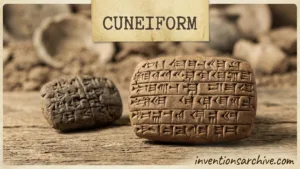
Cuneiform is a wedge-shaped writing system impressed mainly on clay tablets. The surviving record and later development are also considered.
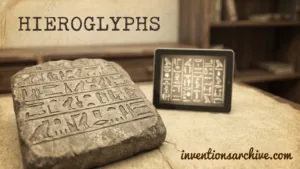
Hieroglyphs used picture-shaped signs to record the ancient Egyptian language. The surviving record and later development are also considered.
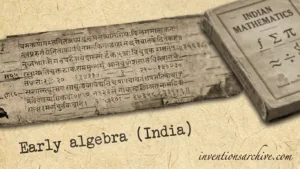
Early algebra in India developed rules for unknown quantities, equations, zero, negatives, and indeterminate problems within mathematical traditions.

Cross-staff is a graduated staff with a sliding crosspiece used to measure the altitude of the Sun, a star, or another visible object above the horizon.

Writing is a system of visible signs used to record language, accounts, names, events, laws, stories, or ideas. Its later development is traced.
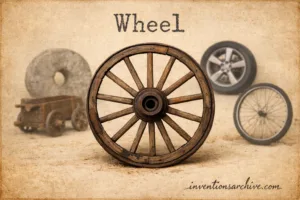
Wheel works with an axle, surface, or shaft to reduce friction, carry loads, shape materials, or transmit motion. Its later development is traced.
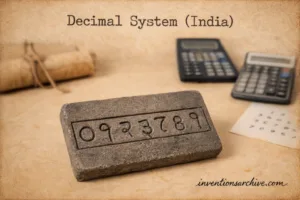
Decimal System is a numeral system in which a digit’s value depends on its position, using powers of ten and a zero marker for empty places.
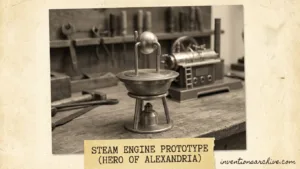
Steam Engine Prototype is a hollow rotating vessel driven by jets of steam escaping through bent nozzles. Its historical setting is also noted.
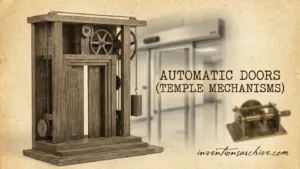
Automatic Doors is a ritual automaton that used heated air, liquid displacement, ropes, pulleys, and weights to open and close temple doors.
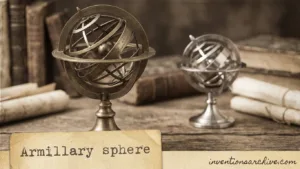
Armillary Sphere was used to model, teach, and sometimes observe the apparent motions of the heavens. Its origins and later uses are considered.